Achieve Your Goals in 2025 with the O.M.G. Framework
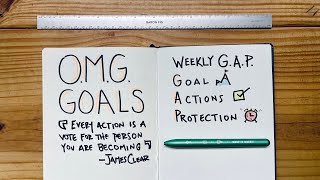
Matt Ragland breaks down the OMG Framework: pick 1-2 outcomes per 6-to-8-week cycle, define milestones, then weekly goals. He shows how the GAP Method turns those into daily actions, why goals fail (scope creep, lost focus, motivation drops), and how to protect time so work actually gets done.
Chapters
Hi everyone, my name is Matt Bragland, and in this video I'm going to be showing you my complete goal-setting framework. This is a really simple, straightforward, break-it-down, big goal to daily task type of system that you can use for anything that you want to achieve. This video has 3 main sections. First, we're going to talk about planning the year in 6 to 8 week cycles and why I believe this is the best way to achieve your goals over the course of a year. Second, we're going to be talking about my OMG Productivity Framework. I think you're really going to like this and see how it helps you break down a big goal that might last 2 or 3 cycles into something that you can do every week. And then we're going to talk about the GAP Method, which is my weekly productivity system that helps me stack winning weeks, achieve little small achievable goals that then build into the type of outcome or goal that I want to achieve at the end of a cycle, the end of a quarter, the end of a year. Now if I rotate the camera a little bit, you'll see that I have a whole year planned out. Every single cycle of the year is on that calendar. I first learned about working in cycles this way from my friend Sean Blanc, who runs a great site and course called The Focus Course, and he learned about it from the founder of Basecamp, Jason Fried, who wrote one of my favorite business books of all time called Rework. And what it's basically saying is you're treating each section or cycle of the year as something that has a very determined outcome, something that you want to accomplish, something that is reasonable to do within 4 to 6 to 8 weeks. And one of the reasons that I found this so helpful in my own life and work is because even like I consider myself a pretty productive, focused person, but thinking about a big, big goal that I want to accomplish over the course of a year, it feels really difficult to break that down into something that I can do today or something that I can do this week. And what cycle planning helps me do is not just break down bigger goals into smaller cycles, and even some we'll talk about in the rest of the videos, even breaking down like what is the outcome— that's a little hint, outcome starts with an O— that I want to achieve at the end of this cycle Now I can start to break down what are the milestones and what are the goals. So I gave you a little hint right there. I don't know if you picked up on it, but we'll talk about that in just a moment. But the other thing that I love about planning in cycles this way is it allows me to build in these buffer weeks where I have margin, where I have time to reboot and rest and like catch up on different types of work. Just make sure that everything is aligned and planned and set up for the next cycle when it starts. I'm recording this video the week between Christmas and New Year's. And this is something that I've done for years, is take a buffer week during like this stretch. There's not as much happening. The world kind of takes a buffer week during this like stretch between Christmas and New Year. And it's one of my favorite weeks of the year because I have time to reflect. I'm not on— I don't have any meetings. I don't have any calls. People are just kind of giving each other space. And so what I'm trying to do and what cyclical planning helps me do is define those buffer weeks and give myself the opportunity, give myself permission in a sense ahead of time to say, you've already planned to chill out for this week, to not take as many meetings, to just do the minimum things that are required to make sure that everything from the last cycle is wrapped up and everything for the next cycle is planned and ready to go. The OMG framework stands for outcome, milestone, and goal. And if you've been watching the channel for a little while, this is an evolution, this is an iteration of the QMWD framework that I used in the past. And what it means is at the beginning of every cycle, I select one, maybe two outcomes that I want to achieve at the end of this cycle. And what that allows me to do is if I approach those outcomes, my two examples for the first cycle of 2024. One is this Hey Creator project that I'm working on. The second is to continue to post at least once a week on the YouTube channel. So those are my two primary outcomes. And what the M, what the milestones stand for, is saying like, okay, how do I know I'm on the right path? How do I know I'm on the right track? Now for the Hey Creator project, hosting a summit, getting to that summit and completing it, that's a strong milestone. The second one is having like some community and content that's going to like happen on the back end of that. So completing the summit, that's the first milestone, completing and launching content community in the latter half of the cycle, that's going to be the second milestone. So you can see like these are kind of like one, maybe two, like midpoints of the outcome that I want to achieve. For the first cycle of the new year. The G in OMG stands for goals, and you might ask yourself, well, why is an outcome goal? And then like the G, what, what does that mean? And that's a fair question. First, OMG sounds really good. I said it's a lot easier than QMWD, which is what it was before. But what this means is now every single week I have a goal, okay? The goal can and should be a sub-goal or a step towards a successful completion or achievement of the outcome that I have set for the cycle. So an example of some goals or tasks within goals that I'm working on for the summit: 1 is to get the rest of the speakers booked. 2 is to have the run of show or the script for the host. Third is to make sure that all the sponsors are happy and that they have everything that they need in order to have a successful sponsorship of the summit. So those are some examples of every single week I'm working on one of these specific goals that directly influences and impacts a successful outcome of what I want to do in the first cycle of 2024. Now, the way that I take this OMG framework, which is a little bit bigger picture, saying what is the one, what are the two things that I want to work on for the next 6 to 8 weeks, big picture, we'll talk more about projects versus areas versus systems in a minute, but how do I break that down into what I'm doing every single week and every single day to bring me closer to the achievement of that outcome that I set for myself as a success. Now the GAP Method stands for Goal, Action, and Protection. I talked about this briefly in the Bullet Journal setup video that just went out before this, so if you're a Bullet Journal fan, go ahead and check that out, you're gonna love it. But this is where we're getting more into the details, more into the nitty-gritty of what this means and how it works. And the G in OMG and the G in GAP are the same thing. They— this is the connection point. Because when I'm looking at, say, like, here's the outcome that I want, here are the milestones to let me know I'm on the right track, here are the goals that I'm going to complete every single week that bring me closer to the milestone, that get me on the path to a successful completion of the outcome that I've set. It is this weekly goal. So let's talk about the rest of GAP. If you know that The G in GAP stands for goal. And it's what can I do this week though? Now I'm looking at it and saying, if my goal for this week is to get all the speakers set up and happy for the Hey Creator Summit, then what are some of the actions that I need to complete to lead to a successful achievement of this weekly goal? Well, I need to make sure that they have all their dates and times, I need to make sure that they have the correct Zoom links. I need to make sure that I have from them their bio, their headshot, anything that they want to promote, a link to that. And I need to maybe get on a Zoom call with one or two of them just to make sure that everything's lined up. That's the goal for the week. I have these 3 or 4 related subtasks, action items. That's how I know this is what I'm going to do to be successful. There's one other thing. Now you can write all these things down, you can put them in your bullet journal, you can put them in Notion or ClickUp, or, you know, just regular old iPhone reminders. You will be most successful when you implement the P of GAP, and that is protection. And that is protecting time to do the things, to complete the actions that are going to lead to a successful achievement of your goal. And when you start stacking those successful weeks, you're going to have a positive outcome for the sprint, for the cycle, for the quarter, however you're organizing your goals. Okay, so now you have everything that you need to be successful, right? You have these brilliant frameworks and methods and theories and practices, things that you can do in order to be successful and achieve your dreams, right? Well, yes, but also it's not always that simple and straightforward. And the last video I talked a little bit about why productivity is hard, and sometimes the reason that goals fail? Well, I think in my experience there are 3 reasons. 1 is focus, 1 is scope, and 3 is motivation. For me personally, the number 1 reason that my goals fail is because of scope. And when I say scope, I just mean that the thing that I want to do takes more time and attention that I am able to give it right at this moment. In fact, the next video that I'm going to make is about how I decide if I have time to make YouTube videos and if for the past year, let's say I haven't had as much time to create YouTube videos, what happens? Well, did I lose focus? Yeah, I guess so. Was I less motivated? There was a stretch in 2021 where I was less motivated, and I'll talk about that next. But for me, the most common cause of goal failure is that it's just way more than I anticipated it being. Now what you can do and what I'm doing, let's say for the YouTube example specifically, is instead of having what we call in the project biz scope creep, like just think you keep adding things in, instead of making videos more complicated and trying to spend a lot of time editing and really make them pop, whatever the heck that means, what I'm doing is making most of these videos, this one's a little bit more, making these pretty short, pretty simple, trying to minimize the editing just so that I can continue to create videos because I really enjoy creating videos and sharing ideas. Lessons learned, but I have to be able to do those videos within the scope of what I'm capable of doing at this time in my life. Another reason that goals fail is because of a lack of motivation. If you're not intrinsically motivated, if you're not internally motivated for success because of a better future or just like, you know, sometimes fear can be a motivator. It's not a great long-term motivator. Neither is anger or hate. But they can be useful in the short term. They're just— it's not a good long-term burn. One of the other things that I talked about in the Productivity is Hard section of the Bullet Journal setup video is something that I have really loved about learning in the Bullet Journal Method. This is in, in the book, which I recommend, great book, not just about bullet journaling, it's about life, man, is asking yourself why are you doing the things that you're doing. So the alignment, the Venn diagram cross-sectioning of what you're doing and why you're doing it. If there's not an alignment there that makes sense and feels motivating to you, then it's probably time to reassess why you're doing those things at all. Another common reason that goals fail— I fall into this, everyone else does at some point— is a lack of focus. And what that also means is like an increase in distraction. You're allowing yourself to get distracted by things that don't really matter as much. And especially in the work sense, one of the best explanations that I've found for this, like you don't really understand in the moment that this isn't helping and it's actually a distraction, or what Michael Hyatt calls uphill work versus downhill work. Now for me, uphill work is, say, like making videos and, you know, writing newsletters. There are things that are like, I can do them and I, I love doing them, but they're, they're harder. They take time, they take multiple hours But they are like the big things that like move me up uphill towards the summit of success, if you will. Downhill work are things that, yeah, they need to get done. Yeah, they're not within your zone of genius, to use that term. It could be stuff like, you know, tweaking thumbnails. That's, I mean, I know that's important. I know that's really important for YouTube. But for me, that's kind of like downhill work. Posting on Instagram. Yeah, you know, Twitter, I should do that. I have done a lot of those things, but those aren't the same as making YouTube videos, as creating courses, as doing like, you know, the right kind of like good fit sales calls, or like finding new clients for the business. That's all the uphill work, okay? The downhill work is just like piddling around with stuff like, hey, let me make sure that the content calendar is dialed in. Should the content calendar be dialed in? Yes. But not at the expense of not doing the uphill work, the big thing that's going to move, you know, move us up, going to help us reach bigger goals. My friend Kay He calls this the difference between $10,000 work and $1,000 work or $100 work or even $10 work. So I have a whole thing about that with Kay. You should check out his work. It's very, very, very good. An important thing that I want you to consider when you're thinking about the goals that you're setting for the year ahead and what you're getting yourself into in terms of the commitments that you're making or the habits that you want to be building is the thing that you're doing. Is it a single-time project, or is this an area that you're going to continue to commit to over the course of the year and kind of for, for whoever, whoever knows how long? Now, this is language borrowed from my friend Tiago Forte. He talks about his PARA method, which is projects, areas, research, and archives. And I think about this a lot when these things like align with goals. Like for example, when I talk about having a successful YouTube outcome or a successful goal related, related to YouTube, YouTube is an area of responsibility for me. It is ongoing. It is not finite. Now this PayCreator Summit that I'm talking about, that I mentioned earlier as, as a big goal that I have for this first cycle, The summit is a project. The summit will be done at the end of January, and the community will launch. The community, the community will then be an area of responsibility for me in my work. And so I challenge you to think about, like, if you want to do something creative, like start a newsletter, is that going to be a project that you do for like 6 weeks? You just want to do like something to like practice and see if this is something that you want to keep doing. That's totally fine. I kind of recommend that as a starting point, or are you committing to making this an ongoing area of responsibility? Now something that is important to remember here, and I, I recommend doing this, this isn't a video about time tracking or time blocking, but you do need to have a level of awareness about how much time you already have committed to specific projects or areas of responsibility in your work and in your life. One of the reasons that I didn't do YouTube for the past year, for the most part, is because I looked at my calendar every week. And we're going— this is gonna be a little bit of a preview on the next video. This is my day outside of sleeping. This is the sleep. And so these blue blocks, this is Matt's time that's not work and not family. Okay, and not chores. We're going to talk about this in the next video. But there are only 2 of those blue sections every single day, if that. And I often have to decide, am I going to exercise? Am I going to read? Am I going to go for a walk? What am I going to do? And always filling those with YouTube videos when I know that even a relatively simple YouTube video is still going to take at least 2 hours, probably more like 3 or 4. I just know that even when I'm trying to keep it simple, and every single week I was like, well, I think I'd rather exercise, or I'd rather go for a walk. The scope of what I thought was a video before the past few weeks kept getting in the way. And so I want you to think about, like, is the thing that you're wanting to do— can you fit it in to what you're already committed to? Do you have to remove some things? Just having that awareness and understanding, like, what is my capacity for these new things going into the new year? Okay, I want you, that's really important. I want you to keep that in mind. The final thought I want to leave you with in this video, thank you for watching by the way, is taking time to define what is success for you. Is it an achievement-based outcome Or is it just a completion of the goal of the project that you set for yourself? We'll bring this back to my, my YouTube journey. Is success for me this year only publishing a video every week? So basically putting 50 videos out this year, that's one level of success. Absolutely. But what if my goal or the outcome that I wanted for this year was also to hit 100,000 subscribers? As of this recording, I'm at 71,000. And so to have a, you know, 40-ish percent growth this year would be pretty significant. I haven't gained 30,000 subscribers in a year since, like, there's a beautiful 18-month stretch from like 2018 to 2019 where just did really well. The way that I'm trying to think about that and what I want you to think about is often the The first level of success is completion. So it's just showing up and doing the work. And then you get to start thinking about, now that I've shown, I've proven to myself that I can do the thing, what does pushing for higher quality or higher growth look like? Can I commit to that? Does it matter to me? It doesn't have to matter to you because one of the other things that I've learned is that not all achievement metrics not all external achievement is controllable. The thing that I can control is publishing a video every week. I can't necessarily control what subscriber growth is like and what the view count is like. I definitely don't control the algorithm. The thing that I'm trying to think about this year and has been like on my mind for the past year is I've proven to myself that I can show up and do the thing. What does it look like to put in the extra effort or the extra intention to make a series of videos or podcasts or courses that are truly exceptional, knowing that completion is phase 1? Also understanding, like, this is kind of a paradox, understanding that not all achievement is controllable, but I can control output and I can control quality. So how do I, how do I strike the balance between I'm going to do this, but I want it to be as great as it can be without perfectionism as a form of procrastination? That's something that I've been thinking about a lot this year. Probably the simplest way to say that last bit is that not all achievement is controllable, but it can be pursued. And something that I'm focusing on in 2024 as just a theme— I need a one word for it— but as a theme is the pursuit of high quality, the pursuit of high achievement. Even if I don't necessarily hit the $100K mark or whatever it might be, I want to do more than just ship. But I don't want that perfectionism or that pursuit to keep me from publishing at all. Thanks so much for watching this video. It was a lot of fun to share with you. Let me know any questions that you have about the content or the frameworks or the method or anything that I said. Please let me know in the comments and I will respond to you. I might write a newsletter about it. I might make another video about it. So like I said, this is one of the ways that I always come up with new ideas on what to make for videos is just by responding to and seeing what you're talking about in the comments and online. So thanks so much for watching. Let me know what you think, and I will see you in the next video. Bye.
More from Matt









Journal reading 📖 Reflectjons on how I’m living & how it aligns with the vision I have for my life.

You don’t have to listen to me. But you do have to be intentional about the systems in your life.
