Analog vs Digital Productivity — Who Wins?
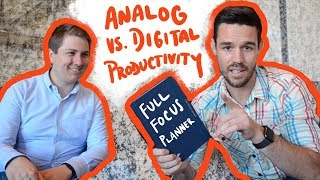
Matt Ragland visits Michael Hyatt's office to review the Full Focus Planner, which helps users distinguish between uphill work (high-impact, challenging) and downhill work (easy, distracting). The planner uses a Big 3 daily priority system, four daily rituals, and an undated layout that combines bullet journal elements with structured planning. Over 350,000 copies have sold.
Chapters
Hey everyone. Matt here with another Bullet Journal productivity video. Today I'm in Franklin, Tennessee to meet with the Michael Hyatt team and review the Full Focus Planner. New one just coming out, and I know a lot of you have asked about it in the past. So, excited to share this with you. Michael is one of the people that I learn the most from when it comes to working and creating content online. So, excited to be a part of this and excited to share it with you. Let's go! John, it's so good to see you, man.
Good to see you too, Matt.
Yeah, so everyone, hey, my name is Matt. Of course, if this is your first time watching us, I do bullet journal productivity videos, but I also do all kinds of planner and other type of review videos. And so today I'm getting ready to show you Michael Hyatt's Full Focus Planner. I've been through this thing, I love it, and I can't wait to show it off to you. You're gonna see a lot of things. In this video, but what I wanted to do, because Michael's office is in downtown Franklin, so just down the road from me in Nashville, I wanted to come into the office, I wanted to see all the planners, and I wanted to talk to my friend John, but we're gonna talk about offline productivity, we're gonna talk about the impact of productivity on, in and with social media, and we're gonna talk about our families a little bit. And one of the things that I like the most, because John and I were talking about this last week, is this idea of downhill work and uphill work. So to me, that is the thing that I loved the most about our conversation. So I'd really like to start there. And just so you all know, while this is going on, I'm gonna be showing you inside of the planner. But you're gonna really, really like this thing. I know I've reviewed some other planners and journals in the past that it definitely is more of this structured. It's not like a bullet journal kind of free-flowing thing, but there's so many things that I like about this. Things that we talk about on the channel, that we talk about in our email and our membership groups of doing things like morning and evening rituals. And one thing that we're also going to talk about is this idea of a workday shutdown ritual which y'all are going to really dig. But I want to start with just talking about this idea of downhill work and uphill work.
Sure. So this comes from Michael Hyatt's book Free to Focus, actually. It's one of the nuggets that made it into the book that actually was a surprise to some of us on the team. Like, we talk about a lot of the concepts of Free to Focus productivity and that really inspired the Full Focus Planner. Itself, but it's something that was actually— most of us hadn't talked a lot about, so it sparked some good conversation. But I mean, as soon as I describe it, you'll know exactly what I'm talking about. Yeah, that there's like almost all work falls into one of those two categories. It's either uphill work or downhill work. Now downhill work are those tasks which they may be attractive because it can be very easy. You can maybe knock off 10 of them. Yeah, and sometimes the downhill work you do are actually important tasks, but a lot of times they're actually distracting tasks. They're the tasks that you get drawn to when you're facing an uphill battle. So maybe there's some sort of uphill work that's actually the most important work you'll do all year, right? Like setting your goals or launching a new course or, you know, whatever that might be. That uphill work, you know it's important, but every time you start doing it, you feel like you're— like, I mean, you're literally— you feel like you're going uphill. You feel like it's it's really difficult, you're doing things the first time, and so it can be really attractive.
No fun at all. No.
Yeah. And so you can see in front of you real quick, if you have a choice, okay, I can work on this really difficult task that's uphill work, or this downhill work that's really easy and it's gonna make me feel accomplished, right? It's really easy to get kind of drawn into spending a lot of your time on downhill work.
Yeah, I faced some of this just yesterday. I was thinking about this concept because, as many of y'all know, I'm shooting a course on productivity and having a great year in 2020. And so I'm putting these videos together and I'm thinking like, gosh, this video is such a pain to do and I want it to be really good, obviously. And then I thought, you know, what I could do is outline another lesson. And while that's— I don't know if that's, that's like kind of uphill, but like to me, even if like I would normally think of like, okay, outlining lessons and getting things going, that is like maybe a little bit more uphill. At least to me in that moment, it was the definite downhill work. And one of the things that I love about this planner is how, like, it really helps you clarify what your uphill work can be and what your most important work and tasks are. Because I think for a lot of us, and sometimes I'll get this in the comments, or it can be a criticism of some bullet journal videos, is that you spend a lot of time on the downhill of, like, can I fancy this up? Can I make it look nice? What's it going to look like on Instagram? When something that we talk about a lot is getting to the core purpose of the work that you want to do and the things that are important to you. And so that's why, like, I love a planner like this, because the uphill work— it, to me, it accelerates the uphill work and it clarifies it, which I think is incredibly valuable for anyone who, yeah, is looking to get their most important most, you know, highest priority tasks done each day.
Totally, totally. Well, I can say that's true for me. I mean, I, you know, like, we sell the planner, so like, of course we all like are gonna like get a copy, but like I've now been using the Full Focus Planner myself for however long it's existed. So I guess it's a little over 2 years. So, so like this is mine, and then—
Did you use planners before this? Were you like—
Yeah, yeah, yeah. So I actually—
So you've been kind of a— let's talk a little bit about like just the offline, online productivity.
Sure, sure, sure, I'd be happy to.
Yeah. So, like—
And I didn't—
You've been using planners, journals in the past before Full Focus?
Off and on. So, I will say, like, I'm a very, like, kind of like digitally minded, or, you know, like, I'm—
Well, you're very hip.
I'm pretty hip, sure. I know all the apps and the tools.
Yeah.
So, the last tool that I really used extensively for my life was Todoist. And that was— I had, before that, I had used the Self Journal. And then before that, I did a bunch of bullet journaling. So, I was— Bullet journaling was actually kind of—
Sure.
How I started into trying out analog. And some seasons it worked really well for me, and some seasons I was just like kind of too overwhelmed with just maintaining the system.
Sure.
Which Todoist did really well.
Sure. Yeah, and I think that is even something that I still struggle with sometimes on the Bullet Journal is that on one hand it is something new and fresh that you can, you know, have a literal blank slate. Yeah. Every day, blank page. But then I tend to be a very rhythmic person in my planning, so I'm just like drawing out the same grid every day, and that can get a little tedious. So that is, and I think that's something like here in the Full Focus Planner of like it has your days, and I do like that it has kind of unstructured days, 'cause I've always struggled with dated planners. Like, I didn't do anything for a week, and now I'm screwed. This could be whatever day I want it to be, in a sense. So, like, if I miss a couple of days, whether it's vacation or I'm not feeling well, I can just kind of go back, I can go back into it, and I like that. The other thing that it has is kind of a, is it fair to say, Bullet Journal-inspired key. Inspired key, yeah. I mean, it's definitely different. But I guess you could say there's a key, there's a legend in the way that you process text.
Yes, I think, yeah, we really try to take the best from every available methodology that was out there, including Bullet Journal, when we put this together. So the planner— there's a lot of philosophy that goes into planner, I mean, different parts of it, but they're really— yeah, but the crux of the value, they're like, I— them kind of the first thing we tell people to start with. And also, I would say, in my experience, the most transformational are the daily pages. And so it's specifically the way we structure it where you have a Big 3 and 'Cause when we're talking about uphill and downhill work, it's visually separated in the planner. So your daily big 3 are your 3 most important tasks. You'll notice there's actually, what is it, 4, 3 times, 4 times as much room dedicated for each of your big 3. And then there's the whole other tasks list, but it's appropriately named. These are your big 3, these are your other tasks. And 3 could be called somewhat of an arbitrary number, but what we found is that if you accomplish 3, important, truly important tasks every day, you're gonna make huge progress towards your goals. And what's interesting about that is, I'm sure you're familiar with the Pareto principle, right?
Yeah, 80/20. Yes, yes, the power law distribution.
When we were first creating our planner, the research that we did into how, like, how many people, how people actually structure the task list, we found that people on average had 15 to 20 tasks every day on their task list. But it turns out if you take, okay, well, what's 20% of that, you end up with 3. And so that's sort of where we get this, this whole idea is that you get 80% of your results from 3 important tasks.
Yeah, I like the thinking behind that. And what I, what I find about those big 3 tasks, I don't know about you, but I could accomplish 10 downhill work tasks, like you just using that term, I could accomplish 10 of those, but I'll get to— but if I haven't done like something that I know is really moving me forward, then I'll get to the end of the day and just be like, ah, you know, I really nailed that Instagram post today.
Yes, exactly.
But in terms of like, did I write something, did I make something for the business that I work at or like for my own thing, then I could do like just those 1 or 2 things, not get to the downhill work, and I'd still finish the day being like, yeah, yeah, maybe I didn't do everything that I wanted to do, but I'll finish the day with an accomplishment and that feels really big, that feels really good to me.
Well, that's, I mean, that's really the, that's like, so you said I didn't have to. That's like the core of our whole philosophy is that productivity is not about getting more tasks done, it's about getting the right tasks done.
Yeah, because if you look up productivity in the dictionary, like it's very machine-based. It's like being able to churn out more widgets in a lesser amount of time or with, you know, like all these things. And I really like to think about it more in terms of, and it sounds like we're aligned on this, like how much progress can you make on the tasks that you've prioritized in your business, in your life? I think getting to the end of the day and feeling that way is really important. It transitions well into one of my favorite parts of the Full Focus Planner is the area for your workday shutdown ritual and your evening ritual. Both of which I think mornings get all the love and there's plenty of good reasons for that. But the shutting down your work, especially like I work at home and so my commute is down the stairs. And if I haven't created some kind of shutdown ritual, and I'm gonna do another video about this, then it's tough, it is tough to make that transition. I'll come downstairs, I'll still be thinking about a problem at work, and then I'm not being present with my family. And then I'll just go through the evening and I'll still be noodling on it because I haven't given the day a close. So why did y'all put that in? What's some of the thinking?
Yeah, so the planner includes space for 4 daily rituals. The morning ritual and the evening ritual are kind of like, right, that's like kind of like no-brainer, everyone knows what those are, at least theoretically. But then we added the workday startup and the workday shutdown ritual. And that really comes from the fact that just we want to, in today's age, like this is the problem, is that almost everyone in every career is feeling this sort of like blurred line between where the boundaries between work and home And some of that is this sort of like wonderful new world of flexible work, work from home, and that kind of stuff. But some of that can be really difficult for—
there's pros and cons for everything.
So yeah, so our company mission is actually to help leaders win at work and succeed at life. And that 'and' is kind of like— that's what we stand for, is that you can do both. And so a lot of that, that's where the Workday startup and the Workday shutdown rituals come in, as far as being able to say, how do you open loops at the beginning of the day to make sure you're actually doing the right things and not just being reactive? To whatever comes across your desk, virtual or otherwise. Right. And then the workday shutdown ritual about saying, okay, how do you say— you don't have to say like, this is done forever, but like, this is done for today. Like, I'm closing that loop. You know, like, I'm deferring things to tomorrow that I didn't finish. I'm, you know, maybe responding to an important email that's gonna otherwise gonna be nagging me for the rest of the night. Right. And then I'm saying, okay, I'm done and I'm going home. Even if going home literally just means closing your laptop.
Right.
Yeah.
And that's something that my wife's a nurse, and so it's like— and so it's one of those things that it's something that I almost envy about, about her and the fact that she can so like completely leave work at work because there are other nurses coming in that are going to take care of the patients. She doesn't have to, you know, like come home and think about that patient. Yeah, she's going to be back tomorrow and she's going to have more patients and, and lots of patients. And then for me I can noodle on an idea nonstop and that can be really challenging without some kind of shutdown ritual. This is my first time looking through one, but this isn't, like this is what, version 4 of the Full Focus Planner? So how did you get to this point?
Sure, so we rolled out, I don't know, we rolled out like essentially a version 1 a little over 2 years ago. To an initial group, got feedback, rolled out another one, right? And we created a think tank of our users to actually collect feedback on how they were using the planner.
What a novel concept.
Yeah. So now we have, at this point, this is version 4, so we haven't, like, at this point the philosophy is pretty ingrained. Like, there's probably gonna be things we're gonna continue to tweak and improve, but of course at this, we've sold more than 350,000 copies of it now, and people seem to be pretty happy with it. So that says something for sure, which is why up until now, we were always focused on the interior and the philosophy, and you could get the planner in any color you want as long as it was charcoal gray. So that was the only option. So right now is actually when we're changing that.
So you're rolling out new colors?
Yes. So I'm not gonna put you on the spot to list all of them. No, that's fine. But there are 3 really just different lines, because it's not even just colors, but aesthetic. So I use the Executive, which which on our sales page says it has the texture of success.
Very nice.
So I like that feeling. I like that.
And this is one of the classic models. And then there is also the—
And then we also have the Boom.
No, I'm just kidding. Not the Boom.
No, we also have the Bold.
The Bold series.
Yes. Then we also have the Bold, which has a lot more of the brighter colors, the poppy the eggplant. Just, you know, a little more—
the inner pages are beautiful in these. You're gonna see them on the video. Yeah. Well, John, thank you so much for having me in the beautiful office for Michael Hyatt and allowing me to show off the Full Focus Planner. This comes out by the time this video is out. This— you can buy these. And so what I would do, everyone, if you're interested in these, like I said, if you want a more focused, structured planner to help you move forward on the goals, the priorities, the purpose that matters the most to you, check out the link in the description below. It is an affiliate link, but I think everyone's used to those by now. It's no additional cost to you, but gives a little bit back to me to help support the channel. So thanks so much for watching. There are going to be more of these journal reviews and planner reviews coming out in the future, but I had this opportunity to talk with John about the Full Focus Planner. I'm a huge fan and definitely 100% would recommend it to all of you. So, thank you so much for watching. Thank you, John, for being here. And yeah, I'll see y'all next time.
Take care.
More from Matt









Journal reading 📖 Reflectjons on how I’m living & how it aligns with the vision I have for my life.

You don’t have to listen to me. But you do have to be intentional about the systems in your life.
