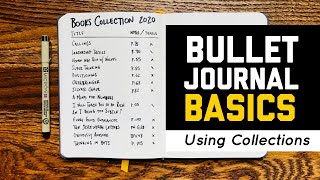
Matt Ragland shows how to use collections in a bullet journal to organize related information like books, trips, or meeting notes. Collections can be any size and must be indexed by page number for quick access. The key is customizing them to your needs without overthinking the format.
Chapters
Hi everyone, my name is Matt, and welcome to another video in my Bullet Journal Basics series. If you want to watch earlier videos in this series about setting up your index, the daily, monthly, and weekly spreads, and reviews and previews, all of it, make sure you check out the playlist that's going to be linked below in the description and also in the end screen at the end of this video. Anyway, if you are here, thank you so much for watching. We're going to be talking about in this video are collections. How to use them, how to organize them, and the purpose that they play, the role that they play in a good Bullet Journal Method framework. Now, in theory, collections are relatively simple. To me, they are just ways to organize your thoughts, brainstorm, notes, projects that are around a specific topic. Now, that could be any number of things. I've had collections for books that I've read, or movies that I've watched, TV shows that I've watched, different things that I'm doing with work, like I would have a collection just for meeting notes or specific projects or products that I might be working on. All of those are examples of ways that I have used collections in my bullet journal. I'm going to use a few different bullet journals to show you how I use collections because there are a few different ways that I have been using them. But like I said in the intro, the main way to think about collections is that according to the Bullet Journal Method book. Oh, I've been looking for this for months. So let's take a look, uh, where to set up collections. 84. Here we go. So Ryder Carroll, who created the Bullet Journal notebook and method, defines collections as comprised of modular blocks, and each module is a template designed to collect and organize related information. And that's why we refer to them as collections. They're interchangeable, reusable, and customizable. The way that I use and track collections in my Bullet Journal— and for 2020 I'm using the Clear Habit Journal from Baron Fig— is first and foremost, I like to get into these collections and start tracking them in the index. So the first one that I might have is, let's look right here. I have this one. This is kind of combining two things, but I have this Low Key Future Log on 174. So this is an example of a collection because it's how I'm laying out like the big, the biggish events and trips for the year ahead. So I'm I have a little bit different of a Future Log setup that you can check out in this video, but this is an example of a low-key Future Log collection that I have. The other way that I might use a collection is that, to me, each month is a type of collection. So, I have them all listed right here, and then I also have page 138 is where I start my Notes collection. So I can quickly find this because of the index. I can see these are my January notes collection. There are a lot of different other ways that you can use collections, like Ryder referenced in his book. But say, for example, this was like my mini Bullet Journal for the month of December, like a transition one. And I had a collection for, surprise, surprise, Christmas list. I had a trip plan collection right here. Again, I referenced those back in the index— Christmas list, Asheville week. I have a YouTube videos collection that I was going through right here, along with the year planning. So these are all different kinds of collections. I wouldn't overthink what you feel like a collection has to be, or that it has to be a certain number of pages or words or anything like that. It could just be one page, and you note it in the index so you can find it later. The key idea here is that these are ideas, thoughts, tasks organized around a specific topic, project, or like something that you want to create about. And the reason for this is, is that if you just have a bunch of like one-off ideas or notes, then those can kind of just go in your regular normal spread. Or if you use just— I have a giant kind of like notes section in my Bullet Journal as well. But if I find something that is starting to become a little bit bigger than just a few lines on, like, my notes collection, then I will probably create an additional collection for it in my Bullet Journal so that I can organize my thoughts and ideas. It's a little bit easier than, like, threading and referencing between different pages, because then I can just say, here are the books that I'm reading, or the books that I have read, and here are my notes on them. That would be a good example of a way to use a collection in the Bullet Journal. If you get stuck in thinking like, oh, a collection has to be like this number of pages or whatever, then you'll get stuck a lot of what I did. So like right here I had my Learn SQL Programming collection, page 100. Let's see how that went. So we can go in here and not very well. So I had a half page. And I honestly think that feeling like I failed in creating a like super duper collection was one of the reasons that I I didn't like feel as confident like continuing to learn because I had done such a bad job with the collection. And it's not as similar, but let's look right here on book collection page 50. I read a lot of books in 2019, but I didn't really do a very good job with the books collection. There is only one book listed here, and I know that I read more than one book. But if I had just kept it pretty low-key and not been hard on myself, then I maybe instead of book collection, I would have— should have just said, um, Company of One, which is the name of the book. That's all you have to do for collections. Just think of them like Ryder said in The Bullet Journal Method. They could be one page, they could be a half page. Put them anywhere that you want in your Bullet Journal, and then just go back into your index and note where they are, like I've done right here. Below Key future, future event collection, page 174. Easy peasy to get to and see what I have going on for the upcoming year. Thanks so much for watching this video on collections in the Bullet Journal, which is a part of my Basics series. In the next video, I'm going to be talking about trackers. There are all kinds of ways that you can use trackers. Trackers are also like sort of a kind of a type of collection, so everything is really starting to like work together, and you can see how the pieces and the different areas of the bullet journal connect. The trackers are a huge part of that. A lot of people use trackers, so I'm going to give you some really simple ideas to get started. Just know that it can be as simple as like making a list of like the days or times that you want to like do or accomplish something, and then just checking a box. Could be as simple as that. I'm going to show you some really simple ways to do that, but we'll get into that in the next video. Thank you so much for watching this one. If you want to watch previous videos in the Bullet Journal Basics series, make sure you check out the playlist linked in the description and in the, like, end screen that's about to come up. And then, uh, subscribe so you can know when the next video comes out. All right, thanks so much everyone, see you next time. Bye! I didn't really plan on the light going out right then, but that was pretty cool. Bye!