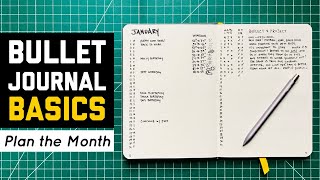
This content was created by Matt Ragland. This content was uploaded by Matt Ragland. This is a YouTube tutorial video (published 2020-01-11) titled "Bullet Journal Basics | Minimalist Monthly Spread for Dates, Mood + Habit Tracker & One Line Journal" featuring Matt Ragland as the solo presenter. It is an instructional how-to on building a minimalist monthly bullet-journal spread: using the month as a future log, laying out days and weekdays, tracking three core habits (movement, journaling, reading), a simple AM/PM mood tracker, a one-line daily journal, and practical goal-setting tips. The content is a solo walkthrough/demonstration aimed at organizing monthly planning and habit/mood tracking.
Chapters
Hi everyone, my name is Matt, and welcome to another video in my Bullet Journal Basics series. I've loved putting these together for you, so make sure you check out the first 2 videos in the series, which are all about the opening pages and the index. And video 2 is all about the daily spread rapid logging that you can use. And then this video 3 is all about the monthly layout, the monthly spread, so that you can get a big picture view of important dates and events, start to do a very simple minimalist habit tracker, a little bit of a one-line journal, and then I can also get a big picture view of like, what are the milestones that I want to hit this month that help me make progress on the goals that I have for the rest of the quarter or the rest of the year. All right, that's all we— that's really all of the intro that is needed. So let's go ahead and hit that overhead shot so you can see me actually working in the Bullet Journal. Here we go. So let me show you how I do this. I keep it really minimal, I keep it really simple. Let me zoom in so you can really see. But I just put the name of the month at the top, obviously, and then this first column down is the day of the month, and next to it is the corresponding day of the week. So January 1st is a Wednesday, 2nd is a Thursday, and so on and so forth. So right from the beginning, this is acting as my future log for the Bullet Journal that I'm using. And the reason that I like doing this more is that I like to keep everything contextualized within the month and the following days and weeks that will be contained in the subsequent pages instead of having something that, to be honest, I didn't look— I didn't ever look at a whole lot in past bullet journals. Like, let's just take a look at the future log. You can see I did it for kind of a few months and then nothing. So that's why I keep it contextualized within the month that, like, anything might be related to.. So, just for each line, I'll put, like, whether it's a birthday or an event or if we're doing a vacation. So, these are just big, like, big events that I can just put down right here. If it's something like having coffee with a friend, that will go into the specific day of the week or the daily spread. So, that is what I would do for my monthly layout. Really easy right there. Like I've said with all these other videos is what's important is to customize any system or any layout that you're seeing to fit the needs that you have so that you can be consistent with it on a daily basis. What I love about this monthly layout is that it only takes me about 10 or 15 minutes to set up once a month and allows me to see a big picture view of the events that I have coming up each month. And then really, again, really simple, really minimal, track those major like keystone habits for me and do like a little short entry in my one-line journal so that I can make sure that just I'm capturing some thought or memory for the day. It makes for, I don't know, just really nice review as the months go on. The other thing that I use the monthly layout, you know, spread page for, spread pages for, is to do again a really simple minimalist habit mood tracker and the one-line journal. Now I like this all, you know, they said all being in context, all aligned, because if you follow this row all the way across, you can see the 1 and the 1 obviously match each other. And I just have my 3 core habits right here. So M is for movement, working out. J is for journaling. And then R is for reading. These are the 3 things when I know I can do them on a consistent basis, just make my life better.. And so that's why I have those right here. And I'll just do something as simple as, you know, just draw an X to signify that I've done it. And just a quick note on the goal setting as well is if you're pretty new to goal setting, I would actually set lower goals than you think you might be able to, than what you actually kind of want to achieve. Because one, achievement feels really good and it builds momentum.. And if you think like, okay, well, this is kind of low, I bet I could do this. You can always like expand that goal if you hit it really early. And if you hit kind of those lower tier goals initially, what you might think of as sub-goals, that builds a lot of momentum. And you can start to use those as milestones for say like the bigger goal that you have that you want to achieve, whether it's the end of this month or over the next quarter. 3 months, or going into the entire year. The mood tracker right here again is also really simple. But what I do for this is the A is for AM and the P is for PM, just to see if my mood shifts throughout the day. But the simple tracking or like signifier that I will use for this is a checkmark if it's good, a kind of O if it's okay, and then an X if it's not so good. So, and some people have noted that you might, maybe I might get confused, but it's my system, so I won't get confused between like, does this mean I have a bad workout? No, it doesn't mean I have a good, it doesn't mean I had a bad workout. That is just to signify that I did the workout, and this does signify that I was maybe not in a great mood. So, uh, just, just to explain it, you can use your own signifiers, but these are the ones that I use. Again, AM, PM, and then just a really simple one-line journal or like diary entry or log if you want to think of it that way. I got this idea from James Clear, who actually has a notebook called The Clear Habit Journal with a one-line journal, uh, kind of section in it. But again, I like keeping everything on the month all on one line so I can look across here and say like, you know, front on, on January 1st, it was a Wednesday. Any events for that day? What were my habits like? Mood AM and PM. And one-line journal entry. Now, if you have had trouble kind of getting into journaling, this like whether it's diary keeping, logging, whatever you want to think of it as. I have some videos about it that you can check out, but this is a really good way. Just think of like one, one thing or one little sentence or one little description of the day. It can be really good because what matters early on with journaling is just being consistent with it. And if you set the bar really low to just like one line per day, you'll find that you start to grow more and more into it. Like I said, it takes me 10, 15, at most 30 minutes to set up at the beginning of each month, it's a very, very, very healthy and productive use of my time and really sets the tone, gives me a lot of clarity going into each new month. So that is the monthly layout that I use. And then like I said, the corresponding pages are the days and weekly layouts and reviews, previews. Check out the other videos on that. There is a lot to come in this Bullet Journal Basics series. So Keep an eye out, ring the bell, and you will dig it. Hope you keep that in mind when it comes to monthly layouts and spreads, uh, really, really simple big picture events, habit tracking, journaling. We covered actually a lot more than I kind of expected in this, but this is everything that I do for a monthly layout. In the next video in this Bullet Journal Basics series, we're talking about the weekly preview and review. Stay tuned for that video in the Bullet Journal Basics series. You can give this a thumbs up, you can subscribe and ring the bell if you want to be notified about these so that, yeah, you'll get them in your, in your feed. And that would be nice. That would make— that would just make me feel nice. But you know, you do what you got to do. I hope that you subscribe. Not selling this very well. I'm better at this, I swear. Anyway, thanks for watching, and I'll see you in the next video. Thanks. Bye.