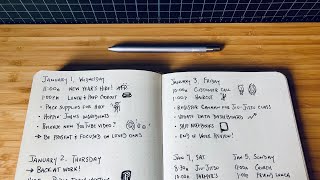
Matt Ragland shows his daily bullet journal spread, which uses half a page split between time-specific events on top and tasks below. He uses simple signifiers and timestamps to keep everything organized across his daily, weekly, and monthly spreads without spending hours on design.
Chapters
Hi everyone, my name is Matt and welcome to another video in my Bullet Journal Basics series. In the first video, we talked about the opening pages and the index and how to set up your first Bullet Journal right from the start. But in this one, we're going to be talking about the daily spread and the signifiers that you can use and a little bit about how you can continue to reference your daily spread back to weekly or monthly or quarterly goals that you might also be tracking and referencing in the Bullet Journal. Now I know that mostly what you care about is actually seeing me work on the Bullet Journal live and in action, so let's go ahead and cut directly to that Bullet Journal overhead shot. So let's take a look at this daily spread a little bit, and we'll talk about the weekly spread a little as well because they're so interconnected. But what I do for my daily spread is what I call upgraded rapid logging. I still have a very similar layout to what the Bullet Journal Method recommendation is, but I do go ahead and kind of give each day a little bit of space because what I do for my daily spread is I section off a little bit of time for each day. Now this one being the holiday week is a little compressed. I'll show you the other one in just a moment, but the idea is still the same. The top half of the daily section is for agenda items, meetings, things that have a specific time scheduled. And the reason that I break this up is that I found it was kind of hard to track for me intermingling my tasks with my events, even with the Bullet Journal recommended signifiers. And so I do agenda items at the top, things with a specific date and time, and then I will do my bullets or my tasks, my notes below this. So you can see that I have this for every single day of this first holiday week, just, you You know, I probably won't make any specific Bullet Journal adds to January 1st, just time with family and friends. And then I'll talk about this real quick, but I will have a specific video for the weekly preview and review. But this is just laying out big picture item for the week of January 6th through 12th. These are the main things, and I'll add to this, but just so you can get an idea, these are the main things that I need to do for my job at Podia. These are the things, or the main thing, that I want to do for the YouTube channel and my, my own side business, Freed Bound. I want to have a new Bullet Journal Basics in this series video shipped this week. And then I'll add in my home tasks down here. Now I'll also add things in, like, again, to the daily spread, but I also put, like, things that don't have a specific day for them. Like if I needed to get the oil changed or get a haircut, that doesn't necessarily have a specific day, but I might want to get it done, say, during the week. I hope you remember that the most important thing to keep in mind when doing your first round of daily spreads with the Bullet Journal is just to try and be consistent with it and create— kind of customize whatever the layout is to something that you can be consistent with. And so if you see like these fancy Bullet Journals or like, you know, these really artistic ones on Instagram or YouTube, There's nothing wrong with those, and I mean, I love looking at them, but for me, they just take too much time to do. And so, if, you know, just true to the Bullet Journal methodology that Ryder Carroll has, just doing that rapid logging, no matter how much or how little that you might have to log for the day, all of that is great. Go ahead and get that down, and just try and be consistent with it, even if it's just one bullet point that you can strike out and complete or migrate at the end of the day. You're going to feel really good about it, and I hope it helps you stay consistent with it. Looking at the daily spread now, you'll see how it's kind of how I do lay everything out so that it has a lot more space. And so I will put like a little bit of a signifier for the day of the month and the month that it is. So whether it's J6 or Jan 7 or write out, you can see what I mean, the day of the week as well up here. And then each day has a half page to work with. Now, I've been using this method for several months now, so I know that even busy days usually only fit into half a page, but this gives me something to work with because now I can look at it and say at 11 AM on Monday, I have our Podia team meeting. So, I can just go ahead and put that in. That was another, like, difficulty I had with the normal Bullet Journal rapid logging is that something that I knew I wanted to put in and just kind of remember, it was hard to do that when you just kind of went down the line as things are happening. And this way I can look at it and say, okay, on January the 9th, I have to get the boys to school at 9:00 AM. Boys to school, boys school. And then other things, but I know right away I'll leave a couple of extra spaces since I know I'm going to add some events in. But then I'll also go down here and say 1 PM, I'm going to have a Podia Q&A webinar. So, I just go ahead and put those in, and then I can add in my tasks. I can now take a look at when I see the week ahead, these are the main, like, objectives or tasks that I need to complete, and then I'm going into the daily spread. And as I showed you back here, kind of in a compressed view, top half is for the events, the agenda items, things with a specific time, and then the bottom half of that daily section is for to-do items, follow-up, anything like that. And that's pretty much what I'm doing for a daily spread. It's as simple as that. So that's all I have for the daily spread video in this Bullet Journal Basics series. In the next video, I'm going to be talking about the monthly layout and things that you can do to give yourself a big picture view of the month, any goals that you have, and then, uh, tell you a little bit about how to do a simple monthly tracker that syncs up really well with the calendar layout that I have and allows you to see like the, the main habits that you want to be tracking and being aware of throughout the day. Again, all really simple. Very minimalist, not a, not a whole lot of like fuss or upkeep or anything you have to do with that. So if this is your first time watching this, make sure you see, uh, video 1 in the series and make sure that you are subscribed with the bell ringing and the thumbs up, all the things, so that you'll be notified when the next video in this series comes out. Thanks so much for watching and I'll see you next time. Bye!