Bullet Journal Basics || The Weekly Preview & Review || 4 Simple Questions for Staying Focused
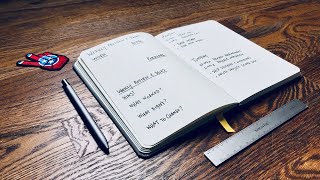
Matt Ragland shows his weekly preview and review routine using four questions: Wins, What Worked, What Didn't, and What to Change. A 15-30 minute session each week connects your daily spreads to monthly goals and cuts down Monday stress by forcing you to plan instead of react.
Chapters
Hi everyone, my name is Matt, and welcome to another video in my Bullet Journal Basics series. In this video, we are talking about the weekly preview and review that I do every single week in my Bullet Journal. This is connected to daily spreads and monthly layouts and everything that I do leading up to this point. This weekly preview and review is incredibly important for me for understanding what I thought I was able to do and actually did in the past week, and and using that information and my monthly layout to see, this is the week that I have ahead of me, and here's what I believe I can do based on past performance. So it's really important and powerful for me. It takes me 15, maybe 30 minutes of focus time each week, and it really sets the tone and gives me a lot of clarity so that I can execute really well on the things that I have to do in the week ahead. So in this video, you're going to just see the sheet that I have for doing my weekly preview and review, and a few questions that I use as prompts that help like kind of peel back the layers and give me really good information about how I can use the like actions that I took and the things that I need to do going ahead. So with all that said and done, let's go ahead and get into that overhead shot, and you can see how I'm working on this in the Bullet Journal. I keep a very simple system for my weekly preview and review in the Bullet Journal. And all I'm doing is I'm looking ahead and previewing the week, seeing what are the primary objectives and tasks that I have for work, home, and personal. And then I also, at the end of the week, come down and I look at the weekly review, wins, what worked, what didn't, and what to change. At a glance, this is really all that I'm doing, but it becomes incredibly important to me to see ahead of time, this is what I want to be working on and this is what I need to change. And basically be happy with at the end of the week. So let me show you what that looks like in practice. So this is last week's review and preview. So you can see a couple of things at work here. So on the left side, I have my main Podia objectives and projects, things that I'm doing for Freed and Bound for the YouTube channel for everything that I have personally, and then some home/personal to-dos. I could have, and probably should have, bumped this up a little bit to allow some more space. Now I know a lot of this with the Bullet Journal sometimes can seem like, okay, I know what I have to do, I don't have to like write all this stuff down. And I can admit, even for someone like me who has like years of Bullet Journals right here, it is something that I still get stuck on and thinking like, ah, well, you know, I've got it all up here, I can remember it, or I know what I've been doing. Inevitably, that is false. And the way that I do these previews and reviews, or reviews and previews, whichever comes first—it's very chicken or egg for me—is it allows me to take, like, again, 30 minutes at the most, but that clarifies my thinking. It raises my awareness of the time and the tasks that I have, and it gives me, again, a lot of clarity for understanding how I need to execute on the projects, on the tasks, on the things that I need to do in the coming week. The bottom, say, third-ish of the page down here, I'm kind of squeezing in the review, but I'm doing— I'm just going over the things that I showed you in an easier-to-see way right here. What are the wins? What worked? What didn't? And what to change? And so you can see that the wins were that I got back to work in full after the holidays. Had a good plan of action for the community, progressed on a migration. Meh, or like what didn't work. Didn't feel as efficient with my time. The blocks were haphazard and still digging out of emails. What do I want to change? I want to improve my time block discipline. And so this is where I'm just doing a review, and now I can preview, go into the new week, looking at what are the things that I want to be doing in my Podia work, in Freed and Bound, and what do I need to add in as we start this new week. But the review that I did last week helps me preview the coming week. So you can see how they work together and in concert with each other, that being able to preview gives me a good starting plan for how I want to accomplish the week. The review helps me see like, this is what I did well and can get better at, which then in turn informs the upcoming preview for the next week. Because too often when I don't do this, I hit Monday morning, I'm like, what am I supposed to do? What am I gonna, what am I gonna do? And then it's just the first thing that like pops in front of my face, either on Slack or in my email, or, you know, like, God forbid, on Twitter. I'm like, oh, well, that's, that's the important thing. Whereas if I'm doing this on— I usually do it on Friday, maybe Sunday night. But if I'm doing this on Friday, I'm not thinking like, well, you know, first thing Monday morning, gotta make sure that I check my email and see what like random question has come through. There is a time for answering random questions on email, by the way. I love your emails. Thank you for sending them to me. Please keep sending them to me. They warm my heart. Anyway, but that isn't something that I would say like first thing Monday morning, the most important thing that I can do to start the week is not going to be that, and especially not some of the other more distracting things. So when I take the time to do my weekly review, turn that into my preview, then I'm hitting Monday morning, I'm looking at my daily spread, I'm doing my rapid logging. All of these things chain together and they help me be really aware and clear of what I need to be doing in the coming week ahead. The other thing that I can do is, since this is the beginning of the year, I can also reference back. Make sure you check out the referencing and threading video in the Bullet Journal Basics series. But then I'll also, 'cause I migrated over to a new Bullet Journal, I can also see this reference for Baron Fig Tiwanot. That's the name of this journal that I just finished. Page 53. Page 53, you can see. And then this is that previous Weekly Review. And so now I'm coming into this one and seeing the same thing. What were the wins? What worked? What didn't? And what do I want to change? And from this last one, I want to focus on 2 to 3 big wins and deliverables so you don't get pulled into the urgent but less important zone. And then transition to clear 2020. The next week begins on page 26. That's getting into the threading piece a little bit, but you can see right down here— you probably can't see it, it's a very light type, but this says page 26, and these are the 2 to 3 main projects and objectives that I want to accomplish, things that I want to do for my own work at home, and then reviewing so that I can go into the next week right here, which I'm still kind of setting up, a little behind on that, but that's okay. And seeing like, what do I need to do that's really important for setting up a productive week ahead? I hope you enjoyed this video. There are more videos coming in this bullet journal basic series. This next video, we're going to be talking about collections. But these first— how many is this? This was the first 4. These first 4 really, I would say, form the foundation of how you use your Bullet Journal, how you can keep using it really effectively as we build into some of these additional things like talking about collections, threading and organizing, migrating trackers, a bunch of different stuff that is still really valuable. But these first 4 videos, I wanted to get these out because they form the foundation of effective and efficient Bullet Journal usage that you, you know, whether this is your first Bullet Journal or your next, these are really good ways to be using the methodology. So thanks so much for watching. If you liked it, give it a thumbs up and consider subscribing if you haven't yet, and ring the bell so that you can be notified when that next bullet journal basics video comes out. Like I said, there are, I think, I should know this, I should know this by now. I have 10 on this list, and y'all have sent me a couple more already. So this is probably gonna end up being at least 12, maybe up to 15 videos. So thank you for your suggestions. I love making these, and yeah, can't wait to share the next one with you. Thanks a lot. Bye.
More from Matt









Journal reading 📖 Reflectjons on how I’m living & how it aligns with the vision I have for my life.

You don’t have to listen to me. But you do have to be intentional about the systems in your life.
