Bullet Journal Method Book Review [Giveaway Closed]
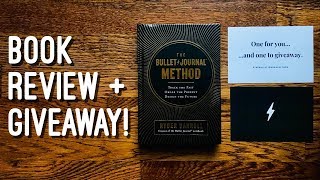
In this solo YouTube video, Matt Ragland reviews Ryder Carroll’s The Bullet Journal Method and announces a giveaway of a copy of the book and a Leuchtturm1917 notebook. He walks viewers through the book’s structure, which mirrors a bullet journal with sections such as Preparation, System, Practice, Art, and The End, and highlights favorite parts like the decision‑flowchart, threading, and sprint‑based goal breakdowns. Matt shares his personal note‑taking workflow: using priority signifiers, marginalia, and dog‑ears directly in the book, then transferring selected insights into his Bullet Journal via collections, indexing, and filtered summaries. He also explains how he creates index cards that capture quotes, topics, page references, and source information for long‑term reference. Throughout, he emphasizes that the system should serve the individual’s needs, not aesthetic perfection, and encourages both newcomers and seasoned bullet journalists to read the book. The video ends with a call‑to‑action to enter the giveaway, subscribe, and engage with his channel.
Chapters
Hi everyone, my name is Matt, and welcome to another Bullet Journal productivity video. I'm so excited for the video today because I'm going to be telling you all about the new Bullet Journal Method book. I have loved this book, and I tell you what, I didn't expect to. And so you're gonna see a lot of videos or posts today about how they always expected that this was going to be a wonderful book. I didn't expect this to be a wonderful book. I expected it to be like the first half of the book, which is like, here's how you bullet journal, and here's a way to make notes, and here's the way to draw dots, and here's the way to make your collections. There is that, but intertwined throughout this book is a wealth of different knowledge and tips and just ways to think through why something matters to you, how to review, how to iterate, how to break things into smaller, like break big goals into smaller sprints and tasks. I'm going to share everything with you about this book. I have been recommending it to anyone that will listen, even though they're like, "Matt, yeah, we get it. We get that you like to write things down." This is an excellent book. Book. You know, Ryder, team at Penguin, thumbs up to all of you. Again, I want to show you everything about this, but first I want to tell you— do you hear my kid? Yeah, he's 3. He's like, it's nap time. So before we jump into that, I do want to tell you I'm doing a giveaway because shout out to Ryder and Penguin. They sent me a copy. They sent me 2 copies of this and the Bullet Journal. Itself. See, in this, in this sweet, this sweet box. Look at that! That's so nice. On top of an extra copy of this, I also have a Leuchtturm1917 Bullet Journal official notebook. So I'm going to be able to give away one of those. Again, they sent it to me. I'm not quite sure how I was supposed to word it or phrase it, but they gave it to me. I didn't buy it. They sent it to me. Because of you, and they want me to give one away to you. So, the best way to do that, I know, is through email. And so go ahead and sign up in the link below if you want to register for the Bullet Journal Method book and journal giveaway. And the cool thing about this giveaway is that the more that you share it with people, the more people you tell about the journal, the more entries that you get. So it has a nice feature to it where The more that you share, the more that you'll be able to increase your chances of winning the giveaway. So let's go ahead and jump into my biggest lessons, takeaways from The Bullet Journal Method book, and I'm going to share with you a little window into how I read books, how I take notes, how I transfer them to the Bullet Journal, and then for a select few, like, important notes and takeaways, transfer onto, like, basically index cards. So, Let's jump into that. Here we go. So as we look into it, one of the things that I think you're really going to love about this book is that it's set up like a bullet journal. Like, here's the index and the different sections right here. So Collection, Part 1, Preparation, Part 2, System, Part 3, Practice, Part 4, The Art, and Part 5, The End. You can see everything is laid out here, and he does have a little note down here, like table of contents versus the index, and just how it really helps notebooks stay organized and easily accessible. So I love how Reider created this book to kind of function like a bullet journal itself. And so a few of the other things that I love about it, you probably know that I love simple illustrations, and the whole book is filled with these. And so I really like right here, this is the test for deciding if something is worth keeping as a task. And so just this nice, cool, just simple flowchart task asking, is it vital? Yes, keep it. No, does it matter? Maybe to you or maybe to someone else, then yes, we're going to keep it. And if no, then it goes in, you know, just the trash as a distraction. And so I really like how he laid all this out. Here's something to start with as a mental inventory. It really takes the reader through some— through a way to get started with a bullet journal. And so for those getting started, for seasoned bullet journalists, I, I hopped around in this book. A little bit. And so I didn't spend as much time in part 1 as you'll see. Let me show you here. As you'll see from my dog ear sections, so you can see most of the dog earring and noting that I did was in like the latter half of the book because that's a little bit more of the seasoned bullet journalist layout there and information. Now I will say like these these points on setting up the system and the journal and key concepts, there were still some things that I think are really, really useful. So don't— if you're, if you're used to bullet journaling, don't like just completely gloss over these. In fact, one of my, one of my biggest takeaways was this right here. This, I'll talk about this kind of dog-ear system, if you can call it that, in just a second. But Right here on page 78, you know, "Let it sink in. Don't immediately bail when the meeting, class, or lecture is over. Information is contextual." So he's really encouraging us to spend a few minutes, sit with the information, make a note about it, and that's something that I've tried to do some in the past, but I really liked this, and so since reading this book, I've really tried to take like 5 minutes or 10 minutes after a meeting or interaction where I can just make a few notes about, you know, what just happened, what takeaway tasks are there. And that's really, that's really useful to me. I would say even the first full half of the book is more about like getting set up and some of the key concepts of goal setting and like just getting information down. Subcollections, index. I will say like, this was another thing that I found really useful was this threading concept and something that I haven't done a whole lot of in the past. So Page 104, 105. And basically what threading is doing— this is all I can zoom in— is saying like, here's page 51, but the previous instance where I discussed this topic is on page 10. The next instance where I discussed this topic is page 160. So especially if you're kind of hopping around to different parts of the journal, this can be a really useful way to keep yourself organized without flipping back to the index every single time, which I am a terrible indexer. It's one of my One of my goals for the new year and for this next journal that I'll be starting very soon is to get better at threading and indexing. Okay, so those are the main sections. Like I said, you can look back when you, when you get it. The index here, preparation, system, practice, art, and end. So now I want to show you a little bit about how I read and take notes in a book. I find highlighting a little annoying. I don't like carrying extra, like, pens or highlighters around. And so what I end up doing, and let me, let me find one for you, it's probably a little bit, a little bit later, is I do a lot of noting with asterisks or signify priority signifiers and marginalia. I think that's how you pronounce it, making tiny notes within the book itself. And so what I do here is that I will make, if I see, if there's something that If there's something that stands out to me in a book, especially a written, you know, a printed book, I'll have my pen, and when I see something that stands out to me, all I will do is make a little signifier. So that priority signifier right here, you can see another one down here, and it's just something that stood out to me. So think back to the last goal you achieved. You push yourself hard, drawn by the potential and promise of a happier life. But when you finally cross the finish line, what did you find? And so this is just something that I want to come back to, all right? Maybe not right away, probably not right away. And then another thing that I'll do is make tiny notes inside of the pages. So this one says, happiness and presence in the moment is what we've been given. Effort through our gifts and talents, not earning but giving. And so for me, I like, you know, notes a lot of times will only make sense to the note-taker, and that's totally fine. In fact, it's something that Ryder talks about a good bit in this, is that your notes, your Bullet Journal, it should make sense to you. You don't have to worry about making it super pretty or like impressive to anyone else. First and foremost, it needs to be useful to you as the Bullet Journalist. And so for this, just what I was thinking about is just being happy and present in the moment with what we've been given. A lot of times I struggle with that. I think a lot of us can, wanting to do, wanting to be, wanting to have more. And more happiness coming from effort through, like, using our gifts, using our talents, not earning something, but, like, giving, giving back based on what we've been given through our own, again, gifts and talents. So that's, that's something, again, that's just one of the notes that I will have taken. Another thing that I've started doing recently that I like, and again, this is maybe if I don't have a pen, is that I'll just make a dog ear. I'll make a dog ear so that I know to come back to this page. And then what I'll do is anywhere that I've made like a little dog, a dog ear on the page, I know some of you don't like that. I'm sorry. Actually, I'm not sorry. I like it. But I'll make a little note actually on the dog ear itself. So you can see right here, this one is just says sprint. And what I'm doing is basically the primary, like, topic or overarching idea on the page that I've decided to dogear, I'm gonna write that down right here. So now as I'm flipping through the book, now as I'm flipping through any book, I can come to a dogear and I can look at right away, like, this says the 5 Whys. And so now I know, like, an idea that I thought was important is just sitting right here on the page. And it's either the sprint or the 5 Whys or anything else, The real why, a lot of whys in this, talk about that in a second. Break sprint, let me see, it's not cooking. So different, different things. And then you can see a priority signifier right here. I do want to talk about this idea real quick with goals and sprints, because I think this is really useful. A lot of times, and this was one of the main takeaways, I'll talk about more about those in just a second, but thinking about a great big single goal can be a little overwhelming. And what we can do though is break that down into different Sprints. So we have this big goal, and then we break that down into, say, like 4 weeks of focused work on a specific, like, part of the goal, known as a Sprint. And then you break down that Sprint into different subtasks. So we can talk about that a little bit more. Again, I would, I would definitely check this out. This is on page 158 of The Bullet Journal Method. It is one of the most important sections for me, something that I've tried to do, but Ryder gives some really good ideas for breaking it down. So that's page 157, and it's in the Goals chapter. I thought when I first heard about the book that it was going to be mostly what the first half is about, which is like the process of setting up and using a Bullet Journal. But the second half, and then really even all throughout it, there are so many good takeaways for living a better life, for being mindful about the things that are important to you, and and why we do what we do, and just being, being cognizant of the people, the projects, and the work that we do, and why it really matters to us. So, that's the book. I would 100% recommend this. Now, let's talk about how I take said notes. If you like this, I'll do a whole nother video about how I take notes, and how I transfer them into a bullet journal, and how I use them in cards, also different things that I do This is just going to be a little snippet of how I do it in relationship to the Bullet Journal Method book. So, as you see, I had so many notes in this. You know, notes on the pages, notes on the dog ear, signifiers, everything. So, how do I take the information that I had in here and transfer it into a Bullet Journal? So, what I do, and you're going to see real quick why I say that I was not very good at indexing.. But if I go ahead and open up, let's see, I've got— am I really this bad at it? Okay, Books Read Collection 180. So, let's flip over here. I've actually already gotten this one out. So, here are my notes for The Bullet Journal Method. And so, what I do is I go through the book after I've read it. This is after I've read it. I go through and I look at every signifier, every little bit of note here, and every different dog ear that I wrote down, and I just skim back through it and I look and see, does this note just need to stay in the book, which is fine, or do I want to transfer it onto the written page? So there are kind of like a few levels of this. So for this, what I'll do is I'll write down the name of the book up here. The author here, the dates, the dates or month that I read it, and then a quick recap. So the first instance of this is on page 44, and I dog-eared it and I wrote down owner. This really stood out to me. Notebooks in contract are beholden to their authors or owners. Their function is limited only by the imaginations of their author. And this is something that I feel like we've really tried to drive home on this channel and something that, again, writers always talked about. So I give them a lot of credit. On this. I think that too often, especially in the Bullet Journal community, I can be guilty of this as well, as we try and make things look too fancy for others while not thinking about how it matters to us and how it can be useful to us. And so I just wrote that down: Notebooks are beholden to their authors, function only limited by the imagination of their owners. So what I'll do is I'll just make that note dash right here. I'll write down the note or the quote or the thought that I had about it, and then I'll write down the page that it was on. So P.44, that's page 44 down here. And so all this lines up. I'm just going to go through every single page, just flipping through it really, and then making notes on the things that really stood out to me. So not everything that gets noted is added into the Bullet Journal, just the things I'm I don't really have much of a filter here on what stands out to me. I just, if something stands out to me in any way, I'll usually give it a signifier or dog ear. And then the, this is where I do more of the filtering is I'll read through and be like, okay, that was nice, but I don't necessarily need to let it, you know, like make it into the primary notes. Here's another one. Again, this was one of the big things that stood out to me right here, and I gave it an additional signifier. After a meeting or an interaction, allow a few minutes for the information to sink in. What sticks? Any follow-up or tasks to note? How is your energy? Take a second and record. So this is an example of a note, a quote, and a thought all rolled into one, but I gave it an additional signifier in the notes here and then still saying page 78 right here. So I'll go through for every single one of these, every single one of these, and see what stood out to me, what matters, what are the things that I need to be thinking about, and then at the end of the notes, I'll also list my main takeaways. And again, I try not to put too much pressure on myself, like, what is the best? What are the best takeaways? And so I'll just make a few, make a few things, and I'll talk about these in just a second. But, uh, and it doesn't always need to be a quote. Like, you can see right here, I just wrote good ideas and steps on collections, future logs, other things that I had not done much with in the past. So that was a big takeaway for me. It may not be for you, but Again, like, this is, this is just for me. And again, like, should be specific and helpful to you. So these were some of the main takeaways. I can always come back to this and take a look at what stood out, what matters. And then I still, like, when I want to go back through the book, I still have all of the old, like, you know, signifiers and dog ears that I used in the past. A lot of times I'll also— this is like the final filter— I'll take these note cards here and I'll write down Again, kind of a quote, a thought, different notes, but what I'll do for these note cards, and I'll definitely have another video about these, is I'll write down the idea, whatever it was that stood out to me, and I'll put it down on this card. I'll write the topic in the top right and then the related pages in the bottom right. The thing that I still need to do for this one is I need to write down the book or person that it was from. So, Bullet Journal method. So that gives me the source. This gives me the page, the topic. And then the other thing that I can do, I'll talk about this in another card. This is an example of a quote. True nobility is being superior to your former self. I love that. I also had that noted right here. Right here on the page. And so I'll write the, the quote of the, of the author or person who said it. So that was W.L. Sheldon. But since I heard about it in the Bullet Journal, I'll write like CC Bullet Journal Method, page, and then same thing, topics in the top right. One more example of this, but an additional thing. So I loved this, uh, I love this quote from the book, "Don't put it off, put it first." Source: Bullet Journal Method. Page. Topic. This was down here in the notes. The other thing that I'll do though is I can also write additional notes or thoughts on the back. So I said, I love this for prioritizing and not procrastinating. For mundane tasks, block time to complete in progress. So all of these I have in a stack. This is a bunch of them here. Something that I have started doing, this is all a, all the note card stuff is a testament to the process of Ryan Holiday and Robert Greene method, or basing my note card method off of as well. So that's everything that I do to take notes in 3 steps. There's reading in the book, and making priority signifiers and dog ears, and coming in here, putting down the next set of notes in the Bullet Journal itself with the main takeaways. And then afterwards I'll also go through, and this isn't all at once, but I'll go through and create the note cards of things that stand out to me. As you can tell, I really love this book, and so I highly recommend you go out and grab a copy. You can get it at any major retailer. I think you can get it at bulletjournal.com as well, so Check all those out. This, even if you think of yourself as a really experienced bullet journalist, this is going to give you, again, like what I thought, like I said at the beginning, all I was expecting from this book was like basically what the first half is, which is like, this is how to BuJo, this is how you do collections and indexes and logs and everything, but it's so much more than that. So thank you, Ryder, for writing this book and then again doing a giveaway for this, the book and the journal itself. So go ahead and enter in the link below. Again, I want to reiterate, they sent it to me. I don't know if I'm supposed to say like hashtag ad or giveaway, but that's what it is. If you don't want to get anything from me after that, you can just easily unsubscribe or opt out. So, you know, of course you have that option. But thank you so much for watching this. There's a ton of great bullet journal productivity content coming down the pipe for the rest of the year. So if you haven't been here before, I encourage you to subscribe, leave a like, comment, check this out, let me know what you think about it. I'd love to hear from you. And thanks to everyone who's been here for a really long time. We're coming up to the end of the year. It's been a huge year, and I can't thank all of you enough for subscribing, commenting, liking, sharing with your friends. I got an email today from someone who's like, hey, an intern of mine sent your journaling video over, and I really like it. I love writing things down. So thanks so much for messages like that, and I appreciate every single one of you. I'll see you next time. Bye!
More from Matt









Journal reading 📖 Reflectjons on how I’m living & how it aligns with the vision I have for my life.

You don’t have to listen to me. But you do have to be intentional about the systems in your life.
