Can You Replace a Bullet Journal with a Notecard?
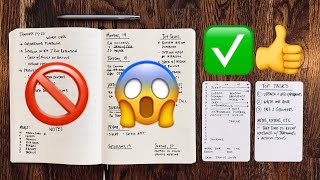
Matt Ragland compares bullet journals to a simpler alternative: a single notecard divided into 15-minute blocks to track one day at a time. The card shows where your time actually goes and whether it matches your priorities, with less setup and decoration than a full journal.
Chapters
Here's a question for you: does your bullet journal really help you focus on what matters in your life and work, or is it just another tool of distraction? Everyone, my name is Matt, and welcome to another bullet journal productivity video. In this episode, we're digging into that question and asking ourselves, is our bullet journal a tool of productivity and focus, or is it another tool of distraction for the things that really matter to us in life? Do you really need a full bullet journal? I mean, let's be honest. The reason that I started thinking about this question was because so many of you put in the comments that you feel like a lot of times you see bullet journals or you feel like it needs to be almost like an art project. I found that I spent so much time trying to make it look nice that I forgot to make it work for the life and the system and the habits that I had for myself. Light. There you go. And we're back. That's why I wanted to offer you an alternative to the big bullet journal that I myself and so many people use, because sometimes if I feel a little overwhelmed even by the minimalist bullet journal that I like to use, I will use something as simple and straightforward as a single note card. And what I want to show you with this note card is how I can plan and perform for my entire day, and maybe even multiple days in a row, with just this simple card, and how you can do the same. Sorry, that sounds really clickbaity, but it's, it's really the truth. I'm going to show you how to do this. Just to give you a little perspective in size, here is the note card, of course, and the pocket notebook. Very common size. This is the Baron Fig Confidant pocket notebook. So you can see a little smaller, but obviously, uh, a ton more pages. Full-size bullet journal. This wouldn't fit in your pocket. This could, but it's a little bulky, even for a guy's pocket. And then this will easily fit, you know, it can bend a little bit more and easily go into a back pocket or purse, backpack, whatever. Both of these will fit great. The reason that this matters to me, the reason that it's helpful for me, is sometimes when I get into a little bit of a rhythm of not putting as many things into my bullet journal or not having that evening or morning practice where I focus on the things, or maybe I'm writing too much in the future or in the past. When I get down to just the things that need to get done, the way that I've set up these numbers on the left-hand side are these are hours of the day. And so this is like the zero-zero start, so 5 o'clock, 5:15, 5:30, 5:45. This is when I know I'm getting back to the— getting over to the next hour, so 6 AM, 7 AM, and so on and so forth. Now I have a— my wife and I, we have a 1-month-old, and so there's actually not always sleep going on at this time. Now this is retro— this is retroactive recording, but these are the things. And I might write down if I have a particular appointment, then I can go ahead and write those in ahead of time. So for example, I know from 9 to 9:30 I'm taking Kanan to school. So just going to write that in and you can see these are all lining up with the hours of the day. So work is starting here at about 9:30. See that lining up? And then at 10, I have a meeting with my manager, Corey, and that's going to take about an hour. From 11, I'm going to be working on onboarding. So this is where I'm seeing what I'm doing with the day. So now I know about 12:30 I finished and I had a meeting. The onboarding task force. That lasted about 30 minutes. So you can see I'm just going through and I'm putting everything in here. Now some of these, I knew that I had a meeting with Corey at 10:30. I know that I have a meeting with Taylor at 4:30. So sometimes I'll leave open space. If I want to be really proactive about my tasks, then I'll go ahead and write them in ahead of time, especially during, especially during the work hours. If it's a little bit more like reactive, what happened during the day, then I can just leave these open. And add in, like, say, when we had dinner or when I put my sons to bed, different, different things like that, spent time with my wife, reading, any of that. I kind of want to keep an eye on how much time I'm spending on work, on family, on me-related activities. Maybe that's like reading or exercising. And then miscellaneous might be stuff like food prep, things of that nature. So I could look at it today and say, like, you know, 8 hours, going to be 8 hours at work. Let's say there's about, there's about maybe 1 hour, 1 hour of me time, and then a lot of family time, which is great because we have a new little baby. This won't necessarily always add up to 24 hours. I just want to see like on a particular day, am I spending like, is my family and work time way out of alignment? Am I spending any time on self-care, exercise, reading, journaling, things like that? That's where I put in different times and amounts of time that I'm spending on the things that are important me in life. I do recommend that you watch the original time tracking video, and I'm going to do an updated kind of 2.0 version in the coming weeks. But that's really where this card and these little notebooks came from, is that I wanted to know where I was spending my time and what I was focusing on. So now when I feel my prioritization and my productivity start to slip, I'm not being as mindful of the tasks, I'll almost like put away the big Bullet Journal and really use this note card to focus in on the things that that matter on a particular day, and I'll, I'll create like 5 to 10 of them so I can have like a couple of weeks in a row. And I'll just use these cards to focus for that stretch. Your top tasks, the things that are important to you. So working on the onboarding playbook, writing that journal email. So I have these two things written down as my top tasks. I can keep referencing back to them. And then the notes section are just where I write down notes or different things that I think about through the day, and I can either apply them to the next day's card or the current day's card or just have them as a note. You can also use a like pocket-sized journal for this as well, these little pocket-sized notebooks. This notebook comes courtesy of my friends at Bond Travel Gear, so thanks for sending these to me. But of course you can get them at Baron Fig, you can get them from Moleskine, and I've gotten them from Field Notes for the longest time. So whether it is this single simple Baron Fig Strategist notecard or something like a pocket-sized softcover notebook. Now the downside of this system is that it doesn't allow for as much like future planning, future logging. It's just the single day at a time. And so you can see the layout that I have on my normal bullet journal shows me the entire week, the top tasks that I have ongoing, and I can always reference back here to the month that's happening, uh, any big events on the month. So that is the drawback of the single note card system. You can use them in tandem together, especially if you find yourself maybe flipping through the Bullet Journal a little too much and using it maybe as a little bit of a tool of distraction. Grab yourself a note card, get everything on it, and that way you can just keep this, like, say, like, up on your desk really easily. And that way you can stay really focused on the things that matter to you for that given day. I encourage you to look at maybe trying out just a single note card strategy for a few days in a row to make sure that you're not spending too much time on dressing up your notebook or decorating it too much. If, you know, if you love doing that, and that's a part of the habit, that's a part of your mindful practice, that's totally awesome. I'm not saying that's a bad thing at all. If you find yourself in a similar situation where your focus, your mindful intention about the things that you have to do each day is starting to slip, then I recommend trying this single simple note card strategy that allows you to get to the point of what matters every single day really quickly. If you want to go through a 5-day time tracking challenge, you can use these note cards, you can use your bullet journal, you can use a small pocket-sized notebook. There's going to be a link in the description below, and hundreds of you have gone through it, actually thousands now, and I get so many emails about how it really has changed the way that you view your day, view your time, and prioritize and schedule the things that matter to you. Thank you so much for watching this video, everyone. If you want to know more about productivity planning and prioritization in a bullet journal with other analog methods like note cards and tiny notebooks, make sure you check out the other videos that I've done, like Starting Your Very First Bullet Journal or How to Plan for Your Year with Themes, Goals, and Systems. It's everything that you need to get set up and be mindful and productive in the year. And so I would really encourage you to check those out. Thank you so much for watching this video. I really appreciate your time and attention. If you like this video, please give it a thumbs up and subscribe if you're new here. You can find all kinds of videos that are about mindful, intentional productivity, mainly using like a bullet journal, notebook, note cards, other analog methods that really help us get our head out of our apps and focus on the things that matter. So thank you so much for being here, and I'll see you in the next video. Bye!
More from Matt









Journal reading 📖 Reflectjons on how I’m living & how it aligns with the vision I have for my life.

You don’t have to listen to me. But you do have to be intentional about the systems in your life.
