Design Your Most Productive Week Ever
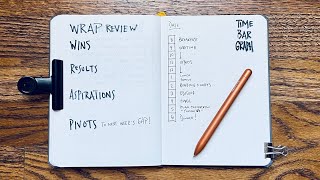
Matt Ragland breaks down a six-step framework for a productive week using the Bullet Journal: preview your week with the GAP method, track or block time based on task familiarity, separate recurring systems from outcome goals, build a master task list, keep a distraction journal, and end with a WRAP review. The system reduces anxiety and compounds into a successful year.
Chapters
Hi everyone, my name is Matt, and welcome to a new Bullet Journal productivity video. I'm excited to share this video with you today, as I am excited to share all videos with you every day that I post one. But this one is unique because I want to show you how you can have your most productive week ever using your Bullet Journal. There are 6 simple lessons and steps that you need to take away from this video that will help you have your most productive week ever. You can think of this video almost like an overview of all of these tactics and lessons. I'm going to link to the longer videos for each of them in the description below, so make sure you check each one out if you want to make a deep dive into each particular tactic or I also want to touch on why we're using the Bullet Journal for this. Well, for this channel, it's because the Bullet Journal is a very big part of this channel. The other thing is, when I teach this, I always start with a Bullet Journal or a planner, because that way you don't have to learn how to use a specific new tool or app or service in order to feel like you, you know, have the right tool to do the thing of having your most productive week ever. But if you are really used to a particular productivity tool that you're using for planning and task management and time tracking, time tracking, any of those things, then you can certainly apply any of these lessons to your most productive week ever. The other thing that I'm really excited to tell you about is this week is the launch of my Productivity Power-Up Masterclass. It's a 4-week cohort-based course. And what that means is we do all of this live together. I take you through all the lessons, I answer your questions, there's a community, we do like Everything that we've been talking about in, like, for the Bullet Journal to help you be more productive, to assemble this personal productivity kit that you can use to take on any goal, to overcome any challenge that you have with the work that you know matters to you. We talk about how you can slay the procrastination dragons of, like, self-doubt and overwhelm and feeling like you're not good enough or smart enough to do a particular thing. Those are all things that I help walk you through. So, what I want you to do is, this is interesting to you, go to mattroglin.com/powerup. There's also a link in the description below, and you can see everything that you need to know about joining this round of the Productivity Power-Up, which starts on April 12th, 2021. But enrollment is happening right now, and I'd love to have you be a part of it. I want to give a big shout out to the sponsor of this video, AppSumo. AppSumo is an online marketplace made for entrepreneurs by entrepreneurs. I've been an AppSumo customer since 2012 and have gotten some huge deals there. And you know what, that's pretty normal because all you get at AppSumo are huge deals. Like I'm talking 70% up, off to 95% off. In fact, the two that I got that have made like some of the biggest impacts on me over the years are like, if you're a YouTuber, you've probably used TubeBuddy. I got a lifetime deal to TubeBuddy through AppSumo. One of the first like productivity apps that I got was through AppSumo. It was called Workflowy. These are deals and this is a community. This is a marketplace that is here to help entrepreneurs, to help creative people do more of the work that they love, to do more of the things that they care about, to build the business that matters to them. Best of all, signing up for AppSumo is totally free and only takes about 20 seconds. And I really love that because you'll see a lot of deal sites now where you have to like be a member of their deal site to then still spend money somewhere else. Not at AppSumo. Not only is it totally free to sign up and super fast, but my viewers can use the code MATTRAGLAND10 at checkout or just click the link in the description below., and you will be able to save 10% off of your first purchase at AppSumo. Like I said, these deals are huge, and a lot of them are lifetime deals. So even if you see that they start charging monthly, you know, at any other time, you're going to have lifetime access to that product because of the deal that AppSumo gave you. So thanks again to AppSumo for sponsoring my channel, for sponsoring this video. And once you pick out your AppSumo deal, please let us know in the comments which product you picked. And how it's going to help you lead a more productive, focused, intentional life. Now let me go ahead and show you how you can have your most productive week ever. There are 6 steps that you can do, and you can practice them every single day of this week, or you can kind of arrange them and kind of mix and match based on the different challenges or the different needs or the different goals that you're facing during the week every single day. The first thing to do is to preview your week. Now I've had a couple videos about this, and I use the acronym GAP to plan my week, and that is specifying what are my goals for this week, the action steps that support those goals, and then when do I need to protect time, block time, in order to make sure that I have the time to take action on those tasks so that by doing all those action steps I can achieve my goal. So that's step number 1: make sure you preview your week if you have a specific weekly planning or preview method, go ahead and use that. But if you don't have one yet, or you want to try out my GAP method, go ahead and do that. The second step to having your most productive week ever is to either track or block your time. Now, depending on what your goal is and what your need is for in terms of like understanding and managing your time, is to basically ask yourself the question, do I already know how long these kind of tasks and goals that I have take?. And if you already understand how long something takes, then I would say just go ahead and start with time blocking. Like, if I know that writing the daily email takes me, let's just say, an hour at the most, then I need to block out an hour. But if I'm kind of new at something, like when I was just starting to make YouTube videos and I didn't know how long it was going to take me on average to film, edit, and publish a video, then it's a little foolish of me to be like, oh, I'm sure I could get this done in just a few hours. When in reality ended up taking me closer to 66, not 68, 628 hours to make that video. So if I'm not sure how long something takes, go ahead and practice your time tracking. If you already have a pretty good understanding of how long something takes, then you can better block time for it. So this feeds back into that gap preview, because when I know how long something takes, I can better protect the time that I need to actually do the things. The third step in having your most productive week ever is to understand the difference between how much focus, energy, and time you give to things that are recurring systems in your life and different goals or tasks that are just like one-off outcomes. So I've talked about this in some other videos, but for me as an example, I spend a lot of time on like these recurring week-to-week goals and sometimes day-to-day goals. Like I want to write a daily email, I want to have a weekly podcast, I want to do a weekly YouTube video. So, and I also have weekly coaching calls. And so if I'm doing all those things on a recurring week-to-week basis, then I actually realize that when I have something new that I want to add into that, like, hey, I want to record a course, or I want to do like this extra thing that I don't normally have as a part of my week, then I have to understand that 30 to 35 hours of my week are already taken up by the system goals and recurring tasks that I already have in my business and in my work. The system versus outcomes is a really important distinction to make in your work because I see a lot of frustration from people who try and add new things into their week and into their days only to find that unbeknownst to them, they didn't have an awareness to realize that most of their time every day was already spoken for, was already taken up, and often with really good things like writing a daily email, doing the podcast, doing videos. Those are all really good, fun things. But if I want to add something new in, then something else is going to have to change, or I'm just going to have to work more, or I'm going to have to say like, this isn't a 1-week thing, this is maybe a 2- to 3-week thing. The 4th step in having your most productive week ever is to set up a master task list. Now honestly, you can probably do this, uh, you know, pretty early on in the process. I would do it alongside doing your weekly preview, but go ahead and just do a brain dump of all of the things that you can think of that you have to do this week. The way that I connect this to my weekly preview is to specify those action steps from my Gap Preview. Those become my top tasks in the master list. That way I know these are the highest priority because these are driving the goals that I want to have. So you're starting to see how a lot of these things kind of start fitting together and combining. To create this like productivity power kit, this like mech suit that you can assemble to like slay the procrastination dragons. But with your master task list, this can just be something that you have on a week-to-week basis. So there are a couple of different ways that you can do this, but I do encourage you, and it's really helpful for me to reduce anxiety for what I have to do every week. I'm going to write it all down and then I'll start assigning it based on either the day that it needs to be done or just when I have time to do it. The fifth step in having your most productive week ever is to fight distractions. And I know this is easier said than done, but one thing that I have found that has been incredibly helpful for me from an analog perspective is to start keeping a distraction journal. And this could be something that you just do in a Field Notes notebook. You could have a collection for it in your bullet journal. You could even write it on your daily log, like, I was distracted by this thing about sports, or I was distracted by Twitter again, or whatever it may be. You can also write down, is it an internal distraction, like something that I allowed myself to get distracted by, or sometimes an external distraction, like, you know, my, my kid ran into the office and wanted something from me or just wanted to talk to me and got me out of my flow. But I don't have to, like, feel bad about that. You know, those external distractions that you might not be able to control, but getting your distractions and kind of the guilt or shame around them out of your head and onto the paper is something that I have found really useful. You can also use it in kind of a more healthy way when you're rolling on an idea or a task that you're doing, but you have another good idea. Well, you can write that down in your distraction journal as well, and like maybe write an exclamation point or a light bulb little icon next to it just so you can know when you're reviewing them. If you do that, then you can know this was a good idea. I should dive into this later, but not at the expense of losing focus on this other thing that I'm doing that I've already said was important at the time. I want to tell you this really quickly too. This kind of goes along with a lot of what we're talking about, but especially with distraction journaling or recognizing when you're getting distracted. Focus on being a reporter, an observant reporter, when you're doing these things, and not like the judge and jury. Too often when we notice that we're not doing the right thing, or I got distracted again, or why can't I prioritize and do, you know, do the work that matters to me, We kind of unfortunately, we naturally approach that as a judge, like you didn't do, you didn't do the thing you were supposed to do again, instead of like doing some like self-care and self-coaching to observe and report like, oh, I was distracted by NBA Twitter again, or I was distracted by looking at someone else that I don't think is that much better than me, but is way more, way more successful and doing all the better things and has more subscribers. Maybe that's a little bit of a meta-description, a meta-example, but these are all things that we tend to judge ourselves on instead of just observing or recording, like, oh yeah, I'm doing that thing again. I don't need to do that thing. Or isn't it funny that I got distracted by like this movie trailer? Oh well, let's get back to the thing that matters. The 6th and final step of having your most productive week ever is to have a weekly Wrap-up review, and you can actually use the acronym of WRAP, W-R-A-P, and what that stands for is your wins for the week, the results of your aspirations, which is the A. So the results of your aspirations for the week, and what I mean by that is look at your preview of the week, your gap preview. What were those goals and action items that related to that. Those were your aspirations for the week, the things that you wanted to do that you said were more important than anything. What were the results throughout the week? Now we're at the end of the week of those aspirations that you had. Were you able to hit them? Were you able to go above them? Were you a— were you— did you not quite hit them? And if you didn't quite hit them, again, observe, report, no judge and jury, just asking yourself, Did something else come up that was more important? That happens. Did you get distracted a little too much? Did you know— what was it? Did you say you could do 5 things, but it turns out as you look at your past weekly previews and reviews, you only actually end up getting like 3 big things done? So what we're doing is we're kind of benchmarking for ourselves. We're saying like, okay, it looks like based on past performance that I can probably only do like 3 big things each week. So now when I go into next week, we're going to do the P of WRAP, which is pivot. We're going to pivot from, I want to do 5 things each week to, I'm going to say that I'm going to do 3, and I'm sure I can come up with more stuff to do if I get past those 3. So that's what WRAP stands for. The wins that I had for this week, the results of my aspirations, those aspirations being the goals that you set up in your weekly preview, And then based on the results and aspirations that I had, what do I want to do to possibly pivot going into next week's preview? Do you see how all those work together? And so having a quality wrap-up review informs and helps my next week gap preview. And when I have a master task list, it helps reduce anxiety for thinking that I've let something slip through the cracks. When I'm time blocking and time tracking, it helps me understand how long things take and helps me protect time and block time for the things that matter most to me. When I'm able to understand like the recurring systems that I have each week versus the new like outcome one-off goals or aspirations that I have and how those balance together and how I can fight distractions and like not judge or get to, you know, be too hard on myself, but can kind of like, kind of like meditating, just coming back to the breath. Coming back to the task. So that when I'm doing all those things, now I can go into the next week's wrap-up review and start being like, oh, okay, what were my wins this week? I was distracted less, that's great. I was more closely aligned with the results of my aspirations. So if you follow these 6 steps, you're gonna have your most productive week ever. I can almost guarantee it. And if you are interested in learning how you can not just like take all 6 of these steps to the next level, but learn more about things like information management, you know, personal knowledge management, PKM, for those like second brainers, PARA frameworks out there, for ways that you can take better notes, the way that you can combine and mix and match all of these things together and stack one great week on top of, on top of another. Because I'll tell you, the secret to having a great year is just having a lot of really great weeks. And I can show you, I can help you like have these really great weeks. Yeah, I hope this channel does that. But if you want more direct, specific help from me and probably like 30, 40 other people that are going to be a part of this next cohort, they're amazing people and I love being a part of this community. Just go to mattrogland.com/powerup and you'll see all the information that you need to sign up and be a part of Cohort 2 of The Productivity Power-Up. But thank you so much for watching this video. Make sure again you check out the links in the description below to see like all of the deep dive videos on each of these concepts that I talked about. But this is an example of how you can build, how you can assemble a personal productivity kit to help you with the outcome of having an incredibly productive, focused, happy week. You see how all these things fit together? So I'm really excited to be helping you with this. Thanks so much for watching this video. If you have any questions about it, please let me know. Which is your favorite and maybe like most challenging, like step or tactic from this video? Let me know in the comments. I'd be happy to help you with it. And if you have any questions about the powerup, you can ask that in the comments as well. Thanks so much for watching and I'll see you in the next video.
More from Matt









Journal reading 📖 Reflectjons on how I’m living & how it aligns with the vision I have for my life.

You don’t have to listen to me. But you do have to be intentional about the systems in your life.
