Diminishing Returns in Work Hours
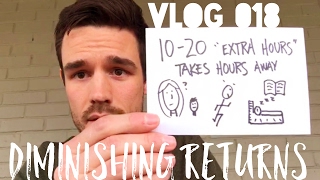
Matt Ragland tested working fewer hours and found diminishing returns kick in after 40 hours per week. A 50-60 hour week produces progressively fewer work units. He challenges viewers to cut hours by 15-20% and see if output stays the same.
Chapters
Hey everyone, how's it going? Welcome! It's Saturday, February 18th. Yesterday I forgot to tell my brother Mark live, well, happy birthday because Mark was 25. So he's @MarkRaglan on Twitter. Go say happy birthday to him and that you care about him even if you don't know him because he's a great guy. All right everyone, thanks so much for joining me today. I've really been enjoying these videos. I'm actually live on Periscope and Facebook Live right now. So doing doing my best Clay Travis impersonation by going live on 2 different places. Let me just make sure. Okay. I had to make sure that it was public on Periscope. I don't really expect that many viewers here. This is also going to go up live on YouTube. Not live, but this is going to go up on YouTube right after this. So, been enjoying. This will be day number 18, February 18th, day 18 of the video challenge. I've really been enjoying it. Encourage you to do some video. You know, got the iPhone and the iPad here. You can go live on Facebook just on your laptop now also. The thing that I want to talk about today— yesterday I talked a little bit about how I got more done, I accomplished more, I produced more this week while working fewer hours. Okay, I've been kind of in that 50-hour range with ConvertKit over the last, I mean, the last several months. And this week right now, about 42, maybe 43 hours. So 5, 6, 7, 8 hours less than a normal week, but I got a lot done. And yesterday, you know, talked a little bit about, go back and watch the video, it's on YouTube, just search for Matt Ragland. I'll drop it into the comments here also. Go check that out because there are a few things that I thought about. And one of them is just the thought experiments. If you're able to, just the thought experiment of what would happen if you reduced your hours by 15 to 20%. Could you still get the same amount done in that 15, 20% less hours? Because if you can and you're able to, It just opens up a lot more things. Just for you as a person, it has for me. It's given me more time with family, it's given me more sleep. Not so much so far in terms of like just exercising, but that is something that I can also work in. What it also made me think about a lot more. Okay, so we're talking about the diminishing returns of work. That's what it made me think about is like, if I kept going, and this is something I was talking about with Newbill, manager at ConvertKit, is that if we kept up this pace, 50, 60 hours a week, you know, maybe more, some of you I know you say you work more, I would challenge you on that, as much as you can, okay? If we keep this up, what is our quality of life gonna look like in 10 years, 15 years, 20 years? And it's easy enough, it's easy enough for me to think, oh, you know, I'm young, I can do this, you know, I can tough it out. I can, you know, I can work 60 hours, I can do that. Maybe I can from like a personal like mojo, get 'er done sort of thing. Maybe I can do that, but I have other commitments outside of just me. I have a wife, I have a son, I have a body that I want to take care of. So just in those 3 other things, if I think of, you know, taking care of myself as a person, No matter how much I work, it's taking away from something in that. So I was thinking of it in these terms also, and I came with slides today. All right, I came with slides. First thing, let's say if I work 40 hours, a normal 40 hours, let's just say that I can produce 100 work units. All right, 40 hours, 100 work units. Maybe that's the case, maybe it's not. Maybe you can produce more, maybe you produce less, and yes, it's a very round number so I don't have to do too much much math. Okay? So that's 2.5, 2.5 units per hour. Normal pace, normal output. Okay? Quality work. So it might stand to reason that you say, "Well, if I can get 50 hours in, then I can produce 125 units." And sometimes— don't, just don't start yet, because sometimes you do have to produce those 125 units and you got to get them done. I'm not saying that's not the case sometimes, but if that's always the case, then you should rethink some things. Not always the case. Okay? That's what we think, right? Maybe, maybe not. Alright? 50, 125. What I find normally is that there's a diminishing return in the quality of the output that I have the more that I work. You know, past that baseline of 40 hours. Alright? So usually, again, this is very easy math. For me. So that, you know, there's no study behind this. This is personal. So it looks more like 50 hours gives me 120 units. Alright, which means I'm still doing 100 units for hours 1 through 40. So that means that hours 41 through 50, those 10 extra hours, I only get 2 units of work. So there's a slight diminishing return. Alright, and to ramp it up even further, if I'm to go up to 60 hours, all right, what's up? If I'm to go up to 60 hours, then it's getting even worse. All right, because I'm still getting again, 2 units for hours 40 run through 50. But I'm probably only getting it, let's, you know, again, as the effort increases, the quality, you know, starts to tail off even more than normal. Okay, so hours 51 through 60, I only end up getting 1 unit of work for each of those hours. All right, so you can see that there's a diminishing return. All right, and if I'm just taking that as a 1-week sample size, then think about the compound effect. And this is the math that I'm not great at, but think about the compound effect of having those diminishing returns over a longer span of time, a year, 2 years, a lifetime of work. Because the other thing, even just in those weeks, and especially even like, say, even in those hours, those 10 to 20 extra hours for work, those, those are taking hours away from something. They're taking time away from your family, from your friends. They're taking time away from yourself in terms of your exercise, your effort, things that you enjoy doing, maybe it's music, whatever, reading, just sleeping, okay? All of those things, you have a diminishing return on all those things. And anything that you do, those hours come from somewhere. We only have— everyone has the same amount of hours. And that's kind of cool to think about. It's also very humbling to think about. Okay, you don't just get to like, oh, I gotta work, you know, you can't just create them. You're taking time away. You're taking those hours away from somewhere else. So even if you think to yourself like, oh, I'm a beast, I can handle this, I can take this load— not saying you can't, not saying I can't— but you're taking time away from other things that you enjoy doing. And over a long stretch of time, that's really gonna mess with you. All right, this is totally not a scientific chart. But here it is. If you continue to up your hours, all right, so hours are here and effort/output is this way. What I want, okay, what I want is for my hours to start to flatten out while effort and output continues to go forward. All right, not— you can see this other way— that if my hours continue to increase, then almost my output is going to curl back on myself. Curl back on itself, but it's going to keep— like, output is going to just keep doing this, and my output isn't going to get any better. It's just my hours that are going to increase. So my goal, and something that I would challenge you to also, my goal is that quality continues to increase while my hours stay steady or even decrease over time. Okay, so quality goes up, output effort, you know, any of that stays kind of even and then eventually starts to taper off. All right, same effort, same quality, same amount of output, fewer hours. The thing that I— the only person that I want you to check out on this is James Clear, friend of mine, awesome guy, one of the smartest research writers. He is almost like Malcolm Gladwell in that he can take a really big, almost research topic and make it incredibly interesting to write about. So check it out, jamesclear.com. And he talked about behavior change recently. I'll link it in the description and the comments, but it's great. You should check this out because he talks about sustainability of your work and the amount of effort that it takes. Alright, so there's this zone right here of long-term growth, and in this zone you're keeping your effort and the ability of you to sustain that effort steady, and you're just kind of staying in this sweet spot. If you go too far up here, like you're doing things that of course you can sustain day after day but they're not that hard, that's kind of in the laziness range right up here. And if you're doing things that are super hard all the time but are unsustainable, then you're gonna burn out. So check this out. I'm gonna put it again, jamesclear.com/behavior-change. I'm gonna put it in the comments and in the description box. Show it right here to my homies on Periscope, of which zero have watched this whole time. The only other analogy that I thought of is Think of it like a car, okay? Think of yourself like a car. If you keep redlining your life and your work especially all this time, if you keep redlining it, then you're gonna see a gradual decline in what the car can do, all right? It's not, it's just, and eventually it's just gonna stop, all right? So think about it in that way. Take care of yourself, take care of your relationships, because if you just think I can push, I can push, I can push forever, that's just not gonna happen. And what I was hitting towards the end of the year is that I just, I was really close to burning out and maybe, you know, I technically did. I don't know. But I was really kind of wrung out and I knew that this like continually trying to push the effort into like the 50, 55, 60-hour range wasn't going to be something that I could sustain long-term. So again, this is what I hope for myself. And I'd encourage you to again, take these thoughts, take these thought experiments and think, if I reduced my hours by 15 to 20%, could I still get the same amount done? Not if I, you know, kept my hours high, or if I increase them, could I get even more done? Sometimes that's necessary. Again, I'm not saying that sometimes you don't have to work those 50 hours to get your 120 units. In. Not saying that doesn't happen, but you probably don't always need to do that. Because what I want long-term is for my output and my quality to continually rise and grow while my hours stay steady and eventually decline. Okay? All right. Thanks so much for watching this. Let's see. Yeah, a good video today. I feel really good about this. Keep watching. I do some of these on Facebook. Periscope can forget about it, and no one— literally no one watched this whole time, which is fine. Maybe the replay, but check it out on YouTube. Just go to YouTube and search for Matt Ragland. I'm the one who looks like me, not the guy who doesn't look like me as Matt Ragland. I think it— like, the channel name is The Matt Ragland because I'm the Matt Ragland. Okay, but just go to YouTube, search for Matt Ragland, find— click on the one that looks like me, and you'll be all set. Thanks so much for watching, and I'll talk to you guys tomorrow. Another good video. Catch you later. Bye.
More from Matt









Journal reading 📖 Reflectjons on how I’m living & how it aligns with the vision I have for my life.

You don’t have to listen to me. But you do have to be intentional about the systems in your life.
