Forget Goal Setting → Do This Instead
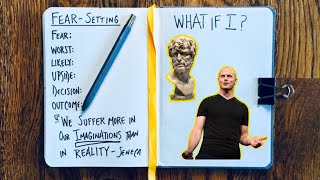
Matt Ragland explains fear-setting, a technique from Tim Ferriss that uses Stoic philosophy to identify and confront the fears blocking your action. He walks through examples like going full-time freelance and attending conferences, showing how writing down worst-case scenarios and realistic outcomes builds confidence to move forward.
Chapters
Hi everyone, my name is Matt, and welcome to another Bullet Journal productivity video. In this episode, I'm going to be talking to you about fear-setting. This idea gained, like, specific popularity when Tim Ferriss did a TED Talk about it in April 2017. The premise is that we often focus, and I know I have focused, on the goals or strategies that I have to achieve in life, whether for work, personal, or relationships. The goals that we set kind of chart a course for how we want to live our life. But what if there was an equally effective way at capping the downside and setting the fears that keep us from doing the things that we care about or things that we're just interested in? Think about it, how often do we keep ourselves from doing something because of the fear we have of either looking silly or being unsuccessful or any number of other things? It was the Stoic philosopher Seneca who said, "We suffer more in our imaginations than in reality." What if there was an effective, efficient way of setting your fears the same way that you set goals. Now I've been doing this in my bullet journal for years, but it was when I saw Tim's talk at TED, Tim's talk at TED, that really got me thinking more about how I could share this with you. So in this video, I'll take you through how I do a fear-setting exercise in my bullet journal. You can copy the same tactics, the same questions, answer them in your bullet journal, say them out loud to yourself. A lot of times now I'll think about these things mentally as I'm going through them to kind of cap the downside or just realize that the thing that I believed I was so afraid of isn't really that big of a deal when I've considered all of the outcomes. But it'll come as no surprise to you that I believe writing it down gives you a clearer sense of what is possible. Now I've included a template that you can use for this, you can access it in the description below. But if If you're already on my email list, then I'm going to send it out to you with the Monday email anyway, so don't feel like you have to download it again, like I said, if you already get my weekly email newsletter. So with all of that said, let's go ahead and look at my Bullet Journal and see 3 different ways that I've done fear-setting in the past, and ways that you can use it in your own life right now. Now I'm going to show you how to do this by doing a little storytime/journal review, and giving you a clear outline and several questions that you can ask yourself to get your fear setting started. So this is from several years ago when I was trying to decide, should I basically go in full time as a freelancer? I go ahead and cover this up. There's nothing wrong with that. I just don't want it to distract you. And so I was asking myself, should I go full time on freelance, like web setup teaching, and start off by naming the fear. The fear was I won't be able to get enough clients and money and that I'll waste time. The worst-case scenario, so going from like just the general like gripping fear to like, oh my gosh, this is the worst thing that could happen, that I won't be able to get enough clients and money. And the worst-case version of that is we blow through our savings as I try and do this. We had about, maybe not quite this much, but around $20,000 at the time. A reasonable fear, probably a little bit more reasonable fear, was that I make some money but should still keep my part-time jobs. And so what I decided to do was not to quit the part-time job that I had at UPS, to take on fewer clients and try and scale up safely. Now something that I didn't go back and write in that journal entry is what actually happened in the aftermath of that because it took a really long time to play out, but kind of the worst-case scenario almost basically did happen. I didn't become like this, you know, profitable freelance designer or like really anything related to that. We did burn through basically all of our savings and that really sucked. So all of that is not the best outcome. Now one other thing that is worth bringing up and something that my wife and I have talked about several times since then is what that experience taught us and that decision is that we could live really lean. We had a very small, like, 600-square-foot apartment. We didn't go out much. We could live really lean and simply. We always know that even if things don't go our way or something changes, if we go back to that place— not that literal apartment, but if we go back to kind of that time of life— that we've done it before and we're okay, and we were able to dig ourselves out of it once, and we could probably do it again. It's worth it to take the risk if you understand that taking the risk could lead to a particular outcome that you're not a fan of. If you know what that is and you accept it, then you can move forward with a lot more confidence. This next one was a little bit smaller of a decision. This was a couple of years ago when I was trying to decide, should I go to Tribe Conference? It's here in Nashville. My friend Jeff Goins puts it on, and the fear was that I won't make up the money in the learning and connections that I make. The worst-case scenario might be that I already knew the content that people were talking about, and I wouldn't make any connections, and it would kind of damage my confidence. But the outcome was that I did make several connections, people that I'm still friends with now, and it was another one of those things that helped me get to the place I'm at now with ConvertKit. Here's one other like more real-life scenario that you could use fear setting in a really short timeframe without writing anything down. You could just do it mentally. Let's say that you see someone or you know someone that you are attracted to and you're thinking to yourself, gosh, I can't go talk to this person. I'm basically, I'm afraid of going to talk to this person. And so if you think about what like the basic fear is, oh, I'm afraid that I have feelings or I'm attracted to this person. But they're not going to reciprocate those feelings to me. Like, that's the fear. Now, the worst-case scenario in this situation would probably be, and maybe we've all experienced some version of this, but the worst-case scenario is probably like this person like literally shames you for even daring to talk to them. And that would be really bad. Like, you would feel embarrassed, you would feel ashamed, but I'll talk about the upside to that in just a second. What's most likely to happen, even if it's a bad thing, like say confirming your basic fear, is that you go up to that person, you say like, you know, you try and talk to them, maybe you do or don't even express that you are attracted to them, but you know, most likely they may just brush you off. They're, you know, kind of polite or not very polite at all. Maybe they're just kind of dismissive, but not mean, just like, yeah, I don't care about you in the same way that you care about me. That's basically the feeling that you get back from them. Okay, so if you can consider that and own that beforehand, then you can go into it with the upside of thinking that they may respond favorably to you. The upside of the worst-case scenario Like, say this person that you're attracted to shames you. That sucks, but do you really want to be hanging out with a person who would shame you like that? And so the upside of the worst-case scenario is like, "Wow, I've learned that this person isn't all that I thought they were because they so quickly shamed me for just daring to talk to them." This last one that I want to show you is actually like in some ways related to you. At the end of last year, started thinking about, should I offer a membership? And I kind of like Patreon style, or a little bit more than Patreon, like just giving you more. And but I have a lot of fear around that. So I went through it and I did the fear setting. I added something that I'll talk about here in just a second. But the fear was kind of still is, I won't get enough members to stay motivated, motivated for them. So just not having enough interest. The worst case scenario is not many members, damages the trust that I have with them, people think I'm greedy, have to cancel and refund everything. That's, that's pretty much the worst case scenario. When you think about it, it's not really that terrible in the big picture. What's the likely outcome? I have some good feedback and enough members to motivate me. Some people might be upset. That's probably most likely the upside. And this is really important. This is something that I started adding in the last year. Is that I learn a lot more about how to serve my core audience, that's you, and what matters to them. And so the decision that I came to, and I don't really have an outcome yet, is to outline and plan to launch membership to my email list in spring 2019. So that's just a very recent, some historical and recent examples of fear setting. Let me tell you why I believe this matters so much. When you look at fear setting as an exercise, it gives you multiple ways of capping the downside and realizing that many of the outcomes that you imagine are terrible are actually not very realistic or reasonable. So you have multiple lenses to look at a decision that you're about to make, both on the good side with the goal setting and achievement, and then with fear setting. It's important to point out that fear setting along with goal setting balances itself really well, so you don't have this over-optimistic everything's going to work out super great viewpoint, but you also— and this is important to know with the fear setting— is that it's not giving you license to have this super pessimistic, like, Eeyore view of, "Oh, nothing's going to work out." But you're looking and being like, "Okay, this is a semi-realistic way of considering things that could go wrong," and even giving yourself an out of, like, "This is the worst thing that could probably reasonably happen." if I follow through with this decision? Because really what you're getting yourself to is this mindset of, okay, I've thought about the thing that could happen that I really don't want to. This is kind of the worst-case scenario. If I'm comfortable with that, now I can feel really confident moving forward because even if it gets to that point, I've prepped myself mentally to be in that situation. Now much of this thinking is derived from Stoicism, an ancient philosophy practiced by the Greeks and the Romans. Seneca, who I mentioned in the intro, is one of the great Stoic philosophers and thinkers. And I think something that I got wrong about Stoicism for a number of years when I would hear about it before I started reading about it is that it's kind of portrayed, or used to be portrayed, as this cold, unfeeling, really like stoic, like, "Mm, I don't care or think about anything." and that's not it at all, at least in how I've come to realize it and practice it in my own life. Stoicism is really about focusing on the moment and what emotions are and how they play with our mindset, and also understanding the role that others play in affecting our moods and our mind, and really just feeling a strong sense of self with the decisions that you make and the emotions you have and the direction that you want to go in life. I follow this practice several times each year as I go into decisions or choices that scare me, because I'm thinking about what is my fear, what's the worst outcome, what's most reasonably going to happen, what is kind of the silver lining or the upside of making this decision, even if I think it could go wrong, and then what's the eventual outcome. So I want to be tracking and logging that. Once you've done this a few times, then you realize for these smaller issues or questions or choices that arise in your life, you can start to mentally process the decision in just a few minutes and think of it kind of like the, the story of should I ask, should I talk to this person that I'm attracted to, that you can run through that decision tree and reach an outcome and reach a decision of like, yeah, of course I'm going to go, I'm going to go talk to this person because the downside, the worst case scenario is relatively limited. So with bigger decisions, I'll still I still spend time in my Bullet Journal doing proper fear-setting, really contemplating and meditating on the different options, giving myself time to think about it, put it aside, come back to it. So, still a really important part of my Bullet Journal practice, and something that I believe will be incredibly beneficial to you as you're moving forward and focusing on the things that matter in your life. If you want more videos, articles, and resources on stoicism, and fear setting. I've linked to several in the description below, including, like I said, Tim's TED Talk. You can also download the fear setting outline that I mentioned earlier and join my email list. I send out an email newsletter every single week with all kinds of themes for thinkers related to fear setting, focus, attention, discipline, and pursuing the things in life that really matter to you. Please give this video a thumbs up and a comment if you like it. If you're new here, I do videos like this all the time, multiple videos per month, and I'd love for you to subscribe and be a part of this community. On this channel, we talk about the non-tech tools that help you focus on the things that matter in your life. Tools like the Bullet Journal, note cards, books, and even ancient philosophies that have a strikingly modern application. Thank you so much for watching this video. I'll see you next time, and I hope you have a great day. Thanks, bye.
More from Matt









Journal reading 📖 Reflectjons on how I’m living & how it aligns with the vision I have for my life.

You don’t have to listen to me. But you do have to be intentional about the systems in your life.
