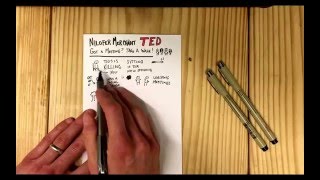
Matt Ragland walks through creating a live sketchnote while listening to a TED Talk by Nilofer Merchant. He uses three pens to capture ideas in real time, treats mistakes as part of the process, then adds color and detail afterward. The talk covers sitting as the new smoking, walking meetings, and how fresh air fuels thinking.
Chapters
So when I'm creating a sketchnote, especially for something live, the first thing that I do is I go ahead and I put in the person's name, the event that it's at, and the title, and some little sketch right here if I want to. So that is a great way to get started that will save you some time and be able to let you set the structure from the beginning. Now even though I have a ton of pens here, there are really only 3 that I use when doing an initial sketch: this Pentel EnerGel and then these 2 Pigma Microns. And even then, I might only use one of them, just kind of depends on the pace. But I don't start with this, I go with these three. So I'm going to go ahead and get started and just listen to the TED Talk here. It's only about 3.5 minutes long, and what I'm going to do is I'm going to overlay and add the audio so that you can see it right as I'm going through.
What you're doing right now, at this very moment, is killing you. More than cars or the internet or even that little mobile device we keep talking about, the technology you're using the most almost every day is this— your tush. Nowadays, people are sitting 9.3 hours a day, which is more than we're sleeping at 7.7 hours. Sitting is so incredibly prevalent, we don't even question how much we're doing it, and because everyone else is doing it, it doesn't even occur to us that it's not okay. In that way, sitting has become the smoking of our generation. And of course there's health consequences to this, scary ones, besides the waste. Things like breast cancer and colon cancer are directly tied to our lack of physical inactivity. 10%, in fact, on both of those. 6% for heart disease, 7% for type 2 diabetes, which is what my father died of. Now, any of those stats should convince each of us to get off our duff more, but if you're anything like me, it won't. What did get me moving was a social interaction. Someone invited me to a meeting but couldn't manage to fit me into a regular sort of conference room meeting and said, "I have to walk my dogs tomorrow. Could you come then?" Seems kind of odd to do, And actually, that first meeting, I remember thinking, "I have to be the one to ask the next question," because I knew I was going to huff and puff during this conversation. And yet, I've taken that idea and made it my own. So instead of going to coffee meetings or fluorescent-lit conference room meetings, I ask people to go on a walking meeting to the tune of 20 to 30 miles a week. It's changed my life. But before that, what actually happened was I used to think about it as you could take care of your health or you could take care of obligations, and one always came at the cost of the other. So now, several hundred of these walking meetings later, I've learned a few things. First, there's this amazing thing about actually getting out of the box that leads to out-of-the-box thinking. Whether it's nature or the exercise itself, it certainly works. And second, and probably the more reflective one, is just about how much each of us can hold problems in opposition when they're really not that way. And if we're going to solve problems and look at the world really differently, whether it's in governance or business or environmental issues, job creation, maybe we can think about how to reframe those problems as having both things be true. Because it was when that happened with this walk and talk idea that things became doable and sustainable and viable. So I started this talk talking about the tush, so I'll end with the bottom line, which is: walk and talk. Walk the talk. You'll be surprised at how fresh air drives fresh thinking, and in the way that you do, you'll bring into your life an entirely new set of ideas. Thank you.
Okay, so the first thing that you might have been able to see is that, look, I screwed something up. I kind of tried to make a woman face here and, God, it really sucked. And so I just crossed it out. And what I would do with this is if I was going to share this, then maybe in post-production, then I would go in and just delete it or cover it up. I could also try and make it something else or really just Give it a little smiley face right there and cover it up. So that is something you can do. I'm not worried about that. I'm not stressing about it. As you can see, the other thing that like, you know, just as I'm creating this, I wish I could give it a little bit more detail, but there was, I mean, even in 3 and a half minutes, there was a lot and it was about getting the idea out rather than making something particularly wonderful. So the big ideas that really stood out to me were, was that sitting is killing you. So you can see that I just made this right here. Sitting is the new smoking, got the cigarette going. She made a point, if you watch the video, she made a point of pointing to her own behind, her own duff, and so I wanted to make a point of pointing to the behind. With the social change, I didn't really do much with that, but I did get the words out. Walking meetings, this guy looks more like John Travolta in Saturday Night Fever. And again, in post, I might go in and try and make one of these look more feminine, kind of like what I did up here with a little bit more time. And then same thing down here, she mentioned nature, so I put a tree. As you can see, nothing that I made here is a particularly wonderful little piece of art. You know, the tree, it's all these 5 simple shapes that we've talked about that are a part of the course. And I just wanted to point that out. You can see here that nothing, nothing is overly— nothing is overly artistic, but what was important is getting the ideas out. Now you may be asking yourself, you know, Matt, when do you add some more context and texture and color. That's all done post-production. And so what I would do here is that I would give myself another couple of minutes to think about what really stood out to me and then make some additional notes on top of that. So you can see now that I just took out a couple other things that really stood out to me that I didn't get down initially. One, this big stat, we sit 9.3 hours a day and that's more than we sleep. That really stood stood out. And then just the walking really opens up our minds to new ideas. Steve Jobs was famous for this, for taking really long meeting walks. So those are a couple of things that I would add afterwards. So take— after you're done, maybe with a live talk, take a couple of minutes afterwards and just jot down any additional big ideas that came to you. This is also when I would go in and add some color. All right, so all I will do from here is take a picture of this with the Scannable app that I've shared about in the blog, and I'll put it in the notes for this as well. I'll go ahead and edit it on my Mac as much as I might want to and just get it to a good sharing— get it to a good sharing size. But this is pretty much all we're going to do. You can see I did really— I— you could do all of this in 10 or 15 minutes. Concentrate on these short talks. These short TED Talks are a great place to get started, and they're very— it's a very low entry, and you can crank through a few of them in very little time. But thanks for watching this. I hope you got to see and got to learn a little bit more of the process and how I create sketchnotes and just what they look like while they're happening. Thanks so much. Bye.