How I Take Notes to Supercharge Productivity & Organize Ideas
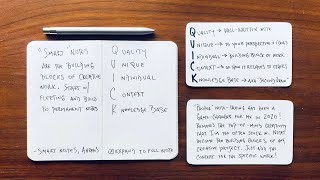
Matt Ragland walks through his note-taking system built on the Zettelkasten method, treating notes like Lego blocks for a reusable knowledge base. He uses a QUIC framework to capture fleeting notes while reading, review them days later, then turn the best ones into permanent notes on index cards before migrating them to Roam Research.
Chapters
What if I told you that you never had to start from scratch again? Like with any kind of project that you had or any type of creative output, whether it is a video, a blog post, a podcast, an outline, a book, whatever it is. What if you had a solid foundation that you could immediately draw from in order to get started really quickly and make incredible progress with the things that matter most to you? Hi everyone, my name is Matt and I make videos to help you get unstuck and focus, plan, prepare, and take action on the work that matters the most to you. In this video, I'm going to be talking to you about proper note-taking. Now, for me, like, I've been a note-taker, I've been a type of note-taker my entire life, but what I'm going to talk to you about in this video today is how to take permanent, durable notes that you can use as the building blocks for any creative project that you have going forward. And one of the incredible things that I've realized is I would even like remove the creative label from that, even though I just said it, because when you're taking these notes, you can actually use it as the building blocks and as a kind of personal knowledge base or second brain for anything that you want to access in your life. With your knowledge going forward. The first people to enlighten me on this type of note-taking were my friends Tiago Forte, Natalie Iason, and Marie Polin. They're all amazing creators, and they all have great YouTube channels, so I'm going to link to them in the description below. But what I realized was when you have these different, like, permanent durable notes, you can use them almost like Lego blocks to assemble any type of creative project that you have. And this is really— this was really encouraging to me because I don't know about you, but oftentimes whenever I came to make a new video, maybe I would have an outline that I had written, like, you know, not very long before actually filming the video, but I would, you know, just basically almost start from scratch every single time. And it takes a lot of, like, internal motivation and confidence that you have to build over time in order to get to that point where you're like, oh yeah, I can make a video about this, or I can write a blog post about this, or I can write my weekly email newsletter about this. And watching Tiago and Marie and Nat work and use this foundation of note-taking as the building blocks for everything that they were creating quite prolifically on a daily basis was something that was incredibly, like, interesting and which is very exciting. So, for the past few months, I've been diving really deep into this world of proper note-taking, Smart Notes. I've written a couple of emails about it already, I've tweeted about it, and I would encourage you to check those out. Again, all the resources are going to be listed below. A lot of you have joined, I think almost 1,000 of you have joined the 90-Day Notes Challenge on Instagram, and I love seeing all of your posts.. But in this video, I'm going to really break it down for you, talk you through how to take smart notes, permanent notes, what the kind of transition from just like jotting a note or a highlight or an underline down in a book or something that you just thought of in your own head and kind of expanding that into something that is a unique individual note building block that you can use for future projects. Real quick, on a personal note, I'm going to make a specific video about this, but the day that this video releases, is the first day that I am a full-time creator, YouTuber, content creator. Wow! There's so much to get into. Like I said, I'm going to get into that in future videos and blog posts, but I quit my job at Podia, and starting today, November 2nd, I am a full-time creator and YouTuber. And thank you for your role in giving me confidence, and views, and occasionally money, that has helped me get to this point where I can make such a big, exciting leap in my life. Full video, blog posts, emails coming about that, but let's go ahead and get more into the note-taking specifics. The inspiration for this type of note-taking organization system is the Zettelkasten, which was pioneered by Niklas Luhmann. Now, he's a really interesting, incredibly prolific person, and I encourage you to learn a little bit more about him. Again, links to resources in the description below. But it has inspired a lot of different ways that you could, like, do this, like analog. I'm going to show you a lot of analog tips, you know, given, given the channel. But also, like, products, apps like Roam Research is basically entirely based on it. Digitizing the ideas of the Zettelkasten, particularly inspiring to a professor named Zonke Ahrens. And he wrote an incredible book that I have been diving really deep into that Tiago and Nat both recommended to me called How to Take Smart Notes. And it has totally changed how I'm producing content, how I'm reading, even how I'm thinking through and expanding on my own ideas. So I definitely recommend that book to begin with, in addition to this video. The way that Zonka explains the process of taking SMART notes is that you begin anytime that you're reading, or even if you just have your own idea, of making a fleeting or fast note. I call them fast notes, but he calls them fleeting notes, and that's just the kind of thing that we do a lot. I realized something that I was doing all the time. What I used to call note-taking generally only made it past the fast or fleeting note stage, rarely made it past. And this is just when you jot something down in your field notes or on a napkin or in the margins of a book that you might be reading, or you underline or highlight. That— those are all examples of taking fleeting or fast notes. Now, there isn't a specific problem with taking fast or fleeting notes, The problem is when we don't transition the important and the key notes into permanent, or what I call durable notes, because it's important to realize that not every fast or fleeting note that you take is going to become a specific individual building block of the ideas that you can use for specific and future projects. But there are a lot of ideas and really important concepts that may start as just something jotted down in your field notes or in the margins of of a book that can become the seed of a key idea or framework that takes your creative project to the next level. Could be something that is the basis for an entire, like, area of focus or work that you do in the future. There are a couple of key components to a permanent or durable note, and I'm going to give you a framework for that in just a couple of minutes. But one of the main things you need to think about is that creating a permanent or durable note isn't simply like copying over a passage from a book or highlighting a quote or something like that. It is taking something that resonates or strikes a chord with you and turning that into a note that is based on your own words, that is based on how you apply your own experience and perspective to the original idea. Now, this doesn't mean that you're plagiarizing, because on the back of the note or any place that you are doing this, whether it is on note cards or in something like Roam, you're still giving it like the inspiration and the references to the concept that, you know, you initially found this idea in. But it is still important to apply your own perspective, your unique view on things, to the note, to the concept that you're building. And like I said, whether you are taking these on note cards, which I have been doing for the past couple of months, or using something like Roam Research, make sure you add your references and any, any other bibliographic material to the back of the card or to the note itself. Now, because I'm a person who loves acronyms, I do have an acronym for note-taking, and it is QUIC, and that stands for quality, unique, individual, contextual, and knowledge base, or like second brain if you follow along with Tiago's work. And to break each of those down real quick, a quality note is one that is well written, that you've put time into personally and have made sure that you're saying it in your own words. Which leads into the U. The U stands for unique, which means you're applying your own perspective, your own thoughts, and your own views on the subject, on the topic, to the note. I stands for individual, which means that the idea and the note itself has to be self-contained enough so that it can become an individual building block of a future project. So you're not trying to shove as many ideas and concepts onto, like, each note card as you you can. Each one should be a standalone piece of information that you can use as needed. C stands for contextual, and there's a bunch of different ways to think through this. This is the one that I'm still working through the most myself and will probably make future videos on. But how does this note, how does this idea fit in context with other topics, other clusters of the same topic, kind of like categories? What is the bibliographic references that you need to add in. So what is the context that you want to find and use this note in, in the future? And then K stands for knowledge base, where you're building up this second brain, you're building up this knowledge library of different ideas, concepts, and notes that you can return back to whenever you're thinking, whenever, say, like I'm thinking, how do I make, what kind of video should I make about creativity? Or the way that I made this entire video, was going through my notes on note-taking, which is very meta, but was incredibly fun and very effective to do. Now, here's how I do this, like, actually in practice. Here's how I actually do the thing. We're going to use the example of reading, but you can apply this to any kind of information or knowledge that you're taking in that you want to summarize or expand later. But the way this works is, as I'm reading, and this can be either with a physical book or even on the Kindle, As I'm reading, I'm taking like little notes, highlights, I'm underlining all throughout the book. And what I'm doing is every couple of days I flip back through the book that I'm reading to see which notes, highlights have really resonated with me. And I know that those are the notes, those are the ideas that I want to take from Faster Fleeting into Permanent durable notes. You see the distinction there? When I'm reading in the moment, I'm often just taking those fleeting notes. That could be like a little bit in the margins of the book, that could be a highlight, that could be like a Kindle note that I add to a digital book. Those are the faster fleeting notes. Now, when I'm reviewing within, say, 2 or 3 days, just so it's fresh in my mind and I kind of have a, like, a trail of thought about why that resonated with me initially, is I'm going back through and I'm thinking, seeing, like kind of reviewing, be like, okay, this, this is still like maybe a good highlight to have, but it's not the building block, it's not the seed or the kernel of something that could become a bigger idea, a bigger concept for me. Now, there are certainly several ideas, concepts, highlights that I'll see are fleeting notes that I then want to turn and transform into these permanent, durable notes. And the way that I do that personally is I'm reading at this point with a pen and a stack of note cards. These are the Baron Fig Strategist note cards that I'm using in this situation, but you can use any kind of note card that you want if you're going analog. And when I come across a fleeting note that I want to turn into a a permanent note, then I'm following that QWIC framework. I'm thinking about how can I make this quality, well-written material? How can I make it unique to my perspective? I want to make sure that there's one idea, it's an individual building block for future projects. I want to add in the context that it could be like with other categories, that categories of notes that I'm taking, bibliographic and reference information, And kind of just the key is this now becomes part of my personal knowledge base. You may be wondering, Matt, why don't you just do this in your bullet journal? And the reason that I do this on individual note cards instead of the bullet journal is that I want to concentrate on having one idea per card and the ability to like pull cards individually instead of trying to like sort through and try and like flip through my bullet journal or any kind of like notebook and find a particular idea. The other thing that this really helps with is I can start to build clusters or categories of the cards based on the topics that I'm talking about, that I'm writing about. That way, when it's time to make a video or write an email or any other kind of particular project that I'm working on, instead of like trying to flip through the index or different collections in the Bullet Journal, I I am just going to the stack, the cluster of creativity note cards, and I'm flipping through those and kind of building out, you know, doing the building blocks of the particular project at that time in real time. And I'm using those to create the benchmark of additional, like, context, word creativity that I'm going to add that's specific to that video, to that email. I have to say that it makes reading a lot more fun. Even though the reading is slower, you feel— I feel a lot more immersed in it. I also feel and experience that I'm remembering and retaining more of the information, more of the ideas that I'm getting from the book. It's a really fun feeling because it's like a treasure hunt. It's like a treasure hunt for your mind. And I love the experience of going back through the books, going back through my notes and piecing things together and finding the big takeaways and elaborating and expanding on them from like the, just the little, the little kernel, the little seed of the idea. It's, it's just fun. It is like a treasure hunt for your mind. And I encourage you to kind of get into it and try it and test it because you do have to kind of get over the hump mentally a little bit of feeling like I'm reading too slow, or this note isn't good enough, or what is this really, a permanent or durable note? Is it still just kind of fast or fleeting? Those are tricks that your mind plays to keep you from doing something that can be really, really important and transformational for you. One of the main questions that I've gotten from my emails, from Twitter, from Instagram, times that I've talked about note-taking, or even from the 90-Day Notes Challenge, is like, what are you going to do with all these notes, or how do you keep them organized, or like, what's the best structure for categorizing everything? And I'm not sure yet. However, that is not a reason to not try this out. I see this all the time, and note-taking is just the latest example of it, is people are asking me, well, once I get done with 90 notes or 100 notes, like, how am I going to organize them? What am I going to do with them? We've talked about what you can do with them. And what I would do in terms of categorization is just use like simple keywords or topics that you're talking about. Like you can write down on the back things like work or creativity or writing or note-taking or fitness or food or whatever it is, whatever the keyword or topic of that note is, just write it on the back. And then you'll start to see different clusters or categories that naturally arise. Now, might you change something a little bit later? Yeah, that's totally okay. But don't get yourself stuck and stopped thinking about how am I going to solve the problem of 100 notes when you haven't even made maybe 1 or you haven't made 10. Let's solve a good problem when we actually get to that point. Another popular question that people have asked is why are you doing analog notes? Those are going to be harder to reference. You're just going to have this like giant stack of notes eventually. And yeah, I would love to have a giant stack of notes to deal with eventually. Why aren't you just doing it in Notion? I thought you loved Notion. I thought you're a big fan of Roam. And both all of those things can be true. The reason that I'm starting with analog is that I just take better notes when it's just me, the book, and the note card or note cards. That's just how, just how my mind is working. Now, it's completely true that digital notes are much easier to reference, and I will say, like, for the type of note-taking that we're talking about right now, that's so much better in Roam than it is in Notion. And to be honest, I don't really see that changing because Notion is just— has a lot more, has a lot more like modular, like block, like specific, like database type, like, you know, pieces to their app. And Roam is just really mostly, you know, focused on text, and that is what notes are, are mostly text. And so when I am creating digital notes, I'm almost entirely doing it in Roam. And a lot of times what I'll do is I'll just set aside some time to go through the notes that I've created on note cards and basically just migrate them into Roam. And I totally understand if you're saying, "Matt, that's too much work. That is duplicitous, too much duplication of effort." And you might be right about that, but I also find that as I have written something down and then I'm typing it in, I'm like just internalizing it even more. Like, it's becoming even more important to me. I might make a couple of changes. I might like change some of the categories a little bit, to make sure that I can cross-reference them in Roam that much easier. But it's not, again, that's not something that I'm concerned about right now because I'm seeing the value day in, day out of creating this type of note-taking system that allows me to never start from scratch again with any kind of creative project. Now, as I'm starting to build things in, as I'm taking these notes and I go like, yesterday I wrote, yesterday I wrote the weekly email. And normally I just feel like, what is top of mind for me? Like, just what's on my mind? And then I'll like kind of just go from there. But now I'm going through my recent notes, I'm going through my notes on creativity, I'm going through my notes on work, I'm going through the notes that I'm making on like this big transition from like having a, you know, quote-unquote normal career into being a full-time creator, I'm— I don't have to like rely on what's at the top of my mind anymore. I just look at like my knowledge base, my second brain. I'm like, okay, let's use these 3 or 4 notes as the, as the baseline, and then I will create something unique for the project from there. But I'm not starting from scratch anymore. So just to be really clear about this at the end, what I love about note-taking is not only is it like a treasure hunt for your mind while you're reading, while you're taking notes, while you're kind of going through them, thinking like, oh, this makes a lot of sense, or I can combine these two together and I can like create this, you know, like almost like a Lego. My kids are really into Legos. I can create these Lego like building blocks of like, there's the project, let's go from there, let's add some additional context specific to the moment. But I mean, you can just see me, it sounds weird, sounds kind of nerdy, about like getting really excited about it at this point, because now I don't have to start from scratch anymore. I just have— I, I go through my notes and bang, I have like a starting point, and that feels amazing. If you want to practice some of this on your own as well, you've heard me mention the 90-Day Notes Challenge a few times, and it started at the beginning of October, but we still have 60 days left, like a little bit, you know, right around 60 days basically. All of November, all of December. So go to the link in the bio below and you can sign up for some additional information. But basically all you're going to do, like, take what you've learned in this video and start making and taking your own smart, durable, fleeting, fast— but start, start creating those permanent, durable notes that can become the individual building blocks of future projects in your life. Thank you so much for watching this video. Thank you so much for the support. So much happened this month. I crossed 50,000 subscribers on YouTube. It was my birthday, and I put in my notice at my full-time job at Podia. Thank you so much to Podia, and mostly entirely so much more to my wife for her amazing support and encouragement through the last 5 years. Definitely 3 years on YouTube, for the last 5 years of putting all of this into practice. So thank you so much, Morgan. Love you. Thank you so much, everyone watching this. If you are new here and you like this video and you're still watching at the end, you should subscribe, give it a like, let me know what you think about note-taking in the comments, and look for a new video next week because this is what I do now. Thanks so much, everyone. One. See you then. Bye.
More from Matt









Journal reading 📖 Reflectjons on how I’m living & how it aligns with the vision I have for my life.

You don’t have to listen to me. But you do have to be intentional about the systems in your life.
