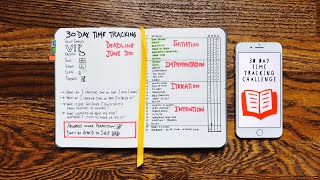
In this video Matt Ragland introduces his free 30‑day Time‑Tracking Challenge, building on a previous 5‑day challenge that attracted over 1,000 participants. He walks viewers through the challenge’s structure—31 daily emails (welcome on June 30, then July 1‑30), weekly themes (Initiation, Implementation, Iteration, Moving Forward with Intention), and the VIP upgrade that adds bonuses. Matt shows the two‑page Bullet Journal spread he uses for planning, detailing the left‑hand “big picture” page (deadlines, VIP info, weekly recap questions, motivational quotes) and the right‑hand page that maps the email schedule and weekly themes. He explains his workflow for drafting the emails in an app, using hashtags and status letters (D‑drafted, W‑written, E‑edited, C‑complete). He then demonstrates his two time‑tracking methods: an hourly grid (30‑minute increments) and a 15‑minute block method (96 blocks per day, subtracting sleep and work to leave 32 personal blocks). Matt shares personal data from a sample day, discusses the rationale behind each method, and emphasizes how tracking revealed where his time went, enabling better decisions about what matters. He cites the impact on his own life and on hundreds of participants, urges viewers to join via the link in the description, follow him on Instagram @bulletjournalguy, and share the challenge with friends. The video ends with a call to subscribe and a reminder that the challenge starts July 1.
Chapters
Everyone, my name is Matt, and welcome back to another Bullet Journal productivity video. You know, I just get so excited when I am able to do these and able to share something with you that I've been learning. And today, what I'm going to be going over is something that I'm really excited about, which is the first 30-day time tracking challenge. Now, if you saw the previous time tracking video that I did, you can check it out up here. But first, let me tell you a little bit about what's going to happen in the 30-day challenge. You see, I had so many people that shared great reviews and great feedback about the 5-day challenge, And I saw the most impact for myself when I went through a 30-day challenge. So check both of those out, and I know you're going to find something that's really useful for you. One last thing that I want to ask you is that if you know that this is going to be useful to you, it's most likely that you know someone else in your life that this can be really useful for also. So feel free to share it with people that you care about, people who you know want to recapture more of their time and use it on something that matters a lot to them. And like I said, you can share with them because it's totally free. And like I said, if you want some extra bonuses and upgrades, there's also a VIP version. Alright, let's go ahead and hop into the video. You've been seeing some of it as we've been just going through the intro here, and we'll go ahead and get started. Here we go. On these two pages is where I've done the majority of my planning, along with an app that I'm going to show you in a minute. Of the 30-Day Time Tracking Challenge. You can see I've got my big picture information over here on the left page. Deadline, the basics of what like VIP you're going to have, everyone's going to get daily emails, what VIP includes, and then some primary questions that I'm going to be asking in the recaps up here day by day, or sorry, week by week. And then just a couple of quotes that I like to follow down here, like with a couple of little icons down there. Number 1, you've heard me talk about this on the last video, but progress over perfection and don't be afraid to ship. So that's something that anytime I'm making stuff, I always try and keep that in mind. So let's zoom over here on the right, and I'm going to give you an overview of how I laid all this out, what these different little letters mean, and give you a little preview of what you're going to be seeing in the time tracking challenge. Again, 30 days. So what I have over here is there's going to be a theme for each week. So there's initiation, into time tracking, the implementation of it, iterating on what you've seen, and then moving forward with intention. So I've got 30 emails here. So of course there's only 7 days in a week, and that only gives me 4 weeks. But then there's a few— there's 3 extra days. So really it's going to be 31 emails that you'd be getting, but the first one would come out on June 30th, and that's just the welcome, give you a heads up going into day 1., and then all the way down here we'll just be going step by step, day by day, and then on Day 29, what you can expect going forward. I just read something about alive time versus dead time today in a book called Ego Is the Enemy, highly recommended. Let me tell you about these 4 letters over here. So D, D is for drafted, W is for written, E is for edited, and C is for totally complete. So you can see that I have the first 2 weeks of these totally finished. And you may be thinking to yourself, "Matt, how can you launch something when you haven't written all the emails yet?" That will just be our little secret. And something that I just know, you know, I know I'm going to get these done. Each of these emails is about 400, 400 to 500 words, takes you a few minutes to read. And what I'm using as an app to write these out, I've really been enjoying it, and it's something that I'll probably talk more about, is that I've transferred everything that I have over here. Let me zoom in a little bit more. And what you'll see here and there are all of the themes, everything written down, the questions that I had over here, all of it's down, ready to be moved over. And then what I do is I come over here and I start writing out all of my drafts. Here's a bunch of them. It's stored based on when it was last edited, but day 4, when to track your time, you can see I've written everything out right here, and then the hashtag helps me find them. So something else to go over real quick is— we'll get to this in a second— but a couple of videos ago is how I'm planning out with this timeline the different steps for the launch and for getting everything together. So you can see this is by week in June. And so the first week, like 3rd through 9th, 9th through 16th, these are for some reason Saturday to Saturday. I don't know why I did that initially, but outline all the emails, put the sales page up for VIP, write through emails 5, 5. So you can see I'm about 13, 14 emails in, in terms of like being totally complete. And then for those of you that are already on the email list, you can see that you've probably gotten an email from me just to see if you're interested in this 30-day time tracking challenge. And so far, it's 360 people, people are interested, which is awesome. Thank you so much. So go ahead and join those other 360+ people and let's track some time together. Speaking of time tracking, you can see that I've got a bunch, I've got these all over the place, but Let me show you one that I've got going specifically for today. We've talked about this in another video. If you want to go check it out, please do. The method that I have here hasn't really changed, but there's two ways of thinking about ways to track your time. And the way that I show you right here on the left, what I've kind of adopted is this just hourly method. And so it starts during the hour that you wake up, no matter what time during that hour you wake up. So for today, I woke up, I woke up at 4:30.. But you can see I have sleep here from basically 4, and I just make this, add a couple of things in here for you. I have these broken down in 30-minute increments. You can do it in 30-minute increments as well, but I wouldn't go, I wouldn't go more than that because most likely you don't spend an hour on every single task that you do. But if you try and do every single task like by the 5 to 10-minute block, you can drive yourself a little crazy. So I slept until 4:30, had coffee and a little snack, read a little bit, and then went to the gym for an hour, came back, ate some more, shower, planned out the day, read some more, spent time with my family, time with my son, and then I got to work, got to work. So those are all things that I've done so far today, and then you can see right here, working on the video. It's a little after 3, so I could keep in right here, video, probably gonna go until 3:30, and then I have other videos actually. So could just extend this out, and I just keep writing in what I'm doing. Now you'll see different things during the— something to note is that, you know, the difference between tracking work time and regular time, we go into all this. Obviously it's 30 days, so it's really in-depth but still very readable. So a bunch of different ways that you can do this. I explain everything in in this, in this course. And like I said, it's totally free. Definitely check it out. The other thing that you can do here is that I have these hours going all the way down to the hour that I usually go to bed, which is sometime around 10. And so like, let's say I go to bed at 10:30. I won't write this in totally, but I might, you know, I'll just start writing sleep right here. The other way of thinking about this is the block method. So this is the hourly method, and then the block method is right here. I would start with hour before you go into block. This is the way that you can think about the block method though. The big block method is, let's say we've got our big blocks right here, and I'll just create this one for you. Cue the inspirational time-lapse music. For these, I'm basically not including my sleep time and my work time. In this grid, and even though I don't include sleep time here regardless, so I'm basically splitting out work entirely. And the way that I think about this, and you can see the math, if you break a day into 15-minute blocks, then you are left with 96 blocks. That's the math. So we're talking about 24, basically 24 hours in a day, there's 4 15-minute blocks in an hour, so 24 times 4 equals 96. I've got my 96, and so if I've got 96, then I subtract 28 blocks for sleep, that's 7 hours times 4, and then 36 blocks for work, that's 9 hours times 4. That leaves me with 32 blocks. So what I'm gonna do right here is that I've got across the top 1, 2, 3, 4, and again, I, I could put more lines here, but 1, 2, 3, 4 times 1, 2, 3, 4, 5, 6, 7, 8. So that gives me my 32 blocks. 8 times 4. You may be thinking to yourself, why in the world would I do this when I can do this? That's a great question. That's why you start with this. Once you get used to this, if you don't want to deal with like putting in big work blocks. And again, we talk more about when to track and weekdays, weekdays versus weekends, work time. We get into all of that. Start here with the hourly grid. Okay. The reason that I get so fired up about this is because I know the impact that it can have on your life. I know what it's done for me. I know that when I was going through time tracking, even though it felt like a little much to like sit down and write back down the different things that I had been doing in the course of a day, it gave me a lot of clarity as to what I was giving my time to. And that was really important for me as I started to think about what I really wanted to do and what really mattered to me. And I was able to make better decisions because I had information about where I was going, the things that I was doing, and what really mattered to me. So I know it can do that for you. I know that it's done that for like literally hundreds of people. Over 1,000 people have signed up for the initial 5-day time tracking challenge. And so I wanted to expand this. I wanted to give you more information and allow you to go through this. And really, I think it'll change some things for you, especially if you find yourself thinking, "Man, where did the time go? What did I do with my day? Am I really, like, doing the things that matter to me and the things that I care about?" And this doesn't even have to be, like, some giant, like, world-changing thing. In fact, one of the things that we talk about in the series is just to keep it simple. Start small. Do one little thing that you've been wanting to do that you've been putting off or something like, gosh, I wish I, I wish I, you know, had more time to write, or I wish I spent a little bit more time with my kids, or I just wish that I read or meditated, or any one of those little things rather than just like mindlessly, you know, scrolling through social media. Just things that we default to, when we start to recognize them, it'll give you a better filter for making decisions on how you really want to spend your time and the different things that you want to spend them on. So, with all of that said, please sign up for this. I know it can make a difference for you. Just go to the description, go to the link in the description below. I'm also going to be sharing a lot of videos on IGTV about this, so make sure that you follow me on Instagram @bulletjournalguy. There's links in the description below for that as well. I can't wait to share all of this with you. Like I said, share it with a friend also. If you're here, if you're new for the first time, check out some other videos, but definitely give this a subscribe. This channel, this community, is here to help you focus on things that matter. We use a Bullet Journal, we use a lot of analog methods to be able to do that, but the heart of what we want to do is take our time, take our focus, and direct it onto the things that matter to us and the ones that we care about. All right, hope that you have a great day. Hope to see you in the 30-Day Time Tracking Challenge that will start on July 1st. And I'm, I'm just really excited about it. Hope you can tell, and I hope to see you there. Bye!