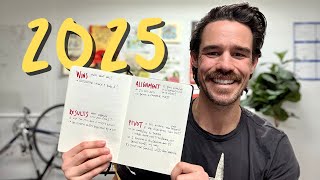
In this instructional video, productivity expert Matt Ragland presents a simple, pen‑and‑paper annual review system designed to help viewers reflect on the past year and plan intentional actions for the next. He explains why reviewing the year is valuable for previewing and preparing future goals, and he emphasizes adopting a "reporter" mindset—observing facts without self‑judgment. The core of the method is the RAP framework, consisting of four prompts: Wins (celebrate personal, professional, health, financial, and relational successes), Results (compare intended goals with actual outcomes), Alignment (honestly assess whether current activities match the desired life and identity), and Pivot (identify small, actionable changes to improve alignment and progress). Ragland illustrates each step with personal examples such as the birth of his fourth child, reaching 100,000 YouTube subscribers, launching the Hey Creator community, and earning a purple belt in jiu‑jitsu. He offers practical tips for executing the review efficiently, including using a printable worksheet, recording voice memos, employing AI tools to transcribe and edit responses, and maintaining a journaling habit. Additional resources—downloadable PDFs, supplemental videos, and a live training clip—are provided to reinforce consistency. The video concludes by encouraging viewers to adopt the RAP process, celebrate wins, learn from results, ensure alignment, and make purposeful pivots for the upcoming year.
Chapters
It's the last week of the year, and it's the perfect time for you to run an annual review. Now, why is an annual review helpful? When you review what has happened in the past year, it helps you preview and better prepare and plan for what you want to accomplish in the new year to come. My name is Matt Ragland, and I've helped thousands of people think and perform better using analog systems like pen and paper, the Bullet Journal, note cards, and timers. These are really simple systems that anyone can use. You don't have to set anything up, including this annual review framework that I'm going to share with you today. At the end of this short video, you'll have a clearer idea of what went well, what didn't go as well, what's in alignment with the type of person and the kind of life that you want to have, and ways that you can pivot or make more progress in the things that you want to achieve starting next year. Now you can do everything that I'm recommending with just a pen and paper, but if you want to get a PDF printout of this annual review worksheet that I have, just enter your email in the link below and you'll get everything delivered to you right away. This is a 4-step review process and it really acts like a series of prompts. So the way to think about this is you're actually just having kind of a conversation with yourself by responding to the questions that I'm going to ask you. What I just want to encourage you to do is be open to the thoughts, the emotions, the questions that might come up for you. And secondly, the thing that I want to encourage you on is approach this review as a reporter and not a judge. When we go into reviews like this, a lot of times there's a lot of hesitation and fear around doing an annual review because you might feel ashamed about what you did or didn't get done. This year, especially like this is primarily a productivity channel. And so people come here to try and learn how to be more productive, how to be more focused, how to be more intentional. Don't go into it thinking like, oh, well, I had all these goals and resolutions and habits at the beginning of the year and I didn't get around to them. And so now I feel bad and how's next year going to be any different? If we approach this as a reporter and not a judge, then we can report on what happened and we can make better, clear, more intentional plans for for next year. Now, if all you watch in this video is the next 30 seconds, here's what I want you to know. There are 4 prompts in this framework. It's wins, results, alignment, and pivot. Wins are the things that went well. Results are looking back at what you intended to do at the beginning of the year. Alignment is really being honest with yourself about, like, is the work that you're doing— are the things that happen this year really in alignment with the type of life that you want to live and the that you want to be. But pivot would be if you know that you're not in alignment, that the wins were not what you wanted, or the results were not, not fitting the goals that you have, then you need to be brave enough to make a pivot, even a small one, to make progress on the things that you have said are important to you. Now let's spend a minute talking about each of these 4 prompts. The first one is wins, and I want you to take a minute or several minutes and celebrate what went well for you this year. Include personal, professional, health, family, relationships, financial, any type of area of your life where there was a win, I want you to celebrate it and really let yourself appreciate the things that you've done well. For me, these were things like the birth of our fourth child, our first little girl, doing things like upgrading the backyard by putting some turf down so the kids could play out there a lot more. It also included things like 100,000 subscribers on YouTube and launching the Hey Creator community and getting my purple belt in jiu-jitsu. The year was full of wins, and it's important to take time to celebrate and appreciate all the things that you've done this year. Next is results, and this is where I really want you to lean into that reporter mindset, because I, I wouldn't necessarily say this is like losses or failures, but I am looking more analytically at what were the things that I intended to do this year, what were my goals, what were the things that like I set out to achieve for myself, and then what were the results of what really happened. And so when I think about it, like just to use an example of how something can be a win but could still like not have the best result is the Hey Creator Community. It had a great launch, we had a great summit, 500 people signed up, and that was, that was amazing. But then the results throughout the year were that it didn't quite grow the way that I wanted. In fact, it shrunk a little bit. We had more members cancel than we had people sign up, and that was, that was disappointing. It wasn't quite the result that I wanted. So this is where you do got to lean into that reporter mindset a little bit more and just be like, hey, Matt wanted to have 1,000 members in the Hey Creator community. He ended up with $450,000. That's not the result we were looking for, even though it was a win to get it launched and get it profitable in the first place. The next is alignment. The A stands for alignment, and this is where you gotta be honest with yourself, okay? You have to look at it and say, based on the wins that I had, the results of the goals and habits and intentions that I set during this year, is the work that I'm doing, is the life that I'm living, is my health, my finances, my relationships, are they in alignment with the type of person that I want to be, with the family that I want to build, with the kind of work that I want to do? This is probably going to take a little bit more time to think about, and I would encourage you to just start with like making some simple bullet point answers, like maybe just free writing, kind of morning pages style, stream of consciousness. Start thinking about like, what do I really want to spend my days doing? But then I really want you to think about, and we'll talk about this in the pivot next, How can you make a small change? How can you do a little bit of what you really want to do? The thing that makes you happy, makes you light up. Maybe you can't change your entire life, but can you change 30 minutes a day into something that puts you more in alignment with the kind of person that you want to be and the kind of life that you want to live? The P stands for pivot. It can also mean progress or plan, and I'll explain. When you have listed your wins, when you've looked at the results of your intentions and your goals, when you've thought deeply about, am I in alignment with the kind of life that I want to live and the person that I want to be? It's time to then take action. And the way that you can take action is in two ways. They both start with P, but the one that I normally think about and the one that I'm acting on this year is pivot. What are some changes that you need to make based on your alignment, your results, and your wins the first 3 steps in order to pivot and do things a little bit differently going into the next year. If you're not in a place in your life where you can make huge pivots and changes, I totally understand that. But what is a small pivot that you can make for a little bit of time, maybe if it's not every day but multiple times per week, that is going to challenge you to be the type of person, to have the kind of business, to like do the type of work, to be the kind of man, woman, mother, father that you really like want to be in your life. Now you might also be thinking to yourself, Matt, I have great momentum, I'm crushing it, I am doing the things that I want to do, I feel great in my career, my— that's awesome, I love it. So let's think now about how can you build on that momentum and make better progress achieving your goals on like maybe there's something in your life that now that you have some other things kind of running not on autopilot, but you're like, okay, I got these things nailed down, What's something else that you could focus on? I wrote out my entire 2024 wrap year in review, and you can read it at the link in the description below. I think you'll find it useful because you'll see like not just the theoretical, hey, here's how you do the thing, but actually me responding to it and me going through these myself. The other thing that I found super useful about this, I think it was Ali Abdaal that says like nobody gets talker's block. We can get writer's block, but we rarely get talker's block. And so the way that I have done this the last couple of years is I take these prompts and then I just like record a voice memo or I speak directly into Notion or like there's a lot of AI tools out there. So the way that I did my annual review this year was I just took those prompts, the ones that I shared with you today, and I just kind of talked to myself. I had a conversation with myself that then gave me a couple thousand words of responses and then like I ran it through like a custom GPT that I have, and then I did the final edits. And so something that used to take me a really long time to do, like a few hours just to write, much less to think about— it takes me days to think about— but it used to take me a few hours just to write. Now it's taken me like an hour, maybe 2 hours annual review. So that's something you can think about also. Now, you may not be able to do all the AI stuff that I've been working on, but even just like talking it out to yourself can be a great way to get started. I also have a free worksheet for this that you can download. Again, like there's a link in description below. And not only will you get like a written template for all this, you'll get a printable PDF for it and two separate short videos where I'm talking about the RAP in a little bit more detail. And there is also a live training video from a clip that I did with the Analog Action members that will show you, you know, based on feedback and having a conversation with one of the students, the members, how exactly you can do this in your own life. One of the best ways to be more consistent with your reviews and make this annual review process a lot easier and have a lot more material to pull from is to build a journaling habit. And I just published a video very recently that shows you 5 journaling methods that you can use to be more consistent with your journaling, to help you think more clearly. It really helps me with my, my mental health also to be able to get ideas like and thoughts and emotions out of my head and onto the paper. So if you liked this video and you want to think about like, hey, how can I be like, how can I think clear and how can I kind of build in a review system for my life and for my work, the 5 journaling methods video is what you should check out next. Thanks for watching.