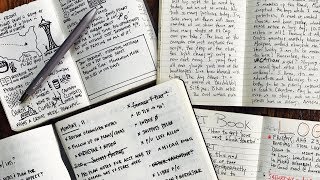
In this video Matt Ragland explains why daily journaling is valuable for mental clarity, focus, and therapeutic reflection, emphasizing that its power lies in the present‑moment process rather than archival review. He outlines four practical approaches to start and sustain a journaling habit: (1) using daily or weekly prompts to spark quick responses; (2) treating the journal as a simple logbook of daily events; (3) compiling answers to a personal list of thematic questions (e.g., entrepreneurship, nature); and (4) writing just one line per day to lower the entry barrier. To support these methods, Matt offers a 31‑day prompt set and weekly "themes for thinkers" delivered via his email list. He advises using any notebook or pen, but recommends pocket‑sized notebooks (Baron Fig Confidant, Moleskine, Field Notes) for ease of tracking progress, while cautioning against over‑planning tools. Throughout, he stresses starting immediately, keeping the process low‑friction, and the positive impact journaling has on his mental health and productivity. The video concludes with a call to action to subscribe and a teaser of upcoming content.
Chapters
Hi everyone, my name is Matt, and welcome to another Bullet Journal productivity video. In this episode, I'm going to be showing you how to start and stick to a journaling habit. It's one of my most popular videos. If you want to check it out, you can do so right here. But today I'm going to be showing you a little bit more detail 4 different ways that you can start and stick to your journaling habit in this year. In the past month, it's been apparent to me how important journaling is. I'm not even talking about just bullet journaling, but a daily almost diary or series of prompts that help me think about my day, where I was effective, where I wasn't, things that are just coming up to me, and how I'm processing them in the moment. It really clarified for me how much journaling at the end of the day helps relax my mind and how much journaling in the morning helps me set a tone for the day and focus on the things that matter. If you're thinking to yourself, why does journaling matter if I'm not going to go back and look at or read or return to my entries from past days, weeks, months, or years? And that is a valid question, but for me, the power and the purpose of journaling lies in what's happening in the moment and clarifying my thought process, relaxing me. It's actually like very therapeutic. And even though I do go back and look at old journal entries from past years, again, for me it's more about being present and thoughtful in the moment with where my time and attention is going. The first way to start a journaling habit is with a series of prompts, whether that's daily or weekly. Prompts are a really useful way to get you thinking on a particular subject or topic really quickly. And so rather than having to create a whole like journal entry for the day out of thin air. You're just thinking up your response or answer to a particular prompt. The second way to begin a journaling practice is just by treating your journal more like a daily logbook. Austin Kleon has a great article or series of articles on this that I'll link to in the description below. Thinking of your journal more like a chronicle of events instead of like thinking of something very inspirational, even though a journal should first and foremost just be for you and not for anyone else. Just thinking of it as a daily log more so than, "Dearest diary, today this wonderful thing happened and it changed my life." It doesn't have to be like that. It could just be like, "Hey, today I, you know, ate tacos and played with my kids at the park." That's a really good journal entry. You can look back and know that on February 11th, 2019, I ate tacos and played with my kids at the park. That's fine too. Think of it like the first step status updates. A third way of beginning a journaling habit is by compiling your responses to a series of thoughts on questions. So Derek Sivers is really good at this, and if he doesn't have a particular entry for the day, he'll just return to this list he has of thoughts on whatever topic. So it could be thoughts on entrepreneurship, thoughts on products, thoughts on programming, thoughts on nature, whatever. You get the idea. The fourth and final way to start a journaling habit and actually stick with it is by just doing a line per day. So you can do this in any journal or your Bullet Journal just by writing down just one, one particular thing, whether it's something that you're thankful for, something that happened, something that you're thinking about. Just constrain yourself to one line per day. And if you feel really nervous about getting into and sticking to a journaling habit, one line per day is a really good way to start because it is such a low barrier to entry. There are a couple of ways that I want to help you start and stick to a journaling habit. The first way is that I've created a series of 31 daily journal prompts that will help guide you through starting your journaling habit. It just gives you an easy, quick prompt that you can read in the morning, and then you can write it out in the morning right after you get it or later in the day, whatever works best for you. But it does give you some guidance and just reminders that help you get the ball rolling mentally and even, you know, physically by writing it out. Now, if you've already gone through that 31-day journal challenge and you're on my email list, that's another way that I'm going to help you continue to start thinking about journaling and different themes for thinkers. So I've added also in the description a link to a little preview of the first couple of themes for thinkers that I've sent out to my email list. And again, it's just a weekly theme to center your thoughts focus and clarify your actions around a particular topic just to help you as you journal from day to day. Of course, a lot of you will be asking, well, what should I use for journaling? What's a particular notebook or pen or app even that I should use? And my answer to that is the only thing that you need to do, like, if you want to keep this super simple, just use any kind of notebook, pen, paper. It doesn't matter as long as you're writing it out. Now, I do recommend that you use a notebook instead of scrap paper just because it's easier to see like day-to-day your progress, and also to of course collect everything in a particular place. But I wouldn't get too worked up about like, what should I do? I basically, I wouldn't delay the start of a journal habit just because you feel like, oh, I've got to get this specific particular notebook. Now I've linked to a few in the description below. There's also a link to my Amazon store where you can see recommended products, and those will give you a good place to start. But again, I wouldn't overthink it. Just go ahead and get started so you can get in the practice of journaling. Personally, I prefer a pocket-sized notebook for daily journaling. Baron Fig Confidant pocket size is amazing. It's the one that I've used for the last year. Moleskine— basically any, any kind of pocket-sized notebook will work really great. The normal Baron Fig or Moleskine pocket size will last me about 6 months of daily entries. But another thing that I've done in the past is use like the Field Notes, really like slim softcover notebooks, and I can go through about one of those per month. So we're either talking about 2 bigger notebooks for the year, or if you want to do this, and this could be pretty cool, 12 different Field Notes softcover pocket-sized notebooks. I hope this video was a big help to you as you start and stick to your journaling habit in the new year. It's something that is incredibly important for me, and I've noticed plenty plays a big role in my mental health and my ease of mind, in the way that I focus on tasks and what matters to me in my life. So I hope that it'll have that same impact for you. If you enjoy this video, please give it a thumbs up, and if you're new here, subscribe. Check out the other videos related to journaling and bullet journaling. I can't wait to share more with you. There is a ton planned for this year, and I can't wait to share all of it with you to help make this year your best year ever. Can't wait to see you in the next video. Have a great day. Bye.
The best piece of advice I have for someone trying to succeed in the film industry or any creative space is if you're doing what everyone else is doing, you're doing it wrong.