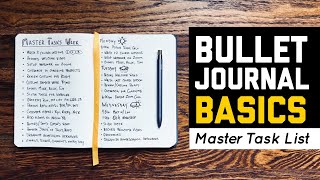
In this Bullet Journal Basics video, Matt Ragland addresses a common frustration among bullet journal users: repeatedly migrating the same tasks from day to day. He introduces the "master task list" technique as a solution. At the start of each week (typically Sunday or Monday), Matt performs a comprehensive brain‑dump of all tasks for the upcoming week, placing any date‑specific items directly into the appropriate daily log. The remaining tasks are kept in a master list, which he then ranks by importance using intuition. Each day, he selects 2‑4 high‑priority tasks from this list to slot into the daily spread, completing them before adding additional tasks if time permits. Unfinished tasks are migrated minimally—only once or twice—by moving them forward in the master list rather than rewriting them daily. He also advises users to periodically reassess tasks that have been migrated multiple times, asking whether they are truly valuable, can be delegated, or should be discarded. The video concludes with encouragement to try the method, integrate it with existing weekly layouts, and adapt it to personal workflows.
Chapters
Sometimes you come into Monday and you're so excited or overwhelmed about the week, and it's just started. I have so many things to do. Hi everyone, my name is Matt, and welcome to another Bullet Journal Basics video. In this episode, I want to answer a question from somebody named Jake, who made a great comment/question about task lists and migrating in a Bullet Journal. And what Jake said was this: I get so tired of migrating the same tasks over day to day to day to day to day, repeating and rewriting every single thing. It is very frustrating to do, and I totally understand that. I think this is a very basic beginner mistake. And the way that I answered Jake in the webinar is what I'm about to show you, and it's this idea of a master task list. For each week inside of the Bullet Journal, but the other way to think about, you know what, I'll get to the second point in just a minute, because I wanna get directly into this. Now, as I realize that as I've talked to people and coached people and kind of walked people through productivity and systems and Bullet Journaling, is that this is a really common thing, is you get to Monday and you're like, okay, I'm just gonna list, like, these are the things that I wanna do, these are the things that I'm fired up that I get to do, or things that, you know, I'm a little overwhelmed and I have to do. You may write down like 10 things, 10 tasks,, and you get through, you know, pretty normal, 3, 4, 5, even 6 of them, but then you go back in and the next day you're writing down those 4 again along with anything else that came to mind. And you knock out, you know, 3, 4, 5, 6 of those, and then, you know, some of them, like, you're just writing down maybe 1 or 2 for the 3rd time, and that, that can feel really frustrating in a Bullet Journal. It's probably one of the main reasons people don't stick with it in my experience. You know, it is nice if you're using a digital planner or to-do system that you just, you know, kind of click and drag it down. I realized that what I did to combat this and make it a little bit easier, because I, I hate rewriting things as much as the next person, only I try and only ever once rewrite a task. I created a master task list at the beginning of each week, and what I do on Sunday or Monday is I just brain dump all of the things that I need to do that week. Now, a quick caveat is that that if I know that something has to be done on a specific day, I'll go ahead and drop that into the day itself. You know from my Weekly Layout Basics video that I do kind of a pre-planned week at least, so that if I know that I have an event, a meeting, or a task that has to be done on a specific day, I go ahead and write that into the Bullet Journal ahead of time. But many of the things that I do, and I think many of the things that you might do, may not have a specific day, and what gets really frustrating is if you write all or most of them down on Monday, and you get through half of them, so you gotta write that other half in on Tuesday, and you get through maybe half of them, 'cause you got more stuff coming in, is that you keep rewriting and rewriting and rewriting the same task, and I totally understand that that feels frustrating. What you do with the master task list is you do that big brain dump, brainstorm of all the tasks, all the things that you know you have to do that week, and then you look at that, you kinda rank them, just, even if that's just your own intuition of what are the most important things that I can do on Monday. And you write down, say, those 3 or 4 things. I like starting with 2, 3, 4 things that I know I want to get done every day. Kind of tough/creative important things that I know I want to accomplish. And then I will work on doing those things. When I'm done with those things, if I have a little bit more time and nothing else has come up, go back to the master task list, add another thing in, work on it, and then maybe you don't finish that one, go ahead and migrate that task and move it down into Tuesday. Then when Tuesday comes around, when Wednesday comes around, now instead of rewriting like past tasks that you didn't get to the previous day, now I'm just revisiting that master task list that I set up at the beginning of the week, and I'm moving in, I am kind of migrating at this point of like, okay, it's Wednesday, what are the 2, 3, 4 important tasks projects that I need to work on in order to move my work forward. So when you do that, you end up only rewriting a task once or twice. Like, you put it on the master task list and you're like, okay, I got to do this, I got to do this on Monday, Tuesday, Wednesday. A lot of times you can pre-plan knowing that you have a block of time available on Thursday to work on this. So this is an easier, better way, I believe, that if you find yourself like rewriting and migrating the same tasks over and over again, like 3, 4, or 5 times every day that week. Try out the Master Task List, brain dump everything on Sunday or Monday, and then add those into your daily spread, your daily log, as you are continuing to go through that day. Now, a quick distinction that I want to make is that if you find yourself migrating a task multiple times, I'd say like 3, 4 times, like even 5 times, if you write something down on Monday and you haven't gotten to it by Friday, it's important to ask yourself the question, How valuable is this really? Now, if you're putting something off and you really need to do it, then you really need to do it. And that happens to me. Like, I don't love like checking and following up on email. And so I'll be like, ah, you know, I really should follow up on that email. I got to do that. So that is an example of one. And sometimes you're just, you know, kind of scared to do it. And that's important to know and realize. Maybe you need to ask for help. And then there are going to be things that come up in your work, in your life, that you're like, you know, I've been putting this off and it doesn't really matter. So you could just scratch it off. Thanks for watching this video. Let me know what you think about the master task list, if you use anything similar, or what you think about the idea. Like I said, if you find yourself often, like, over-listing and over-tasking yourself early in the week, this could be a good idea to write down all those tasks that don't have a specific day assigned to them. And that way, every single morning when you get up, when you do your preview, when you look at the day ahead, look at, look back at that task list and just decide, what are the things that really matter to me today? What are those 2 or 3 important tasks that I can go ahead and slot into my day, block time off for, and then make a real commitment to completing them and making significant progress? Okay, thanks again for watching. If you want to see more videos in my Bullet Journal Basics series, make sure you check out the playlist here, and you can subscribe whenever the thing comes up on my face, but Thank you so much for being here, and I will see you in the next video. Thanks. Bye.