How to Organize your Bullet Journal with Threading & Naming
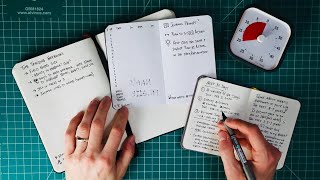
Matt Ragland shows how to use threading and naming conventions to connect ideas across multiple notebooks. He demonstrates page-number references and cross-references for tracking time, groceries, fitness, and other projects in a multi-notebook system.
Chapters
Hi everyone, my name is Matt, and welcome to another video in my Bullet Journal Basics series. In this video, we're going to be talking about threading, which is one of the superpowers you can really use to help organize and connect the different ideas, collections, thoughts, and notes, not just in your main Bullet Journal, but across other notebooks that you might be using as well. I'm going to show you exactly how I thread different ideas, notes, collections together in my Bullet Journal so that I can always make sure that things are organized and I can find and connect different pieces of information that I have, not just in my main bullet journal, but across different notebooks that I might be using, like a Field Notes or my, like, daily diary type journal. One of the things that makes threading really easy and effective for me is that I assign names or titles to every bullet journal or notebook that I use.
And a lot of times I will use a really simple naming convention of the type of the maker of the notebook. So in this case, Field Notes, and these two, it is BF Barenfig. And then I will give, if there's a name of the notebook that already exists, like FNG11B, which stands for Field Notes Group 11 Series Bronze color.
Still got it.
This is the Barenfig Clear Habit Journal, and I'm using it in the year 2020. And then same thing here. So this is just a little pocket journal that I use for like my daily, my daily journaling. And so that's why I call it the BF Baron Fig J for journal 2020. That's how I created a naming or just referencing convention for the actual journal so that I could find them easily.
So when I make a note in my Baron Fig Clear 2020 bullet journal, then I have an idea that I've maybe been noting in the Field Notes G11B.
And so just for an example right here, I'm thinking about like, what would a time tracking notebook look like? Has to be more than a grid. Some ideas. And then you can see that I have right down here on the next page, reference notes BF clear 20 .144. The 144 stands for the page number. I'll talk about that in just a minute, but let's just go ahead. Now I know I'm just coming to BF clear 20. I'm going to come to page 144 where I have more notes on the potential time tracking notebooks. So that's how I can connect an idea that was first made in a to-go kind of setting with this Field Notes, reference it back to my main brainstorming section collection in the Bullet Journal. So I also have a couple of lines blocked out down here for where I have also referenced or threaded different ideas for these time tracking notebooks. You can also see that I have right here cross-referenced back FN G11B, pages 1 through 4. 1, 2, 3, 4. Another thing that I can do is if I'm referencing just another page in the same notebook or journal, especially if it is my regular bullet journal, then I might reference a date that I've talked about it or just reference the page number directly. That lets me know that the reference is inside the same journal. If I don't give kind of that naming convention at the front, I know that it's in the same journal. So let's go to page 72, March, a couple of days in March. So here we go, 72, and you can see that I have Outline, Outline Time Track Notebooks cross-referenced back to page 144.
And because of this, even if I'm doing a callback to a journal I used last year or 2 years ago, I can still use that same naming convention to make sure that I'm getting to the right notebook and the right page.
I hope that gives you an initial idea of how you can do this. Let me show you a couple other examples of where this will work. So you can see on Sunday March 22nd that I had a grocery list, go get groceries, and the list is in FNG11B page 23. So let's switch over and check on that. Here we go, page 23. Now for field notes, I do my own page numbering, which— so in case you're wondering, why don't I have a field notes that has page numbers? Some of them do. Another place that I'll do this, see You can see that I was shooting a journaling video. You can check that out, and it's the most recent channel video. Not the most recent in the Bullet Journal Basics, but I was shooting the new video. Again, let's go back. Notes on Field Notes G11B24. So that was just there. Page 24. You can— if you watch that video, you'll recognize this page. So these are the journal prompts that I brainstormed. While I was out one day. And then what I'm also doing is that I wanted to reference the actual journal notes and entries that I made in BFJ20, March. So I'm coming over here. Obviously I know this is the journal, and then I'm flipping through and I'm just getting— I wanted to show a few in March in general. Like, this is March 11th. This is the day that the coronavirus smashed through the U.S. consciousness and the NBA suspended its season. So journaling and noting on all of that. If, uh, if this kind of work intrigues you, make sure you check out the Journaling Through Chaos video. But you can see that I was referencing that again, the March entries for Baron Fig Journal BFJ 2020.
There's also a section in the Bullet Journal Method book about threading, page 105 to 106, and then on page 296 of the frequently asked questions of the Bullet Journal Method notebook— no, not notebook, just book.
Okay, same thing right here. A task that I had, a little project goal, was a fitness guide that I wanted to build in Notion. And you can see that I made the thread and the reference to the same field notes, pages 28, 29. So now if I'm referencing back and forth right here, pages 28 and 29, workouts and movements, weighted alternatives, all these different things. And then all the way down at the bottom, where did I put it? Here we go. Doing this March 16th through 23rd in the BF Clear 2020. Ah, okay, so yeah, doing it during March 16th through 23rd. So those are the dates that I need to reference. I would put the— I would make sure I still put the page number. I would still know, and did figure out, March 16th through 23rd but I would come back here, and I probably just should have put down here page, uh, 74. That is the field notes page number. That's what had confused me a little bit. One last example to show you is here. One of my big objectives for this current week is wrapping up our email masterclass challenge.. And so I'm saying email notes and lesson ideas, page 141. Again, there's no other like preamble or title to it, so I know instinctively that this is a page number in this specific bullet journal. So flip over to it and you can see that I've got the initial lesson ideas all right here, supplemental work, just an initial brainstorm so I know where to start and how I can continue to kind of make notes and additions for this, for this project, for this objective.
The point is that threading can be a great way to extend the functionality of your notebook and make sure that you can connect different ideas across different bullet journals that you're using, or pocket notebooks like Field Notes, daily journals like what we talk about, have been talking about a lot recently. So think of it as a way to just connect the different ideas. Now, whatever method that you use for making sure that you have a naming convention or a linking threading convention. Again, I like to give titles or names to every notebook that I use, so then I'm just referencing this is the name of the notebook that this other idea is in and the page number that it's on. I could also thread based on collections if it's in the same notebook. I could also just, if I'm threading in the same Bullet Journal, then often maybe if I'm not referencing the page number specifically, I might reference a date or date range as a way to make sure that I'm looking back at when I was initially thinking or writing notes about a particular idea or project.
So as a quick recap, make sure that you have some kind of naming, titling, referencing convention for each of the notebooks— pocket, bullet, whatever it is. Diary, journal that you use so that you can use that as the main referencing and threading system for going back and forth between the different notebooks that you might use. That way, if you're going between one or another, that way it's easy to say a note, reference these notes, thread these notes to this other journal that I'm using. So BF Clear 20, page 144, and I know I just need to come straight over. And I can do this for any journal, any notebook I have, to extend the life of a journal, make sure that I'm staying organized, and not have to tote around the same, like, journal or notebook every single place that I go.
I hope you enjoyed this video in the Bullet Journal Basics series on threading. Make sure you check out the other videos. Right now there, I think, are 5 or 6, and we have a couple more coming in the next month or so. But make sure you check out the ones on opening pages, on index, on monthly. We weekly, daily layouts on collections. There's a lot of good ideas. There's a lot of, like, really nitty-gritty details. If you're starting on the Bullet Journal for the first time, make sure you check it out. It's going to be linked in the end cards right here. This should do it. But thank you so much. I should probably stay over here. Thank you so much for watching this. Check out this playlist for all the Bullet Journal basics. Subscribe on my face if you are new here, and I'll see you in the next video. Thanks so much.
More from Matt









Journal reading 📖 Reflectjons on how I’m living & how it aligns with the vision I have for my life.

You don’t have to listen to me. But you do have to be intentional about the systems in your life.
