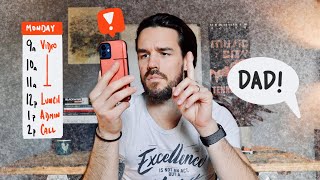
In this video Matt Ragland explains why distractions undermine productivity and presence, and offers a practical system for both preventing and recovering from them. He starts by emphasizing that having work and relationships you care about naturally reduces the urge to distract yourself. He then introduces his "gap‑preview" planning method, which involves setting weekly goals, identifying the concrete actions that achieve those goals, and deliberately protecting time for those actions. Rather than relying on willpower, Ragland advocates shaping the environment: blocking off calendar time, removing phones, and even turning off the internet to eliminate notification triggers. When a distraction does occur, he suggests three recovery tactics: (1) write the intrusive thought or task in a bullet journal or master task list, (2) use a short whiteboard break to jot it down, and (3) keep a "distraction journal" of silly, non‑actionable thoughts to deflate their pull. He also recommends a brief mindfulness reset—taking a couple of deep breaths and returning to the task, analogous to returning to the breath in meditation. Finally, he proposes an incremental habit‑building routine: start with a 30‑minute distraction‑free block each day, repeat 2‑3 times a week, and add ten minutes each week until a full hour is achieved. He closes by inviting viewers to share their own distraction triggers, normalizing the struggle and encouraging community support.
Chapters
Getting distracted is one of the biggest challenges for our productivity and for our presence with others. And while social media gets a well-deserved bad rap for distracting us much of the time, it goes a lot deeper than that and is often caused by low-leverage activities that don't actually get us where we want to be going. In this video, I'm going to show you how to resist and recover from the distractions that haunt you in everyday life. I'll also share a simple way to get started with distraction-free focus time for the people and projects that matter the most to you. My name is Matt Ryglen, and I help you be more creative and productive using simple systems so you're able to build lifelong habits, including being distraction-free. I do want to start by saying one of the most effective ways of resisting distractions is to have work that you're interested in doing and people that you're interested in living life with that help you not want to be distracted to begin with. Now, in the context of what we talk about on this channel, using the gap preview method to really dial in what are my goals for this week, what are the action tasks that will lead me to those goals, and when do I protect time to work on those actions so that I can complete my goals by the end of the week. When you have a set plan and list of things to work on that you know matter and are bringing you closer to the goal that you set for yourself, it's easier to resist distraction because you know that you have something worth doing. The advice that you probably get most often when it comes to distractions is just to resist them through willpower. And while that can be helpful in a short amount of time, it is challenging to only rely on willpower over the long run. Now, there are a few ways to effectively resist distractions without only relying on willpower. One of the most effective ways for me and many others has been to block your calendar, protect time. To say, I'm going to have focused, undistracted, uninterrupted time to work on a particular project. And this doesn't even have to be just about work. You could also say, I'm going to block out time to spend with this person. Another way of resisting distraction that's really effective is by removing the distraction entirely. And that could be putting your phone in another room while you're working or playing with your kids or being with your family. It could also mean you go as far as unplugging the internet for 30 minutes or an hour. You'd be surprised how much work you can get done without the internet. I know that if I'm shooting video, that doesn't have anything to do with the internet at all. So I will unplug the internet, I will put my phone in another room, and I will have an hour that I can just focus on shooting videos. Between blocking my calendar so that no one else can schedule a meeting with me, and by removing the phone and turning off the internet, I am resisting distraction, but I'm not necessarily relying on my willpower. I'm making my environment conducive to resisting distraction by eliminating the notifications that could come through. Now, when the inevitable happens and you are distracted by a notification or maybe a stray thought that gives you anxiety about something that you need to get done or something that you forgot about, Then there are a few strategies that I like to use. A couple of them are a little fun, a little tongue-in-cheek to bring some levity to the anxiety that I might be feeling about the distraction. The main one that I do is I will write down, if it's a task, I will write down that in my bullet journal, in my master task list. Might also write it down in a Field Notes notebook. Another thing that I could do is what my friend Sean McCabe calls his whiteboard trick. And basically all he's doing is when he's in his focused distraction-free zone, if he thought about something that he needs to remember to do, he will take a short 10-second break and write down whatever that distracted thought or whatever it was. He'll just write it down on a whiteboard and then get back to his focused work time. Another thing that I'll do that I have a video about is called my distraction journal. And this is just kind of a funny, silly little list of things that might distract me during the day. So they're not actually things to do, but just distracting thoughts. And I'll just make a list of those. And what happens is when I write those down, it loses some of its power and hold over me because I'm getting it out of my head and onto paper. Really want to watch this movie trailer, or let's check and see what the football injury reports are. Let's see what's cleared the fantasy football waiver. And when I write that down in the moment, I really don't need to look at this right now. So it's a fun and a tongue-in-cheek way to list your distractions, and it really does take some of the power away from them so you can get back to the people or the projects that really matter to you and that you've set aside time for in that moment. So those are the two main ways that you can start to eliminate distraction in your work and your life. Resist through the environment that you set up and then recover whenever the actual distractions do come, because they will come, recover through writing those things down. Or, and this is one of the things that really helped me with meditating and working, is that when I noticed I was getting distracted, I was getting a little frustrated, I realized that it was a lot like being distracted while I was meditating, even though I literally don't have anything to do while I'm meditating. But you're supposed to take a couple of deep breaths. Just return to the breath, then all I have to do when I'm distracted while working, if I get frustrated by that, then my way to recover is to take a couple of deep breaths and just return to the work, return to the task that I set, just like I would return to the breath. Here's a simple way to practice this and be focused and distraction-free for just a small part of your day, because I do think it's important to start small. If you go into tomorrow and think to yourself, I'm going to spend my entire morning distraction-free and I'm going to get all these things done, it's going to be great. Then I'm just going to tell you, it's probably going to be hard. It's hard for our brains to completely switch off of the distraction treadmill, the notification cycle that we're so used to being on. So what I recommend you doing is literally block out in your calendar, lock yourself in your office or your workspace at home, wherever it may be. And just focus on a 30-minute block of time to be distraction-free. Turn off your phone, turn off your internet if it needs to be. Whatever it is, just focus on a particular task or being with a particular person without notifications and without distractions. Just try that for 30 minutes every day for the next week. Okay. And even if that feels hard, just try and do it maybe 2 or 3 days of the week. But focus on that 30-minute block. And then each subsequent week, add in 10 minutes to that 30-minute block so that by the end of 4 weeks of practicing that focus time in your day, you will be up to an hour-long block of focused, distraction-free time. And I promise, if you can work on this, if you can get to that point, then it will do wonders for your relationships, for your projects, for your pace at work. You will be able to get more done, probably in less time, because you're so dialed in and resisting distractions, recovering where needed so that you can focus on the people and projects that matter the most to you. Thank you so much for watching this video. If you have particular things that drive you to distraction on a regular basis, let us know in the comments. No shame. I know for me, I get super distracted by like football and sports news all the time. I just can't help it. I'm so interested in sports, but not in a, like, nice way. It's in a very distracting way from the people and the work that really matter to me. So no shame, no judgment on the things that distract you. Thank you so much for watching this video, and I'll see you in the next one. Mm-hmm.