How to Set Up Your First Bullet Journal: Annual Planning & Goal Setting
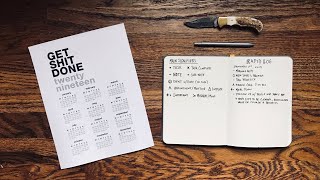
Matt Ragland shows how to start a bullet journal with dot-grid notebooks and fine-liners, using rapid logging and daily spreads that connect tasks to monthly and yearly goals. He recommends the "Tow Truck Trick": link journaling to an existing habit like brushing teeth to make it stick.
Chapters
Hi everyone, and welcome to another Bullet Journal productivity video. In this episode, I want to show you how to begin your very first Bullet Journal. It's something that I've touched on before, but mostly I've shown you, like, big picture things, like goals, and habits, and different trackers, or the weekly, monthly layout that you could do working on projects. What I want to talk with you about in this one is really starting from the beginning, starting from scratch. A really good reference for this, just to let you know from the beginning, is the Bullet Journal Method book. You can see the review, and everything that I did for that book here, so make sure you check that out. But really, what kickstarted this for me, to make a video about it sooner rather than later, is: one, it's the new year, I think a lot of you are going to be trying your first Bullet Journal, and the video that I did on productivity planning may be a little too big for you to start with. The other thing that nudged me along with this is that I've talked with two people recently, about starting their very first Bullet Journal. And one is John Acuff, who's an author living here in Nashville. You should check out his books, they're amazing, they're some of my favorite books. And then Coca Sexton, who works on content at Slack. And both of them are starting their first Bullet Journals, and just looking for some advice and tips. And I started thinking about it more like, well, you know, what would I be telling people if they were starting their very first Bullet Journal? This is the video for you. Shout out to John and to Coca, because you were a big part of like, getting me going. With this and sharing and teaching everything that I know about Bullet Journaling. The main thing that you want to do when it comes to your very first Bullet Journal, and I can't emphasize this enough, is you want to be able to keep it simple. When you start your first Bullet Journal, it's important to know that you can do this on any paper that you want. I do recommend graph or dot grid journals or paper to be able to do this. It just kind of helps you stay within the lines in a good way. That being said, it's hard to go wrong with either Baron Fig or Leuchtturm for your journals. There's also a bunch of others that are out there now. Scribbles That Matter, Rhodia also make great dot grid journals. But what I do like about Baron— well, you know all the things that I love about Baron Fig from past videos. It's an amazing company, great people, and I highly recommend them. They're beautiful journals. One nice thing to like about the Leuchtturm specific bullet journal, it does have a key for you. So all of the, like, primary signifiers that you would want to use in your bullet journal can be found, like, right on the inside cover. You can use any journal, you can use any paper, you can use any note cards that you want to kind of get into the practice of bullet journaling. And the same thing goes for pens. You can use any pen that you want. There's a lot of fancy pens out there. You know from my holiday gift guide, if you watched that, that I subscribe to the pen category of better than BIC, but not, like, super expensive. So pens like Pigma, Micron, Staedtler, those are the ones that I use the most, and I've been really happy with them. The main way that most people get started with Bullet Journaling is with rapid logging. So without worrying about doing the right layout, or watching a bunch of videos on like, oh, I have to make these certain icons, or do these certain things, or do a layout in this way, you don't have to do any of those things. Again, remember to keep it simple. The best way to do that is with rapid logging, and using these basic signifiers that are pretty common amongst the Bullet Journal community. And keep in mind that you can use these any way that you want. It's a totally flexible system, and that's what so many people love about the Bullet Journal, including myself, is that you can make it fit whatever you want it to be for your life and for your work. One of the problems that I personally have with rapid logging is when you have a bunch of dated events or meetings, appointments that you have, it can get a little unwieldy to organize them. And so That's why I have gotten into the weekly layout that I use, which is an agenda on the left, and then top tasks for that day on the right. I also have a running list of, like, undated, non-urgent tasks that still need to happen. Sometimes they are urgent. Well, no, if they're urgent, they go on, like, the daily spread. Now, if you are committed to rapid logging, and it is a really good way to start, another way to work on the future tasks that you have is with the future log. I have to say, you know, full disclosure, it's not something that I've used used a ton so far. I'm going to test a little bit more with it in 2019, but like I said, usually what I've done, and I have found works best for me, the system that's worked best for me, is a daily layout that has agenda items, appointments, meetings on the left-hand side, and then top tasks for the day on the right-hand side of the page. Anything that I don't get done from a top task on that particular day, then I will use the migrate signifier and just move that down to the next day. The other thing that I do for a weekly spread, and you can see a bigger explanation of this in my 2019 productivity video, I'll link to the particular timestamp in the description below, but I'll use a single page for each week to describe the outcomes and objectives that I have for that week, and how they align with the goals and themes that I have for the month, for the quarter, for the year. So I make sure I'm always asking myself, this thing that I'm thinking about doing, or that I believe has to be done, is it aligning with a goal, with a theme that I have for the year, for the month, for the quarter? The big thing to remember that I always encourage people with is that you want to keep it simple. The more complicated you make it, the less likely you are to continue with it. So I do recommend use these primary signifiers, Start with rapid logging and have an idea or task log that you can put undated, non-urgent tasks that still need to be done. So rapid logging, future log/idea task log for the month or for the week. Have that, start there, make sure you nail that, and just stay consistent with it. The more complicated you make it, or think like, I've got to make these trackers and these layouts, and the video said to do this, don't worry about that as much. Because, you know, like with any habit or with any practice that you want to cultivate, it's just not going to happen the more complicated you make it early on. Now, there is a habit hack that I use in order to remember to stay consistent with my Bullet Journaling practice, and I call it the Tow Truck Trick. And what I do with that is I basically hook up the Bullet Journal practice to a habit that I'm already going to be doing anyway, something that's already automatic for me. Once I kick off that established habit, I'm just going to connect and put my Bullet Journaling habit, you know, kind of on the backside of that existing habit. So what I do do is after I brush my teeth at the end of the day, I will go back and I'll spend just about 10 minutes going over the things that I did for the day and what I want to be my top things going into tomorrow. And that also gives me a nice little buffer, like, that also gives me a nice little buffer at the end of the day that I'm not looking at my phone, I'm not watching anything, I can just like look at the paper, I can kind of reflect, and it gives a really nice closure to my day. Then what I'll do still before I go to bed is that I'll I'll go to my computer, I'll take the Bullet Journal, and I'll go to my computer, and I'll actually set the Bullet Journal on top of the computer, or the keyboard. So that way, when I go to start work the next day, the first thing that I see is the Bullet Journal, preferably opened up to the page that I'm on, so that I look down right away, and I start to work on the task that matters most, the thing that I absolutely need to get started on at the beginning of the day. I'm already hooking those two things together. Obviously, I'm going to start work, and so the Bullet Journal's going to be there, and obviously I'm going to brush my teeth at the end of the day, I put it just somewhere in the kitchen, or somewhere in the house that I can easily get to it, and then I take it to my computer. Hope you enjoyed this bullet journal video. If you're starting your very first bullet journal, leave a comment. Let me know what you think about this video. Any other questions that you have, I'd be happy to answer in the comments. Thanks to John and to Coca for asking good questions, and being interested in bullet journaling. I love sharing about this. I love teaching everything that I know about it., and if you have any questions, make sure that you ask them in the comments below. If you enjoyed this video, there are so many others. That's what this whole channel is about. It's about being productive. It's about using analog tools like a Bullet Journal, like index cards, different things to get your head out of your apps and start to focus on the things that really matter to you. Be dedicated to the tasks, to the outcomes, to the objectives that you have in your life and in your work. If that's the kind of thing that interests you, if that's the kind of person that you are or want to be, Give this a like, subscribe, because there's going to be so much more coming in 2019 to help you with that. Hope everyone has a great day, and I will see you in the next video. Thanks, bye!
More from Matt









Journal reading 📖 Reflectjons on how I’m living & how it aligns with the vision I have for my life.

You don’t have to listen to me. But you do have to be intentional about the systems in your life.
