If You Think Life Is Boring, Try This Notebook Trick
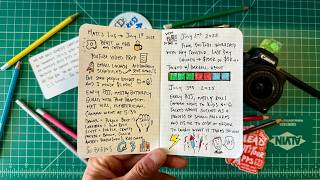
Matt Ragland argues screens leave us half-awake and proposes three tech-free practices to reset: Austin Kleon's Logbook method, where you record one daily highlight; a three-step storytelling framework to turn moments into narratives; and sharing stories in community. He cites C.S. Lewis on how screens distract us from real joy.
Chapters
So many of us are living life with our eyes half open in a blur of experiences that aren't our own and only experienced through a screen. It reminds me of C.S. Lewis' quote in his book The Weight of Glory, where he talks about how we're like ignorant children who are content making mud pies in a slum because we can't conceive of a holiday at sea when there's a whole ocean of joy right around the corner for us. Because in a way, these screens have become our modern mud pies, things that we're content giving our lives away to. And I'm not saying that everything about the screen or technology is bad. I owe a lot of my career to things that happen on a screen, including this video that you're watching right now. But the problem still remains. And what I want to show you in this video are two simple ways that you can change the way you think without having to involve technology at all. You might be surprised, but there's a ton of research behind these two things that I'm going to share with you in this video, and it actually does a lot to change how you experience yourself and how you live in the world. They'll help you start to notice the good things that are happening in your life instead of comparing yourself to what you see on the screen. It's like a giant reset button for your brain. So take out a pen and paper because I'm going to show you two simple ways to stop chasing fake happiness hits and start to enjoy your life again. The first way to change the way you think is through journaling. Journaling literally changes your brain by helping you notice the things that you experience in everyday life and turn them into meaningful stories that you tell yourself. And if that sounds a little grandiose, well, it's true. And the way that I can help you experience this is by learning how to journal yourself. And this isn't about keeping a diary or doing the Julia Cameron Artist's Way, 2 pages of free-flowing thought per day. Journaling can be as simple as writing down a single sentence highlight of your day. But if you're getting started with journaling, my favorite way to do it is with Austin Kleon's Logbook Method. He thinks about it like a ship's log, and he's just writing down the things that he experienced that day.. And if you're one of those people who says, well, nothing really interesting happens during my day and I don't have a very interesting life, well, I would challenge you on that, that if you start paying attention to things that happen in your life, you will find that all of a sudden your life has become more interesting. Comedians are the masters at this. They have made their careers out of seeing and noticing and observing things in their own lives and in people generally. That they turn into jokes and sell out stadiums with.
We're so anxious to get the next text. They give you those 3 little ghosty dots to tell you it's coming. Oh, we're cooking up a good one for you. Wait till you see this. You are not going to believe what this guy is about to say.
I've been journaling for over 10 years, and while I don't always journal every single day, I have noticed that when I am journaling consistently, I do feel like I'm living more of an interesting life. I do feel like I have more stories to tell because I am intentionally looking for things every single day, both consciously and subconsciously, that I can put into my journal and then that I can share in stories with other people. That leads me to the second way that you can change how you think, and that is telling stories. I have a 3-step framework that you can take, and this also applies to the journaling advice, where you can take the things that you experience and observe every single day and turn them into interesting stories. The first thing that you're going to do is observe the moment of change. That could be for you, or it could be for someone else that you're watching, listening to, or reading about. What is the moment where, for example, you think, I thought that this was going to be really easy, but then it turned out to be really hard, or vice versa. I thought that this was going to be really hard, but once I jumped into it, I realized that it was much simpler than I thought. I realized that it wasn't going to take as much time as I thought it was going to. And you may think at first that's not anything interesting or exciting or important, but Let's go to the second step in this sticky story framework, and that is the emotional hook. Because if you're thinking about this very first, like, moment of change story, like, I thought this thing was going to be easy, but it turned out it was more challenging than I thought. It was a lot harder than I expected. The emotional hook is like, well, how did you respond? What did you think about? How did you feel? And most people, myself included, are going to say, I don't know when I'm going to publish this because it feels too raw. Well, I got frustrated and ashamed and angry because I realized I didn't quite have what it takes, and that was even worse because I thought I did have what it took to make this thing easy, but I didn't, and that made me sad and frustrated and angry. And you may think like, well, I don't need to pull back the curtain on my life quite that much, and if you don't want to from a story perspective, then just leave that in your journal. But I would challenge you with this: who among us, hearing a story like that, whatever the topic is, aren't going to hear it and think, yeah, I've been in that situation. I've had a time that I thought something was going to be easy, and then it was hard. And I responded that way too. Now let's go to the third point of the story, and that is the lesson or the main takeaway. And that's where you get to share, no matter how simple it seems, what did you learn from this? Like, well, I realized that instead of trying to run a half marathon, I was probably going to have to limit myself to a 5K instead. Or I think about like when I first started doing jiu-jitsu, and I realized Oh, I thought because I was athletic and in shape and tough that I would be able to do better at jiu-jitsu. But as it turned out, I just got my butt whipped by a 60-year-old and I was just putty in his hands. I couldn't do anything. It's like he was dancing and I didn't know what the dance was and he was just twirling me around. That's when I realized this is going to take longer than I thought. But I also realized this is the main lesson. This is the takeaway. I realized that it's good to be a beginner at something. It's good to have some humility. It's good to be in the mindset of in 10 minutes I'll be done. But even if, Matt, this is just to you in the future, you know, keep trusting, keep trusting yourself. It's okay to get some bumps and bruises and sometimes you just got to go. Sometimes you just got to go. These are all things that are universal lessons. I could insert any topic or any experience into that story and think about what was the moment of change, what's the emotional hook, and then what's the lesson or takeaway. And what I would challenge you to do is try and tell a story about something that happened in your life every single day. And that can be a good thing for you to write in your journal and just go through those 3 steps. It doesn't have to be a story that you would tell at a dinner party. It doesn't have to be a story that you would tell on a first date.. It doesn't even have to be a story that you would tell a loved one or your neighbor. It just can be a story that you tell yourself about something that happened, and you will get better at telling stories if you do these things. Now, I know I only told you 2 things, but the 3rd thing that I would encourage you with on this is do these things in community. Do this with a group that you can share your stories with. Do this in a way that you can communicate your ideas and your lessons and these moments of change and these emotions with other people. Because in a very rapidly changing technological world, and when we can connect with anybody over the internet, the things that make us really human, the things that really connect us and make us feel alive, are things that we can do together. And that's why I wanted to go with these 3 things specifically: journaling with pen and paper by hand, telling stories and observing the things that, uh, we experience, the things that are happening in everyday life, and then sharing those with other people in community. Those are 3 things that honestly AI can't touch. These are 3 things that you don't need any technology to do, and they're 3 things that make us and make you uniquely human. So I hope you try these 3 things out. Let me know in the comments which ones, uh, connect the best with you, which ones you might have questions with. And for journaling specifically, Make sure you watch this video right here about 5 different journaling methods. I mention the ship's log and the highlight, and there are 3 others, obviously. So check that out and let me know which one you choose. Thanks for watching.
More from Matt









Journal reading 📖 Reflectjons on how I’m living & how it aligns with the vision I have for my life.

You don’t have to listen to me. But you do have to be intentional about the systems in your life.
