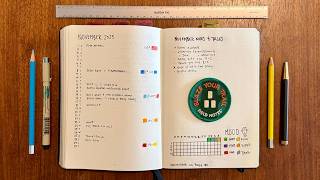
This content was created by Matt Ragland. This content was uploaded by Matt Ragland. This is a YouTube video titled "If You Want To Achieve Your Goals in 2026 — Start Now" (created 2025-11-02) featuring Matt Ragland delivering a solo instructional/personal-productivity monologue. He demonstrates a simple November bullet-journal monthly layout (a two-column days/weekday format), discusses habit and mood tracking (preferring quick marks over elaborate grids), explains how the monthly view feeds into his GAP weekly planning approach, and encourages using the remaining ~6 working weeks to build momentum toward 2026. He also promotes his analog-only course, Analog Action (offers a $50 viewer coupon), links to related videos, and urges viewers to adapt systems to what works for them. Content type: YOUTUBE.
Chapters
Hey everyone, in this video I'm going to be showing you a November layout in the bullet journal. It's going to be fast, it's going to be simple, it's going to be fun, it's going to be something you can do in just a few minutes. Let's go ahead and get started. So what's the point of a monthly layout in the bullet journal? If you look at YouTube, if you look at Instagram, if you look on Pinterest, or you just Google monthly layout in a bullet journal, you're going to see things that look like art projects that look like something a super scrapbooker would make, and that's not really the way that I do a monthly layout. As the great meme would once say, ain't nobody got time for that. The point of a monthly layout for me is information. It's key dates, it's events, it's birthdays, it's anniversaries, it's holidays. It's knowing when I'm supposed to be at a specific place or text someone or call them or send a card for their birthday. That's the point of a monthly layout to me. It's knowing what days go where and which weekdays are associated with them. It's very simple and straightforward. So that's what you're going to get in this video. It's a simple 2-column layout for planning your month in a bullet journal. Also talk about a habit tracker and a mood tracker that you can use, but everything you're going to see in this video, everything you're going to see from me, on this channel is about how to be simple, systematic, and productive using your bullet journal and analog tools. Let's go ahead and get started. Very simple. All you're going to start with is one column for the days of the month, 1 through 30 here in November, and then the corresponding days of the week. And then you have a row for each day. So you see it's Saturday, November 1st, and Florida-Georgia football is this weekend. Not super hopeful as a Florida fan, but that's the big event. November 2nd, so on and so forth. November 8th, cousin Josh's birthday. November 15th, brother Neil's 40th birthday. Let's go. November 28th, stuff like that. November 28th, shout out to String. These are the kind of things that I'm putting in the monthly layout. I'm not using the monthly layout to say something like, on November 20th, I have a haircut at 2 PM. That goes into the weekly log. That goes into the daily log for November 20th or whenever I'm getting my haircut. See you soon, Jenna. Quick thing on habit trackers. I have a whole video on habit trackers that you should check out, but personally, I gotta be honest, I don't like making those grids. They are I don't know, they only take like 10 minutes. Again, ain't nobody got time for that. At least I don't. I'm running a business. I've got 4 kids. I like to exercise. I like to read. If I have 10 minutes where I can read a chapter of a book, or I can go for a walk, or I can make a little grid in my bullet journal, I'm going to do all those other things that are not making a grid in my bullet journal. But honestly, I've told you all this before, so deep cut for those of you watching this. If you see in a thumbnail that I've made a grid for like a habit tracker or a month or something, y'all, that is literally just for the thumbnail because I know that's what people look for in the thumbnail. That is not something this guy's doing. Sorry if you think I'm a liar and a fake. This— I'm not making those grids in my weekly or monthly layout. I can get the same effectiveness just making little X's or just writing down like, this is the book of the Bible that I read, that I read this, that I read today. That's how I think about habit trackers. I do like making the mood tracker look a little, little purdy. But that's really all that I'm worried about, that I'm thinking about when I am tracking something. The other thing that the monthly layout gives me is that marker in the Bullet Journal that then gives me the following pages to plan out my weeks. And since I use a flexible but still structured planning, weekly planning method that I call GAP— and I just did a video about this, you know, you got to check it out, uh, here in the card and the end screen— is now I can look at it and say, all right, I know that I use like 4 pages to like 2-page spreads for each week. So now I can basically just look at it and say the next 16 pages are those days of the week that then I can start to fill in some of those specific appointments or things that I have to remember on a particular day. Hey, and speaking of weeks, there's really only 6 working weeks remaining in the year. I know we've got 2 months and you know, that's basically 8 weeks, but nobody does much the week of Thanksgiving. Nobody does much the week going into Thanksgiving, and then that weird, like, you know, Twilight Zone week between Christmas and New Year's. And so you really only have 6-ish true working weeks in the year. And so for me, I just did a video about this, about locking in. Go back, watch that video. It still rings true for no matter, like, how much how much of a small window that you have. But 6 weeks is still enough to do something that is going to build momentum for you going into 2026. Do not wait. Do not wait for January 1st, 2nd, 3rd, 4th, whatever that first Monday is in the new year to actually start thinking about what you want to do and who you want to be in the new year, because you can start to lock in. You can make these decisions any day at all. It doesn't have to be the first Monday of a new year type of decision. Decision. Let's build some momentum together. And the best way that you can do that, one, you can watch these videos, and two is I have an analog-only productivity course called Analog Action. So by watching this video, you get a $50 off coupon to the course. So go in, check it out. You can also sign up for the newsletter. You're going to get a little taste of it going through the newsletter. But if you are ready to lock in, if you are ready to get literally everything that I know and everything that I've been working on as like a productive person over the past 10 years. And these videos that this is— gosh, this is year 8 of the channel. It's all simplified in there. So you could watch 250 videos, or you could wait for each like email to come out every single week, or you can get everything that I've thought about and planned about all in one place, all immediately accessible to to you. So go check out Analog Action. You get $50 off just by being a viewer, not even a subscriber. I mean, a lot of you are subscribers, just by being a viewer of the channel. So thanks for watching this video, and if you want more, go check out Analog Action. Look, here's the thing that I want you to take away from this video is that the Bullet Journal is an incredibly adaptive tool. And even though I just talked to you about like my whole productivity system, I want you— my, my goal, my hope for you watching these videos is that you start to figure out what works the best for you. And that's not always the best thing to say on the internet. The best thing to say on the internet is this is the best way and this is the only way and you have to follow it in order to be productive and achieve all your goals. You should learn from people like me, others, but it's not going to work for you until you figure out what works for you and you're brave enough to say, I like this thing that Matt says, and I'm going to integrate it into my life and into my work. But this other thing doesn't really work for me. I like what this other person said as well. Great, great. Please combine and remix and collaborate and put together the pieces of your own puzzle in a way that works best for you. But the most important thing that I want you to be thinking about is how can I build the best system, let's call it, so that I can create the best life for myself, so that I can reach the version of myself that I am striving to be, that I can live the life that I'm dreaming about? What is the best combination of rules and systems and habits and like parts of goals that are going to make the most sense? That's what you should do. That's what I hope you're taking away from these videos and what you're taking away from other videos that you watch. You have to do what is going to work the best for you. And that takes a certain amount of courage that not everybody has. But if you're watching this, I hope that this is an encouragement to you to go out and build the life on your terms that matters the most to you. Thanks for watching.