Lessons learned from every book I read last year
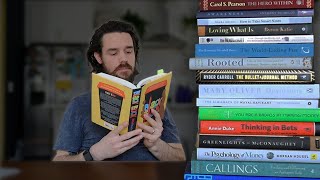
Matt Ragland shares one core lesson from each of 22 books he read last year, covering goal-tracking, courage, creative writing, habit formation, money psychology, and more. He pulls a passage from each book and ties the insights to his own productivity system.
Chapters
Hey everyone, a slightly different look for the video today. I'm going to be walking you through all 22 of these books. These are my 22 book recommendations for 2022. They cover topics like communication at home and in the workplace, thinking in mathematical models, callings, finding and following an authentic life, money, money mindset, decision-making, novels, poetry, it's all here. I'm going to get into this video really quickly because I'm going to give you a lesson or passage for every one of these books. And even if I only spent a minute on each book, well, you can do the math. This is already looking like a pretty long video, but I wanted to go through each of these and give you some specific takeaway. I encourage you to check out all of them. But if you hear something in this video that inspires you or intrigues you, definitely check out these books. I've read all of them and they are 100% worth your time and attention. Before we jump into these books, I just want to let you know that Monday, January 10th is the last day to sign up for the Productivity Power-Up, which is my 4-week live productivity course that will help you assemble your own personal productivity kit. Going into the new year. So we've talked about this concept of the productivity flywheel. We've talked about goal setting. We've talked about task manager. We've talked about time management, all those different things on this channel. What the power-up gives you the ability to do is combine all of those into a system that works best for your work and for your lifestyle. You get to work with me directly, and there's a community of 30+ people and growing who are joining us for this live cohort. So I'd love to have you be a part of it as well. Just go to productivitypowerup.com and you will learn everything you need to know in order to join us in this new round. If you have any questions about it, please let me know in the comments and I will get back to you as soon as possible because we're starting soon and I'd love to have you be a part of it. So without further ado, we'll start from the top of the stack with the Lion Tracker's Guide to Life and go all the way down to the bottom of the stack, though no less important. With Radical Candor by Kim Scott. Let's go ahead and get into it. The first book I recommend is The Lion Tracker's Guide to Life by Boyd Varty. And this passage is page 48, and it's about finding the first track. Now he's obviously talking about tracking lions, but if we're talking about tracking our goals, our desires, the things that we want to do, I still find this metaphor really really helpful. In my own life, I have often struggled with the first track. Full of grand visions and the desire to do something great, I often couldn't find the first small beginning and then the next small beginning. I couldn't dial huge possibilities into small practical actions. I couldn't trust that doing enough was what would need to be done today would, with time, render a path and an outcome that could be great. I had to learn to be in the process of transformation, not trying to be transformed. You can't skip past creating to the creation. Book 2, Courage Is Calling. Canaan calls these my lion books. Courage Is Calling by Ryan Holiday. And what I want to share with you is this passage on page 57, a small mini chapter, as everything is in this very readable. Don't fear decisions. Dean Acheson, who was Undersecretary of State under George Marshall, Secretary of State for Harry Truman, advised Kennedy and Johnson, and he went on to say, at the top there are no easy choices. All are between evils, the consequences of which are hard to judge. What cowardice fears most of all, Søren Kierkegaard says, is the making of a resolution, for resolution instantly dissipates the mist. Holiday goes on to say that what we most often fear is consequences. So we keep deliberating, hoping we can put off consequences. If you think to yourself, you can't lose if you don't choose, of course you can. You lose the moment, you lose momentum, you lose the ability to look yourself in the mirror. Courage is Calling. Book number 3, Bird by Bird, Anne Lamott. One of the best books for writers and creators. And the best chapter in this is Shitty First Drafts, which starts on page 21. People tend to look at successful writers, writers who are getting their books published and maybe even doing financially well, and think that they sit down at their desks every morning feeling like a million dollars, feeling great about who they are and how much talent they have and what a great story they have to tell. That they take in a few deep breaths, push back their sleeves, roll their necks a few times to get all the creaks out. And dive in, typing fully formed passages as fast as a court reporter. But this is just the fantasy of the uninitiated. I know some very great writers, writers who you love, who write beautifully, that have made a great deal of money, and not one of them sits down routinely feeling wildly enthusiastic and confident. So if you feel bad or not confident about writing your shitty first draft, just know You're in good company. So get off your ass and do it. Or get, you know, on, onto the ass and do it. The Hero Within, Carol Pearson. I've been very much inspired by the hero's journey first described by Joseph Campbell, but this is a more modern description of it. And this is really early on, coming in hot on page 6. Many people put off their journeys expecting to be cared for. But in the contemporary world, this desire is thwarted. Most of us would like to count on being safe, but the world has a way of throwing us out of the secure nest. The result is we learn to fly or fall to the ground to try again. When the hu— when the heroic journey was thought to be for special people only, the rest of us just found a secure niche and stayed there. Now we have no secure places in which to hide and be safe. In the contemporary world, If we do not choose to step out on our quest, it will come to get us. We are being thrust on the journey. Hero Within. There's so many things that I would like to say about each of these books, and maybe I'll do a deeper dive on some of them, but all I can do for you right now is recommend them and read a little bit to you and hope that some of it really resonates with you. This is Awareness. Anthony De Mello. Page 73, the chapter on labels. The important thing is not to know who I is or what I is. You'll never succeed. There are no words for it. Drop your theories. Don't seek the truth. Truth isn't something you search for. If you stop being opinionated, you would know. If you drop your labels, you would know. What do I mean by labels? Every label you can conceive of, except perhaps that of human being. I am a human being. Fair enough. Doesn't say very much. When you say, I am successful, that's crazy. Success is not part of the I. Success is something that comes and goes. It could be here today and gone tomorrow. That's not I. When you said I was a success, you were in error. You were plunged into darkness. You identified yourself with success. The same thing when you said, I'm a failure, a lawyer, a businessman. You know what's going to happen if you identify yourself with these things. You're going to cling to them. You're going to be worried that they may fall apart. And that's where your suffering comes in. When your illusions clash with reality, when your falsehoods clash with truth, then you have suffering. Awareness. Anthony DeMello. Shout out to Jeff Goins for giving me that book. I think that's actually his copy. How to Take Smart Notes by Zonka Ahrens. My favorite part in this rather academic book is on page 65 in the chapter Become an expert instead of a planner. Experts rely on embodied experience, which enables them to reach the state of virtuosity. There's no universal rule that could tell one upfront at which stage it would make sense to follow up on an idea, a possible contradiction, or a footnote. To be able to become an expert, we need the freedom to make our own decisions and all the necessary mistakes that help us learn. Like bicycling, it can only be learned by doing it. All the advice in the world is keeping you from learning the very thing academia And writing is all about gaining insight and making it public. How to Take Smart Notes. Bang. Loving What Is. This is a very deep book that has really helped me along with Self-Compassion. That would be like bonus number 23. I just did this list before I started reading Self-Compassion. But the whole basis of Byron Katie's The Work are these 4 questions. And these questions are things that when you have a thought in your mind that is really messing with you, ask these 4 questions. Is it true? Number 2, can you absolutely know that it's true? How do you react? What happens when you believe that thought? That's number 3. And then number 4, who would you be without the thought? There's a lot to unpack here. I recommend probably going to her website and learning more about these 4 questions, but anytime I I think something that I'm really struggling with or something that I'm choosing to believe, even subconsciously, asking those 4 questions. Is it true? Is it really true? Because oftentimes, like, I can't know that it's true. I'm assuming that it's true. And number 3, how do you react? What happens when you believe that thought? Normally I feel bad. And then who would I be without the thought? I would usually be happy. Those 4 questions, loving what is. The Work, Byron Katie. The War of Art, Steven Pressfield. One, just super easy to read, very challenging. Break through the blocks and win your inner creative battles. But it's about so much more than just creative battles. It's about anything that you feel stuck on, that you feel resistance for. This passage is about resistance and procrastination. Procrastination is the most common manifestation of resistance because it's the easiest to rationalize. We don't tell ourselves, I'm never going to write my symphony, or fill in the blank for whatever you're going to do. Instead, we say, I'm going to write my symphony. I'm just going to start tomorrow. The whole book is chock full of lessons like that. A professional acts in the face of fear. The amateur believes he must first overcome his fear, then he can do his work. The professional knows that fear can never be overcome. He knows there is no such thing as a fearless warrior or a dread-free artist. Mm, get some. The War of Art. The World-Ending Fire by Wendell Berry, an essayist and poet in Kentucky. And a shout out to my Uncle Dan Davis for turning me on to Wendell Berry many, many years ago. And this essay is called Why I Am Not Going to Buy a Computer. It was written in 1987. Get this. There's some great reasons behind this, but he, like, writes with a pencil and maybe a typewriter. To make myself as plain as I can, I should give my standards for technological innovation in my own work. They are as follows. Number 1, the new tool should be cheaper than the one it replaces. Number 2, it should be at least as small in scale as the one it replaces. Keeping in mind, he writes with a pencil and paper. Number 3, it should be able to do work that is clearly and demonstrably better than the one it replaces. It should use less energy than the one it replaces. That's number 4. Number 5, if possible, it should use some form of solar energy, including that of the body. Number 6, it should be repairable by a person of ordinary intelligence, provided that he or she has the necessary tools. Number 7, it should be purchasable and repairable as near to the home as possible. It should come, number 8, it should come from a small privately owned shop or store that will take it back for maintenance and repair. Number 9, it should not replace or disrupt anything good that already exists, and this includes family and community relationships. He goes on to say that I disbelieve and therefore strongly resent the assertion that I or anybody else could write better or more easily with a computer than with a pencil. I do not see why I should be sympathetic when somebody has used a computer to write work that is demonstrably better than Dante's. And when this better is demonstrably attributable to the use of a computer, then I will speak of computers with a more respectful tone of voice, though I still will not buy one. I love Wendell Berry. This is Rooted by Leanda Lynn Haupt, and it's life at the crossroads of science, nature, and spirit. I love all of those things: science, nature, and spirit. This is page 63 and the chapter Wander. Wanderlust. Ever unrequited. Who has the means? Money is not required, nor equipment of any kind. The necessary means here are more rare. A spaciousness of mind, an expansiveness of time, an unhurried pace. It's a circular problem, to be sure. In Wanderlust, Rebecca Solnit writes of her suspicion that the mind, like the feet, works at about 3 miles an hour. If this is so, then modern life is moving faster than the speed of thought or of thoughtfulness. Wandering tilts us out of our everyday measure of chronological time into the eternal spirit of Kairos, sacred time. Footsteps are decommodified in wandering. We remove our Fitbits as we take off our shoes to enter a sacred river, for that is what we are doing, stepping into the place where the wild earth meets our wild minds. It's a dangerous business, Frodo, going out your door. You step onto the road, and if you don't keep your feet, there's no telling where you might be swept off to. Wandering, we are feral. We have escaped. Anything can happen. Ominous things. Luminous things. 1, 2, 3, 4, 5, 6, 7, 8, 9, 10, 11. Wait, okay, definitely, maybe gotta speed it up a little bit. This is The Bullet Journal Method by Ryder Carroll. I've done a lot on this book. Definitely check out the full review. This is page 226, Practicing Imperfections. Are you the type of person who strives to have a perfect notebook? Maybe you don't have great handwriting or you lack the artistic ability to make your notebook pretty. Does that matter? Only if you want it to. You could look at your notebook as the evidence of your imperfections, or you could look at it as a testament to your courage. Those crooked lines and rough letters paint a picture of someone striving to learn and make positive change in their life. It may not be perfect, but it's unquestionably beautiful. For all you folks that think the BuJo has to be pretty. Ryder Carroll, The Bullet Journal. The Bullet Journal Guy says nay nay. This one's easy. This is Devotions by Mary Oliver. So I'm just gonna read y'all a poem. Why I Wake Early. Hello sun in my face. Hello you who make the morning and spread it over the fields and into the faces of the tulips and the nodding morning glories and even into the windows of even the miserable and the crotchety. Best preacher that ever was, dear star that just happens to be where you are in the universe, to keep us from ever darkness, to ease us with warm touching, to hold us in the great hands of light, good morning, good morning, good morning. Watch now how I start the day in happiness and kindness. God bless Mary Oliver. The Almanac of Naval Ravikant. Edited and curated by Eric Jorgensen. This is page 95 in the chapter Building Judgment. Real knowledge is intrinsic and it's built from the ground up. To use a math example, you can't understand trigonometry without understanding arithmetic and geometry. Basically, if someone is using a lot of fancy words and big concepts, they probably don't know what they are talking about. I think the smartest people can explain things to a child. If you can't explain it to a child, then you don't know it. It's a common saying, and it's very true. Richard Feynman explains mathematics in 3 pages. He starts from the number line, counting, and then goes all the way up to precalculus. He just builds it up through an unbroken chain of logic. He doesn't rely on definitions. Almanac. Jen Sincero, you are a badass at making money. I still don't really consider myself a badass at making money, and I definitely didn't grow up with the thought that people who were good at making money were necessarily great people. There's a lot of stuff in this book, and this is on page 70, that really have me rethink my relationship with money. Money is a renewable resource. It comes and goes, it ebbs and flows, it's meant to move. When we're cheap about spending it or weird about receiving it, we block its natural force. We put ourselves in a place of lack instead of abundance. That's all coming from an energy of abundance and a healthy, happy appreciation for money. What you focus on, you create more of. And so if the plan is to get rich, you're going to want to focus on abundance as much as you can. There's a lot to unpack there. I wouldn't say I agree with absolutely everything in this book, but for someone who— not to spend time breaking this down— definitely grew up with a lack mindset, when it came to money, this was really helpful. Thinking in Bets, Annie Duke. Great book. One of the world's best poker players and likely the most accomplished female poker player. It's about thinking in bets, but also decision-making. From page 28, what good poker players and good decision-makers have in common is their comfort with the world being an uncertain and unpredictable place. They understand that they can almost never know exactly how something will turn out. They embrace that uncertainty, and instead of focusing on being sure, they try to figure out how unsure they are, making their best guess at the chances that a different outcome will occur. The accuracy of these guesses will depend on how much information they have and how experienced they are at making such guesses. This is part of the basis of all bets. I did a podcast episode on this book. It's 7 minutes long, but you can imagine 22 books. If I spent 5, even 5 minutes breaking down each one, that is nearly a 2-hour podcast episode. So I have talked more about this one though. Check it out. Link in the description, show notes. Black Buck, maybe the only novel in this list as I'm thinking about it, by Mateo Askaripour. I believe I'm pronouncing that properly. Such a good book. I will say lots of language in this. It's a great audiobook as well, but not something to be listened to with the kiddos in the car. It's about selling. It's about startups. It's about personal development. It's about so much. It's, it's a really fantastic novel. This is the main character, Darren. My session with Eddie was the day's silver lining. I learned that no one's going to stay on the line with someone as interesting as C-SPAN. And that what and how you pitch depends on who you're pitching to. And the point of speaking with someone is to have a conversation, not conduct an interrogation. But best of all, I learned how to have fun on the phone. This is where Darren kind of pulls back from the page and speaks directly to the reader. Reader, all of that is critical advice. No one is going to listen to someone who sounds like they'd rather be doing something else. When you're trying to convince someone of anything, you need to tailor your message to the person you're speaking with so it resonates as powerfully as possible. Black Buck. Greenlights by Matthew McConaughey. Don't call him Matt if you ever get the chance to talk to him. Matthew McConaughey. And there's not really a particular passage that I can read to. I will say that this chapter, Be Brave, Take the Hill, and pages 257, 258. This has been something that I've thought about a lot because Matthew McConaughey took a step away from being Mr. Rom-com guy and basically didn't work in movies for like 2 years. And this was because he wanted something different than the type, literal type he had been cast for. And he was willing to wait it out and he was willing to take the risk. He was willing to be brave in the face of uncertainty because people thought of him a diff— a specific way. And even though it's easy to think, well, you're a movie star and you've got plenty of money. You can wait it out. So many people never wait it out. And we all have these things that we could do in our own, like, scale that take courage to do. And that whole chapter is really, really powerful. Those two chapters, I think it's Turn the Page and Be Brave, Take the Hill. It's just about his, the story within the story of him shifting from rom-coms to stuff like Dallas Buyers Club. All the books just fell. That's all right. 5 books left, everybody. We're doing great. Drinking my tea. Shout out to Highgarden in Nashville. Technically in Jolton, I guess. The Psychology of Money. Again, the way that I thought about money for a long time was kind of broken. And so this has been really helpful for me to rethink The way that I think about the psychology of money and what I believe about it. And this is on page 41. And these two things in the chapter, Never Enough. The hardest financial skill is getting the goalpost to stop moving. And it's one of the most important. If expectations rise with results, there is no logic in striving for more because you'll feel the same after putting in the extra effort. It gets dangerous when the taste of having more, more money, more prestige, more power increases ambition faster than satisfaction. In that case, one step forward pushes the goalpost two steps ahead. You feel as if you're falling behind, and the only way to catch up is to take greater and greater amounts of risk. It goes on to also talk about social comparison and how it basically— you'd rather make— you'd rather make $50,000 and be the richest guy on your street than make $150,000, but be the poorest person on your street. That is real. And even if it's hard to remember, at least I have a mental model for remembering those things because there are, there have, like the goalposts moving is a very real thing for me. It's something that I've tried to be more mindful of. Callings by Greg Lavoie. This was a book I read. In 2020 when I was deciding to go out on my own. And one of the things in here, this is on page 56, this confusion or this conversation between the head and the heart. This is very common for me. This is the head talking. Have you taken a look at our savings account lately? That thing's all skin and bones, and that's with a regular paycheck. It couldn't possibly support your shaky new venture. Hold your horses. Don't listen to the drama queen. The heart. Aren't you just a few years from pension? Of course I'm not a few years from pension, but a few years from, say, getting all the equity I possibly could at the companies I was at. The heart. I want out. I want some of the creativity I left back in college. I want to live in California by the sea. I want to be my own boss. I want to do the brave thing, do something for love. Where would the world be if all the heroes just followed the bottom line? Going back to the author now. We need to learn to allow the tensions between the head and the heart to hammer out a compromise, a promise together. Perhaps you tighten the budget and work for another year to build up the money to leave sooner. You move to a city in California where business opportunities are good. You take the company you work for as your first client. You come up with Plan B. You surround yourself with people who are working on dreams of their own. In other words, you encourage the head and the heart to meet at the bargaining table. Not to retreat to their respective camps. Thinking Better. This actually reminds me a lot of Thinking in Bets. The art of the shortcut in math and life. I'm not a big math person. And so this is one of the reasons that I wanted to read this book and full disclosure, I'm not fully done with it. But I will say that from the beginning, something that really jumped out to me and made me want to read this is I'm going to dive in and share with you some of the most potent shortcuts that humans have ever discovered. It is the power of spotting a pattern. The ability of the human mind to glean a pattern in the chaos around us has provided our species with the most amazing shortcut: knowing the future before it comes the present. If you can spot a pattern in data describing the past and the present, then by extending that pattern further, you have the chance to know the future. No need to wait. The power of the pattern is, for me, the heart of mathematics and its most effective shortcut. Goes on to list a bunch of different shortcuts like The diagram, the geometric, the language, the calculated, the data, the calculus, the network shortcuts, probability. Uh, I've really enjoyed it. And even though it has lots of mathematical charts and descriptions in here, I still found it really readable and definitely recommend it. Atomic Habits, another book I've done a full review on and definitely recommend, should check it out. The, the Clear Journal from Baron Fig is also worth using as well, a worthy companion. Instead of reading a particular passage in this book, the one part of a lot of James' work that has stood out to me, helped me understand the impact of habits, was the impact of environment on those habits. So in Chapter 9, he talks about the role of family and friends in shaping your habits. He talks about how if you have things in your line of sight to improve your good habits and remove the temptation of bad habits, like if you don't want to eat unhealthy food, just don't buy it. And that sounds a little easier said than done, but if you don't have ice cream in the freezer, you're obviously not going to eat ice cream at 10 PM. By the same token, if I wanted to have more of a journaling habit, Then instead of having my phone be on the counter first thing in the morning to look at, put my journal there instead. I'm changing the environment. And that's one of the things in Atomic Habits that I've really liked and has been the most helpful for me in this super helpful book. The 22nd of 22 books that I recommend for 2022 is Radical Candor by Kim Scott, one of the most accomplished people in startups and tech, worked at Google and Apple and has this really wonderful perspective on how to communicate with others using this concept, this term that she calls radical candor. And I really like the term candor. I first, like having a candid conversation because it doesn't mean being aggressively honest to where you might hurt people. This is pretty early on at page 22. I'll show you this, but it's this ability to be in the upper right quadrant here. Where you both care personally for the individual and you're challenging them directly. And so it's a really good, in a diagram quadrant-based approach to how we think about the ways that we communicate. And even though it's geared towards communication in the workplace, they said we read this at ConvertKit, it also is something that I've used in many of my personal relationships as well. Gonna be careful here or I'll just fall over. Okay, so here they all are, all 22 books that I recommend for 2022. They're all excellent. I hope that you found one or two, a few, several that piqued your interest and you go down the rabbit hole. Every book is listed below in the description in the show notes. So I encourage you to check them out. Honestly, I'm pretty talked out at this point. So I'm going to go ahead and end the video. If you are watching towards the end, shout out to you for checking out all of these and listening to one of my longer videos, but I really appreciate you. Thanks for checking this out and I'll be back with more videos in the very near future. All right. Thanks so much. See you next time. Bye.
More from Matt









Journal reading 📖 Reflectjons on how I’m living & how it aligns with the vision I have for my life.

You don’t have to listen to me. But you do have to be intentional about the systems in your life.
