Migrating Bullet Journal Data to Airtable: Time Tracking & The Quantified Self
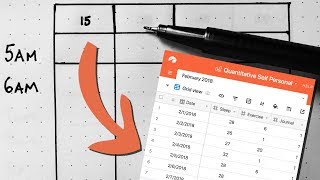
Matt Ragland walks through moving his bullet journal time tracking into Airtable using 15-minute blocks across eight categories like sleep, exercise, and work. He shows how to calculate daily averages, rate days with stars, and attach images and notes. He offers his template and a 5-day time-tracking challenge for viewers.
Chapters
Hey everyone, my name is Matt, and welcome back to another Bullet Journal productivity video. In this episode, I'm going to be showing you how to take your time tracking to the next level with a spreadsheet. That's right, super nerdy thing. Gonna be showing you a spreadsheet where I'm quantifying and tracking all of those things that I have in my manual, you know, time tracking notebook. You're going to be seeing like how much time I spent on sleep, side hustles, with my family, with my wife, on random miscellaneous things throughout the month of February. I'm going to show you how I put all that together, where everything goes. I'm using just a simple spreadsheet tool called Airtable. I'm going to link directly to the sheet in the description below. So if you want to check that out and sign up, it's totally free., and you'll be able to see how I'm putting all of this together. So a lot of you have been asking me over the last few episodes, like, what are you doing with all of this information? And I'm gonna show you exactly how I'm taking it from the page into the cloud and quantifying it over a long period of time. So I'm one month in. I wanna show you how I'm doing this so that you can hop on and start doing it for yourself too. All right, here we go. This is called Airtable. It's a great tool that I've been using, and I'll show you why I think it's a little bit better than just a regular spreadsheet, even though you could totally use a Google Sheet Excel spreadsheet, anything will work. I'm going to show you why I like Airtable specifically for this. The numbers that you're going to see here are very normal. What you're also going to see that I really like are these ratings that I can do with the stars on the side, and then I can also like attach images and pictures. So you'll see those down on the right, and I can also like elaborate on the day rating as well. So it's a little bit of like, you even, like, micro-journaling, along with the really distinct, like, just raw numbers of the data. And, again, I'm taking that from the time tracking that I've done that a lot of you have, that a lot of you have already seen in my videos, whether it's, you know, with this Field Notes, or just random little cards, or like I'm doing right now inside of the primary Bullet Journal. So, Let's take a look at this. I just want to explain it. I just want to explain it to you real quick. But what I'm doing, let me just go ahead and maybe, maybe that's a little too much zoom in. So these are my kind of the primary ways that I've blocked out or gridded out, scheduled my time. And so of course there's sleep, exercise, journaling, reading, time with my wife, time with family. That's a little too much zoom in. Friends kind of goes in there as well. They're like family to me. They're just wonderful people. And so I want to spend time with them. They're like family., and then time I'm eating or preparing food, time on the side hustle, and then miscellaneous. And you can see I have a little help text here, whether it's watching shows or movies, social media, and the reason that I put this here is this is the first place I go when I'm hunting for time. Like, if I want to find this, I'm thinking like, where can I grab an extra like 1 or 2 blocks out of the day? Go to miscellaneous, that's where you're gonna find it. And then the work numbers as well. So, if you haven't seen the time tracking videos, check those out. They're going to be linked in cards up here or here. I think it's here and in the description below. Check those out if you haven't seen those yet, because it's going to make a lot of this make a lot more sense. But remember, in every hour there's 4 15-minute blocks. Somebody in the comments tried to tell me that I did bad math. I'm not saying that I'm fantastic at math, but I did this math. And so if I sleep 7 hours, okay, that's 28 blocks. All right, so you can see that right here. Sleep, 28, but 28 blocks, that's 7 hours sleeping. So let's scroll down here and see that on average I slept 7 hours and 15 minutes during the month of February. I can also see right here, now this is going to be a little skewed, I'll explain it in a second, but on exercise I averaged 6 blocks of exercise per day. So an hour and a half. Now that can also include a little bit of time getting to and from the gym itself. So that could be, that could be something that's, that's added in. Now the gym's only like maybe 10 minutes away, so it's not a lot of time. The reason is you'll see that I've got this block right here, 20, 20 blocks, 12 blocks, 22 blocks. I was training for a marathon and so I had some big run days where I was out there for like 4 or 5 hours at a time. So that's why on average 6. It'll be interesting to see in March and I'll show you a little bit more of March in just a second. It'll be interesting to see in March when I'm on a more consistent, like, you you know, just every like 4 or 5 days a week instead of like, and none of these like huge chunks of time. You can see on average I spent 30-ish minutes journaling each day. And so it was probably a little bit lower than that. But again, if you went through the 5-Day Time Tracking Challenge, which you should check out up here or in the description below, then you'll know that it's a very rough measurement of time. So if maybe it's something I spent 20 minutes doing, I'll just go ahead and say 2 blocks for that. Okay, so you can see here, and there were a couple of days like this one here and here, I was catching up on some days where I didn't do as much, like maybe just jotted down a couple of things. Reading slash meditating, it's really more, it's really more reading though. I did meditate, meditate today, and that felt really nice. Morgan, that's my wife. Different than spending time with family, I want to make sure that I'm spending specific time with her every single day. And so you can see on average we spend about 30 minutes together. Maybe that's just talking, maybe it's, you know, having We're just reading together sometimes in the morning. A lot of time it's just chatting, so, or helping her, helping her with what she's doing online, different things like that. This was a date night. We only had one date night, which kind of sucked. So you get the picture here for all of these different grids. So this is how I block everything out. One other thing to bring up is right here in this side hustle one. You can see that I had some bigger, I had some bigger blocks here and there, but on average I spend 45 minutes a day 3 blocks working on my side hustle, and that makes a big difference. You know, just those little, little chunks of time. And then you can see that I also spent, um, and I'll see if I can explain this a little bit better, uh, an hour and a half a day on miscellaneous. So that could be a bunch of different things. That could be like cleaning, that's where I put like the shower. And so like some of that's always going to exist, uh, but it's also, that's where I throw like TV watching. And maybe watching TV needs to have its own block so I can know absolutely like that's absolutely where I could go steal some hours to exercise more or to work on my side hustle, whatever it might be. Or, you know, any— literally anything else is probably like better than watching TV if it's something that I care about more than watching TV, which is a lot of things. And then of course work right down here. So let me explain this. So this shows that I worked an average of 6 hours and 30 minutes per day. That includes weekends and everything. Let me explain that for a second. There were, because you can see that there are a bunch of days that have zeros. Okay, there's 3 straight right here. What really threw it off are these 5, 6 days right here. This was when we were on our ConvertKit team retreat. And so I just kind of threw in, it was really tough to track on those days. So I just threw in what was basically 10 hours a day of work. Now some of that wasn't work work, but just time, scheduled time with the team. And so that kind of threw off my numbers for everything else. So these are my total, my 96 total blocks. They're all in there. They're all accounted for. And then I can see my averages down here. Okay. I have a 1 to 5 star rating for the day. And I'm normally a very even keel, like lean on the happy side kind of person. And so what I did try and do, so you might look at this and think, well, oh, Matt just had a bunch of average days, 3 stars. I do want to like really make sure that days that feel like they're 4 and 5 star days really come across as special days. So just because I'm positive and I like think of things and, you know, I'm a very optimistic person, I don't want it to be like I have like these normal 4 and 5 star days and then when I really have an exceptional day I'm like, what do I do with that day? And so that's why like even to me like 3 stars is still like a good day. I didn't have any 1-star days, ones that I was really like kind of bent out of shape or, you know, stressed or tired or whatever. Some of these 2-star days, they weren't even like really bad days, but just maybe I wasn't as happy. And like these right here, like I had some great days during the retreat, but you know, like they were just really good days. And so I didn't, I didn't put those as 4 or 5-star. I could maybe— let's go ahead, this, this first, this first full day right here. That was a nice day. So let's go ahead and make that a 4-star day. Nice work. You can see this one right here. First day climbing in a while, new video up. So just a little, a little note. Date night at Butchertown Hall. Just something to remind me about that day. And then something that I really like is the ability to attach these images in here. So you can see that I attach an image. This was just a thumbnail from the video that I put up that day. And the other thing that I really like So right here I can expand this entire record inside of Airtable. So let me go ahead and click on that. But I can see right here everything about that day. So sleep, exercise, I could change any of it, total blocks, day rating. So I could change everything about that day's record just in one, in one view. And then the files right here. Uh, let me come down to this one as well. This is the day I ran the marathon. 22 exercise blocks took me, yeah, about 5.5 hours. I was disappointed. But yeah, it's great to do a marathon in the mountains. I didn't read at all. Spent some time with my wife. We were able to have like a date hour, which was nice. Spent a lot of time with my family. My parents came up to watch, which was— they're awesome people. Shout out to Chuck and Maybeth, great people. And then a little bit of ratings context. Uh, I wrote a lot more— where is it— in this. A lot more here. Uh, so that's why I said like, see notes and journal and pictures. Ran the marathon, wish it was faster. Be content, you are loved. Yeah. Got to remind myself because I was like, why did I run so slow? So this was the trail. Let's go ahead. And this is post-race, the fam, the crew. And this is right before the race. So I was very hopeful. I was very hopeful. And then right here, I was not as hopeful. That's what I really like about Airtable. So I'm going to drop a link into the description where you all can sign up and use your own. I'll have everything laid out here for you. Just got to start plugging in your numbers. Been trying to take a picture every day. No big deal if I don't. You can see over here on February that some days have pictures, some don't. Um, so yeah. Oh, this one right here, let me show you this one. February 13th, these pictures. And sometimes it might just be a screenshot, like this was a run that I did, and this was— oh, this was a great Jocko podcast. I just picked up this Jordan Peterson, his book 12 Rules for Life. Two thumbs up, definitely check it out. That podcast episode, I'll link to it in the show notes, it's fantastic. Just as an aside, but Oh man, got the wheels turning. Okay, that's everything for the spreadsheet. Let's throw it over to me in a more official, like, this kind of perspective. All right. All right everyone, thank you so much for watching this video. Thank you for watching all the videos. Thank you for subscribing, for liking, for commenting. I'm getting so much, like, just personal happiness about seeing you interact with the videos and you're asking great questions. So keep it up. Helping give me more ideas for where, like, I can really build the next and create the next videos that are answering your specific questions. So please keep asking them. The video that I did today, this video came from a couple of people asking really specific questions about, like, what do you do with the time, like, after you've tracked it? Where else does it go? I was like, oh, here's what I'm doing with it. So I wanted to share that with you. So go ahead, sign up for the 5-day time tracking challenge. Sign up and check out the Airtable below in the description. There's gonna be a bunch of other stuff in the description, so definitely check that out. And if you have any questions, please let me know. Ask in the comments. I'm happy to chat with you. I've had some really good, really good email threads and a couple of chats on Instagram and Twitter. So I'm here for you. I want to help. This is the first thing that I've done in a long time online personally where I've thought, tell your— like, really, when I tell you, tell your friends about this, I really mean it because you've shown me that it's something that really matters to you. I know it matters to me. So I I think it can help a lot of people. Please share, subscribe, give it a thumbs up. I almost said rate, rate and review, but that's podcast. Just give it a thumbs up and a comment and make sure you subscribe. Thanks so much everyone. I'll see you next week with another video. Take care. Bye.
More from Matt









Journal reading 📖 Reflectjons on how I’m living & how it aligns with the vision I have for my life.

You don’t have to listen to me. But you do have to be intentional about the systems in your life.
