Minimalist Beginner Friendly Bullet Journal Setup
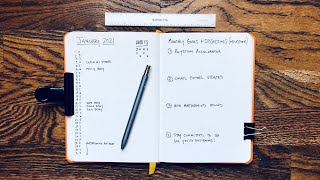
In this December 2020 video, productivity creator Matt Ragland walks beginners through a minimalist approach to starting a Bullet Journal. He first dispels common misconceptions that bullet journaling must be elaborate or time‑consuming, emphasizing that the system can be as simple or as artistic as the user prefers. Ragland then presents five concrete, sequential tips: (1) begin with a daily log that records the date, time‑specific appointments, and bullet‑pointed tasks, using simple symbols (X to mark completion, arrows to migrate tasks, strikethrough for cancellations); (2) add a weekly spread or master task list to capture top weekly goals and migrate the three most important tasks to each day’s log; (3) adopt a minimalist monthly layout—a single column of dates with day initials—to note major events and milestones, keeping the focus on weekly/daily work; (4) incorporate a single habit tracker (e.g., journaling, reading, exercise) into the monthly layout, marking daily completions to build momentum; and (5) practice consistency, starting small with the daily log for two weeks, then expanding to weekly and monthly spreads on a defined schedule, reinforcing confidence through incremental habit building. Throughout, Ragland stresses that consistency breeds confidence and that a minimalist setup prevents overwhelm. He also promotes his upcoming “Connect the Dots” podcast, which explores intersections of productivity, mindfulness, and broader life goals, and encourages viewers to subscribe to his multiple channels and email list.
Chapters
Hi everyone, my name is Matt, and welcome to a new Bullet Journal productivity video. It is getting very close to be the end of 2020 and transitioning into 2021. I know there's a lot of good energy around moving into a new year at any time, but this year feels particularly special. What I'm going to share with you in this video are my top 5 tips for setting up your very first Bullet Journal. Whether you're watching this when it was released, kind of in this new year transition time, or you just found it at any given time of the year, these are really great tips for setting up your very first Bullet Journal as a beginner, because there are a lot of misconceptions about the Bullet Journal, and there are a lot of things that if you watch YouTube videos or see them on Instagram, or you just do a Google search, for bullet journal, bullet journals, it's going to look like you have to have a really fancy bullet journal layout, like it takes a lot of time of your week, of your day, of your month, of your life. And I'm here to tell you that none of that is really true. The bullet journal is as minimalist or as extravagant as you want it to be when it comes to your creativity and your artistic talent. Now, I myself tend to be very minimalist with my in my bullet journal. The fanciest I might get are some like simple icons or stick figures or just doodling in my bullet journal. But it's not some of the very, very beautiful, I might add, very beautiful artistic bullet journal layouts and setups that you're going to see in lots of YouTube videos and Instagram and on Pinterest. So come one, come all, my beginner bullet journal friends, and let me give you my top 5 tips for setting up your first bullet journal in the new year, or really at any time. Let's go. My number 1 tip for a bullet journal beginner is to start with the daily log. Now, you may think that this is too simple. Well, that's good news. It should be too simple at the beginning because, you know, we'll talk about this in a little bit more detail in tip number 5. And spoiler alert is that your consistency creates confidence. And when you are doing this consistently, really any habit consistently, you will build confidence. And so the best way to do that is just to start with the simple daily log in your Bullet Journal. What do I mean by that? All you're going to do is write down the day of the week, the day of the month, and what I like to do is just start listing first the appointments or meetings or any kind of specific time of day agenda items. So I write all those down, and then right below them, I start to make my bullet points of the different tasks that I have for that day. That's really all you have to do to begin with a Bullet Journal. Now, as you go through and you complete tasks for the day, you're just going to X out that bullet. If there's something that you need to do tomorrow, draw an arrow or a, in a right angle bracket, to indicate that the task needs to be done tomorrow. And if it's something that you just realize, hey, I actually don't need to do this, then just strike through it completely and be done with it. So that is the very first tip for starting your first Bullet Journal, for being a Bullet Journal beginner. Just start with the Daily Log. And I would do that for up to 7 to 10 days. Let's just say 2 weeks of consistently putting down the day of the week, the day of the month, any agenda items that you have at specific times, and then the tasks that you have for the day. You can also draw a short little dash in your kind of legend or key for the day to indicate that you're just making a note about something. Maybe it's a task, maybe it's just something that you heard or realized or just thought of during the day. So in, in that sense, you can also use the Bullet Journal kind of like your daily journal, like diary listing as well. My second tip for Bullet Journal beginners is to then move into a weekly spread or a master task list. This is really useful because one of the challenges that a a lot of Bullet Journal beginners have is writing too many tasks down on Monday, and then a bunch get migrated to Tuesday, and then you still don't get through all of them on Tuesday, and so you start to, now you're writing down tasks 3 times, and I totally understand that to our, say, kind of like productive, efficiency-focused brain, you're like, "Man, I'm gonna write down the same thing multiple times." So, what I would do with that is create a master task list for your week. When you do this, what I would focus on now is take the top 3 tasks from your master task list and migrate them into whatever day you're currently looking at. All right, and so those are going to become your top 3 tasks for the day. And if you complete all of them, double thumbs up for you. Now go back to your master task list and grab, you know, just an additional 1 or an additional 2. And just move those into your daily task log or your date— your daily log in the Bullet Journal. So that is something that is going to be really valuable for you, is as you have built consistency with the daily log, start to plan out your week ahead. And whether that is with a master task list or looking at the week ahead and saying, these are the 2 to 3, like, main goals or objectives that I have for the week, and focusing on whatever subtasks that you have related to those goals. So one way or another, start to look at your week from a broader perspective than just the daily log and think about what are the main outcomes and objectives that I have for this week. Create those subtasks, create a master task list, and then start to assign those tasks out by the day depending on either when they need to be done or just when they fit into your top tasks for that specific day. My third tip for bullet journal beginners is after you have mastered the daily log and the weekly spread, you're going to then expand your practice out a little bit more and go to the monthly layout. Now, I keep a very simple minimalist monthly layout, a column of the days of the month with the corresponding first letter of the days of the week right next to it. This way I can quickly see different events or major milestones that I have in my business, in my life, in my work, with my family. So I'll write down things like maybe a birthday is happening, or I'm doing a launch, or this is when I want a new video to come out, and I'm just putting those down on my monthly layout. I keep it really simple and really minimal so that I can focus the majority of my creativity layout logging time on the weekly and daily spreads. For me, I spend probably 80 to 90% of my Bullet Journaling practice on weekly and daily, but it does help for me to zoom out past daily, past weekly, to the month, and kind of take some of the elements that I talked about in the weekly layout or the weekly spread tip and think about from a broader perspective, what do I want to be doing this month? What are my main milestones for the month? What goals and objectives do I have? And what are the deliverables? What are the subtasks that need to get done in order for me to hit each of these milestones or achieve these goals that I have for the month ahead? Now, if you're watching this and you're thinking to yourself, Matt, you're talking about like you know, big picture goal setting now and breaking things down. And I thought this was just about like specific Bullet Journal things. To me, the Bullet Journal is my main productivity lever for making sure that I'm getting the most important work done every day. Now, what I'm going to do is next week you're going to see my 2021 or my annual planning goal setting video come out. So make sure that you're subscribed to this channel so you don't miss this.. And even in the meantime, if you want to kind of get an idea of how I think about goal setting and breaking down goals into tasks that I can do every single day or a couple of times a week to reach those goals and achieve them, check out the description below, and I'm going to link to a couple of videos that I have that will help you get started with this right away. My fourth tip for Bullet Journal beginners is to have something to track. Use the Bullet Journal as a tracker. Because it is a lot of fun and it gives you a nice endorphin boost and you feel really awesome when you're going through your tracker and you're checking off or X-ing off, filling in the blocks of the things that you want to be doing that matter to you every single day or multiple times per week. This is a really exciting feeling to have, and it's one of the most popular things to do with bullet journals is to use them as habit trackers, or it could be like a spending tracker or a savings tracker or a debt payoff tracker. You can use any of those methods as a tracker in your Bullet Journal. Now, I have an entire video about habit trackers in the Bullet Journal, so make sure you check that out in the description below. But what I want you to focus on for— as a beginner is think about just one habit or one thing that you want to track in the new year. Because just like I recommended that you start with the daily log as a way to consistently create confidence in yourself and in your practice. We're going to do the same thing with a new habit that you want to be tracking. Now again, going at this from a minimalist perspective, the easiest way that I have found to do this is to use my monthly layout as a simple habit tracker as well. So you'll see in my monthly layout that all I do is I write down the the first letter of my habit next to the corresponding, like, days of the week— or sorry, days of the month. And what this allows me to do is, at the same time that I'm looking at my month, my monthly layout, I can make little X's below that specific habit. And the 3 that I really try and focus on are daily journaling, reading every day, and then exercising— maybe not every day, but you multiple days of movement per week. And so I'm really trying to shoot for like 60 to 70% completion for the month. And so that's, you know, doing each of those 20 to 25 times. One of the tough things about putting it on the same line in the same page as the monthly layout is it kind of constrains the number of habits you might want to track. And I'm not a big multi-habit tracker myself. I I like to focus on the 2 or 3 to 4 core ones. But if I was tracking a lot and wasn't trying to necessarily like do everything every day, then I could look at and say like, okay, movement, journaling, reading, taking notes, meditating. January 1st, I was able to move, I journaled, I read, I didn't take any notes, but I was able to meditate. So then I can look down, of course, on the 1st, it's a Friday. How did I do for each of these? Now, like I said, there are tons of ways to make really beautiful elaborate habit trackers, and if you want to spend some time doing that, I'd say more power to you. They look awesome, and for a lot of people, it's kind of a way to meditate and just kind of slow down, and I think that is amazing as well. So don't, don't hear me— for those of you thinking that I'm against artistic lovely bullet journals, I'm 100% for them. I just want to help you as a beginner so that you don't think that your Bullet Journal has to be beautiful in order for it to be functional and useful for you in your productivity, in your life, and just for, like, reducing overwhelm. I don't want it to be an additional source of overwhelm for you. I want this to be something that helps free you and focus on the things that really matter to you. My 5th and final tip for Bullet Journal beginners I've touched on a couple of times in the other 4 tips, but it's consistency creates confidence. And the best way to be consistent early on is to start small. Start with the daily. Once you get comfortable and consistent with the daily, you're confident. You're like, yeah, I can kind of do this. I thought I wasn't going to be able to do it. Look at me doing it. Then you kind of expand out a little bit because, you know, you've grown, you've developed, you're more confident, and you can start to say to yourself, okay, let's look at the week ahead.. And once you do that for a couple of weeks, you're like, all right, I'm expanding again. I'm gaining more confidence. Let's look at the month ahead. I would actually recommend that if you're starting this January 1st or January 4th, which is the first Monday of 2021, then just for the first 2 weeks, only focus on your daily log. And then on January 18th, happy birthday, Dad, on January 18th, by the way, On January 18th, now spend the next 2 weeks doing a weekly layout. All right, so think about those master tasks. What are your goals and objectives for the week? And do that for the next 2 weeks. And then in February, on February 1st, which is also wonderfully a Monday, then start to expand out. And let's look at the month ahead. What do I want to do in the month ahead with my goals, with my objectives? What kind of projects do I want to work on? What are some things that I can knock out in the pursuit of larger annual goals that I might have, or quarterly goals, which again, in my, in my goal setting video that's going to come out soon, you can learn more about how to do all of that. So think about how you're going to expand, think about how you can start really small, and go from daily to weekly to monthly, and then you can start to do like quarterly or annual, but you're building up. Too often what I see with Bullet Journal beginners is that you spend a bunch of time on your index, your future log, and like, okay, now I gotta, I gotta do the month. And once I do the month, all right, well, what do I do for the weekly? So before you even get to like day 1, Monday, January 4th, or whatever day 1 is for you as a bullet journalist, then you're like, I've already done like maybe hours of work at this point, and now if I don't fill in each day I feel like I'm wasting space. I feel like I'm not actually very good at this. And too often, sadly, a lot of people stop Bullet Journaling. And this happens a lot with any kind of habit, but I'm going to have another video about that as well. That's why I kind of turn things around a little bit, and I think, what is the simplest start that we can make? It's just going day by day. Just taking it day by day, my friends. So that's what I want you to focus on as a Bullet Journal beginner. Go from daily to weekly to monthly. Have a habit or something else that you want to track on a daily or multi-day basis. A lot of fun to do that. And just remember that consistency creates confidence. So those are my 5 Bullet Journal tips for beginners. I hope that you start a Bullet Journal in 2021. It has been a life-changing habit. Practice for me. It's amazing. You can find links to like all the bullet journal supplies that you would ever want to— well, maybe not. I don't really link to like washi tape and binder clips because that's just not something that I use, but you can, you can find those on Amazon. But thank you so much for watching this video. Another thing that I want to tell you about— I always need to say this before I'm like, thanks for watching the video, because then people are like, bye, you're done. I'm not actually done right now. I am starting a new podcast and it is releasing today. My new podcast, Connect the Dots, launches today, December 21st. I'm so excited to share it with you. Connect the Dots is a show about how ideas and concepts and principles overlap and intersect. And a lot of times we go at this from a productivity perspective. But I also like talking about how mindfulness and habits and routines all fit into the kind of work that we want to do, the kind of people that we want to be, the kind of like families that we want to leave, and the kind of places that we want to work at. How does— how can we connect the dots with all these different parts of our lives to create healthier communities, healthier people, and just a better, a better world? I know that sounds really high-minded, but yeah, that's kind of, that's kind of what I'm excited about. So make sure you check out in the description below links to Connect the Dots podcast. There's also a YouTube channel that you can follow that has all of the clips, best moments from the show. Make sure you subscribe to all of my channels now because now I'm a multi-channel guy. I would love to see you in each of those places. You can sign up to my email list at the bottom as well in the description. Thank you so much for watching this. Thank you for being a part of the channel, whether this is the first video you've ever watched or you've been watching my videos for a really long time. I'm very grateful for, for you and to you as we move from the end of 2020 into 2020, into 2021. I hope you have a great, great transition into the new year. It's going to be a lot of videos coming from me and also podcasts, so make sure you stay tuned in. Thanks so much, everybody. See you in the next video. Bye.
More from Matt









Journal reading 📖 Reflectjons on how I’m living & how it aligns with the vision I have for my life.

You don’t have to listen to me. But you do have to be intentional about the systems in your life.
