Minimalist Bullet Journal Setup for the New Year
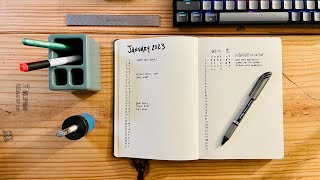
Matt Ragland shows how to set up a minimalist bullet journal using his GAP method (Goals, Actions, Protection) to link weekly goals to daily tasks. Skip the art and decoration. A 30-minute setup with day columns, habit tracker, and mood tracker is enough to stay consistent.
Chapters
Hi, my name is Matt Ragland, and in this video I'm going to show you how to set up your first or next bullet journal for the new year. The most important thing that you need to know about setting up a bullet journal is that it does not have to be an art project. Project. What I'm going to show you in this video is how to create and stay consistent with a simple, effective, minimalist Bullet Journal layout that helps you focus on the work and the habits that matter the most to you. I like to use a minimal monthly layout. I'm talking about days of the month in a column, corresponding days, days of the week in a column, and then like just a row across for like, hey, here's a big event. Like a birthday or a holiday or something that I absolutely have to make sure that I remember for this particular day. Usually these are things that I'm moving into the weekly layout anyway, but that's something that we'll get to. And again, I have a whole video about weekly and monthly layouts that you can do a deep dive on in the description below. On the opposite page of the monthly layout is where I have a similarly simple and minimalist habit tracker. I'm using the same days of the month column and then just a simple like dot or X to indicate that I have done that particular habit for the day. And the 4 that I track, and I don't necessarily try and do them every day, but these are the things I like to track month over month, are journaling, movement, meditation, and reading. So I'm trying to track, am I doing one or multiple of those 4 things every day, every week, but it's just really simple. I can put a mood tracker right to it, right next to it. How am I feeling in the AM or the PM? You know, check, minus, up, down, however you want to use it. And then a highlight of the day. So in my monthly layout, really simple. I'm just doing like, here are the events, here are the days, here are the weeks of those days, here's the habits, here's the mood, and here's a highlight. You don't even have to do all that. You can do like just the monthly layout or just the habit tracker. Keep it really simple. Don't draw anything unless you just love to draw stuff. I love that you love to draw stuff, but if that is not something you're trying to do, you're not trying to make a part of your practice, just make, make your rows and columns and let's move on. In this video, I'm using the official Leuchtturm1917 Bullet Journal Edition 2 Navy Blue. There are 3 quick things that take you less than 30 seconds to flip through when you're first opening your bullet journal, and that is to, of course, put your name. But then mark your intentions, look at the index, and then look at the future log. The reason that I mentioned those 3 things specifically is not because you have to do anything with them right now, but it's because it's something you often hear about in the Bullet Journal, and I'm here to tell you that you don't have to do anything with them right now at the initial setup, okay? I rarely use the index, I rarely end up using the future log. They are conveniently marked in the official Bullet Journal Edition by Leuchtturm,, but I would just move past them at the beginning of this video. The other thing that you'll see on all of my bullet journal videos is that I like to put a bunch of stickers on mine. So that's another thing that you can do to give it a little, give it a little sass, give a little pizzazz, a little personality to your bullet journal layout. And that's about the extent of the decoration that I do in my bullet journal. Now let's move on to the weekly layout and the daily log for for the Bullet Journal. To me, this is the beating heart of the Bullet Journal Method. And if all you do, literally listen to me, all you do is master the Daily Log and the Weekly Layout, you don't even have to do a Monthly Layout, in my opinion, you are well on your way to simple, effective, minimalist productivity using a Bullet Journal. Let me say that again. All you have to do to be an effective bullet journalist is to master the daily log and the weekly layout. Let me tell you why both of those are so important. I use a weekly planning method called GAP, which stands for Goals, Actions, and Protection. That means I define my goals for the week, the actions I need to take to achieve them, then protect my time in the calendar to work on these actions. The GAP method gives me a lot of clarity about what I need to do this specific week to achieve my long-term goals. So when I look at what are my goals for the quarter, for the month, and then I break those down into what can I do this week, next week, then all I have to do is take those action steps for the goal that I have this week and migrate those into the daily log. So the weekly, the weekly layout, this GAP method tracks with my bigger quarterly or annual goals.. And then it connects, it's that connective tissue down to like, here's what I have to do today so that I can achieve the goal that I have for this week so that I can eventually, after stacking all of these winning weeks, achieve the goal that I have set for at the end of the month or the end of the quarter and eventually for the end of the year. Now, if you're not one for weekly planning or you have a different system for planning your goals, I use a quarterly planning system called the QMWD. I talk about that again more in a video that you can see in the description below. At least the thing that I would recommend doing is at the beginning of the week, just make a master task list of everything that is on your mind or like contingencies that you have for the week. And you can rank them by priority or value if you want, or just by the anxiety that they're causing you. And then again, take it from the master task list into like, here's what I'm going to do today. So you're going to migrate the task either from your, uh, GAP Method actions for the week into the Daily Log, or from the Master Task List for the week or the month and into the Daily Log. This may seem repetitive and unnecessary, but it serves an important mental function. Ryder Carroll, the creator of the Bullet Journal Method, had this to say about writing and rewriting tasks over and over: Making that choice over and over again to write and rewrite a task or reminder is the first opportunity to ask, Why am I doing this? The inconvenience can be clarifying. Making a list on a sheet of paper is an unusually rich metaphor for life. It takes effort and the space fills up more quickly than you expect. In my opinion, the simplest way to be productive and successful isn't about who can set the biggest long-term goals, but who can be the most consistent in the long run. The biggest mistake that people make when setting up their first bullet journal is it takes way too much time, and they try and do too much at the beginning. When I was watching Matt D'Avella's Bullet Journal review video, I noticed that he said it took him 4 hours to do his initial setup. All right, so I've finally set up my Bullet Journal. It only took me 4 hours, which feels like a waste of time. So hopefully this works. I don't think I spend 4 hours in my Bullet Journal for an entire month, much less to set it up at the beginning. I don't think this should take you more than 30 minutes, if that. The reason people get stuck taking too much time with their initial Bullet Journal setup is because they're trying to set up too much, like trying to do an entire future log or trying to do grids for every month or every week. You don't have to do that. You especially don't have to do that to be a Bullet Journal practitioner and to get all of the benefits of just mindfully looking at the tasks that you have and moving through them step-by-step, piece-by-piece, task-by-task. So instead of trying to recreate a box grid calendar in your Bullet Journal and using math, you don't have to use math when doing your Bullet Journal layouts. My long-term goal planning framework is called QMWD. And again, there's a longer deep dive video about this in the description below. But what that stands for is that I have the quarterly big goal, I have the monthly milestones, I have weekly deliverables, and then I have daily actions. And it is those weekly deliverables and daily actions that make up the GAP method. So that weekly deliverable becomes the main goal that I have for that week. And then the actions in the GAP method are the daily actions that I take that help me start to stack successful days into winning weeks. And then I hit my monthly milestones and naturally, just by showing up and doing the work specifically and intentionally in my Bullet Journal, of course with other digital tools as well, I am making progress towards the big goal that I want to achieve at the end of the quarter. At this point, you might be thinking, Matt didn't go very far into his Bullet Journal setup, and if you watch other Bullet Journal setup videos, you might be right. My goal is to help you realize that all you really need to do to set up your Bullet Journal is start one month, one week, one day at a time and be consistent. In my opinion, a Bullet Journal is not meant to be an art or scrapbook project, but a log of your work habits and experiences. Now, if you have been Bullet Journaling for a long time and you have a pretty good feel for how you want to do things and you have the experience and knowledge that says like, well, I know I'm going to do this, I'm not going to fall off the wagon. If I do fall off the wagon, I'm going to get right back on that thing. Then by all means, plan out as far as you want. You may not even still be watching this video anymore. Doodle all that you want. To be honest, I think all of the artsy bullet journals look beautiful. They're just not for me, and I often see them as ways that people fail to be consistent and fail to, like, stick with their bullet journal habit, and because they think they have to, like, do all this artsy stuff in order to, like, be successful with it. I'm just here to tell you that that's not the case at all. But if you're new to bullet journaling or looking for a simple, effective, minimalist productivity system that helps you focus on the important tasks and habits in your life, the process I described in this video won't let you down. If any of the topics or concepts that I mentioned in this video sound interesting to you, I encourage you once again to check out the deep dive videos that I share in the description below. Thanks again, happy new year, and let me know what questions you have about your Bullet Journal setup in the comments below. Bye.
More from Matt









Journal reading 📖 Reflectjons on how I’m living & how it aligns with the vision I have for my life.

You don’t have to listen to me. But you do have to be intentional about the systems in your life.
