More Work in Fewer Hours
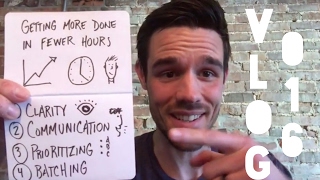
Matt Ragland cut his work week from 48-50 hours to 40-42 while maintaining output using four tactics: clarity on weekly goals, regular communication with his team, prioritizing high-impact tasks early, and batching similar work into time blocks.
Chapters
Everyone, good afternoon. It's almost— it's now afternoon in terms of Eastern Time, but coming to you from Wired Coffee Bar in— I don't know how to pronounce— I'm embarrassed to say I don't know how to pronounce the name of the city. It's Luton. I'm sorry for anyone living here, I'm totally mispronouncing it. It's a great coffee bar and it's a great background and the lighting is fantastic. So one of the things that I wanted to talk about this week— it's been a really good week. We made it down to check Chattanooga, and that was— it's been a good week. It's been on the stressful side because just getting into a new place is always tough. Morgan ended up working 5 days instead of 3, which, you know, is normal for a nurse, for anyone who knows nursing schedules. And so Kanan was in— Kanan was in daycare for 5 days, which he's never done before. And so that was kind of hard on all of us, but, um, it's been a— it's been a good week, and we're feeling much more settled in, and that's really good. What I wanted to talk with you about this week, and one of the reasons that I've been doing all of these videos, is that I want to have a log and a recap of what my, what my weeks have been like. And so I can go back and watch some of this. So if you have been watching this since the beginning, you know that one of the biggest initial pushes for this on my side was seeing all the videos that Kanan had, you know, over the past 20 months now, going back and wanting to watch it, just remembering what that was like and giving me a little context context and more of a framework for thinking through, oh, that's what this was like. And I want to keep having that, not just, not just for him, but for my own work, for what's happening with Morgan and I just in our lives, and having some more— and video's so easy now and, you know, so accessible, and I wanted to be able to continue to record that. But what I wanted to talk about today in terms of work is how this week I was able to get more done working less hours. Okay, and I was talking this, talking about this with my manager at Newbill. Holla to him yesterday because we were both saying the same thing, like we're both gonna work not a ton less, but we're gonna work, you know, much less for Newbill. But like I'm gonna go from maybe like 48, you know, 50 hours to like 40, 42 this week. So, but I'm— I feel like I'm getting a lot more done. And there are a bunch of ways to think about this, and I encourage you to think about how can you structure your time so you're getting the important things done and you're also getting just as much or more done in less time, because it's an interesting thought experiment to try and get more done in less time. What if you really tried to push yourself towards that instead of just thinking, oh well, I think— what's— I'm gonna put it in the description box and, you know, just in the comments. And I don't— because I don't want to miss, you know, say it incorrectly, but there is a study that basically your work will fill the amount of time that you've given it. And so I'm trying to think— I'm trying to think about it in those terms. Like, if I'm only I'm only giving myself, you know, 40, 42 hours a week. How can I get everything done that I had been putting 48 hours into into 42 hours? Okay, and so there's a few things that came up for this with me. And number 1 is clarity. At the beginning of the week, Newbill and I have a meeting, and I have kind of a meeting with myself even right before that where I'm getting really clear about what I want to accomplish this week. What do I want to accomplish with onboarding for ConvertKit? What do I want to accomplish in other tasks? That maybe have been piling up, maybe removing some of those that haven't been as important as they first seemed when I kind of created the idea or the project or the task. So getting really clear about what are the things that we want to get done. All right, the second thing is communication. So communicating not just with, not just with Newbill, but with the rest of the team, and taking a little bit of time each day. And this is something that I've struggled with some in the past of thinking I have a ton of stuff to get done. Why am I gonna spend 30 minutes just writing about all the things that I need to do? I could spend 30 minutes actually doing those things. But what that does is it creates better communication. Other people on the team know what you're doing, and there's less redundant work for the team. And that's really important just from an organizational standpoint. Okay, so communicating clearly with your manager and your other team members, just other people in the company. Just documenting better is a huge thing. All right, number 3. Prioritizing your tasks. And I didn't really have like some, you know, clever format for going through these 4 points, but with the prioritization of tasks, because one of the things that I've been getting better at but is still a work in progress is taking that big picture, big picture project or goal and whittling it down to more actionable weekly tasks, okay? And being okay with making those smaller things like, hey, let's change the wording on this email and test it. Let's send a new email and measure that. Okay, so we did do— we did kind of knock off some bigger picture things this week, which is, you know, which is just good for morale and feeling positive about everything. But prioritizing what tasks are the most important each day, and for me, the more that I can get done on those bigger tasks early on are going to make me feel better about the rest of the work that I have to do for the rest of the day. The other thing is that, and this is a place where, you know, just prioritizing prioritizing time and also how it relates to the rest of the team's workload. So one of the things that I do is I don't do as much like with support email replies during the day. Like I do it in, you know, a couple of batches and chunks, but then most of what I end up doing is either really early or really late. Not really late, but you get what I'm saying. Really early or really late because that's normally where less of the team is involved. And so if we have a big, larger number of people helping out, like during the normal times of the day, then I can help make their job easier by working in email replies early in the day and later in the day. And just creatively, that is a time that, you know, is a better fit for me to do email. So that is another thing, just prioritizing the tasks, not just in the project, but just what you have to do overall for the day. And then the last thing, batching, and that I kind of already went over that, but knowing— not worrying about, not worrying about emails that I have to get done like all throughout the day, but knowing again I'm going to do those in the morning and I'm going to do those in the afternoon. The other thing is that if I have any, if I have any stuff that I'm doing that's just like recording or like data, data entry, matching automations, reviewing, uh, reviewing metrics, a lot of those I'll do in the afternoon because while it does take some creativity, it's not same as like writing an email, doing a workshop, you know, doing, creating a video. Any of those things just require, you know, for me, more creative willpower than like just, you know, going through the spreadsheets. I can, you know, I can put some music on, I can, you know, maybe listen to a podcast, and I'll just keep cranking through those. So now, how do we get— I mean, there's, there's no like super secret here. I'm not saying like this one, you know, this isn't very headline-worthy of like try this one tip and you'll get twice as much done in half the time and your life will be amazing. This isn't one of those videos, but you know, I was able to make, I was able to make progress on the amount of things that I was able to get done in a week while actually working less hours. And it's through these, you know, again, these 4 things of getting clear, communicating with your team, prioritizing the tasks, and batching them together. So So, that's what— let's get this, this is going to be part of the thumbnail. But this right here, this is what did it for me this week. So, thanks for watching this and, you know, post any comments, post any comments you have. Would love to hear them and chat with you about them because it's a cool topic. And again, just the experiment, just the test of if I shaved an hour off of each day, right? If I shaved an hour off of each day, how can I work 1 hour less each day but still get get as much done or more done. Would love to hear what you have to say about that. And have a great weekend. I'll talk to you soon. Bye.
More from Matt









Journal reading 📖 Reflectjons on how I’m living & how it aligns with the vision I have for my life.

You don’t have to listen to me. But you do have to be intentional about the systems in your life.
