My Bullet Journal Setup: A Minimalist Plan for Increasing Productivity
Matt Ragland shows how to build a productivity system around yearly themes like shipping products or improving skills, then break them into quarterly, monthly, weekly, and daily tasks. He uses time-blocking, micro-habits, and concrete examples like learning SQL to show how planning actually works when paired with execution.
Chapters
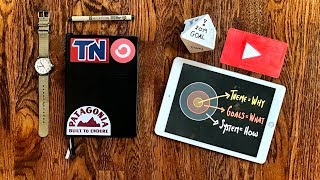
Hi everyone, my name is Matt, and welcome to another Bullet Journal productivity video. This is a big video. This is an important video. I know you're going to love it. This is the 2019 big picture goal-crushing productivity video. This is where everything started for me last year with the 2018 productivity video. If you want to, like, take a walk down memory lane, or you haven't seen it before, it's right up there. So I'm gonna break this into 2 videos. I'll go ahead and tell you that now. The first one, this one, is going to cover your big goals and how to break them down into quarter, month, weekly tasks, projects, different things like that. I'm also going to show you how I align the themes of the year for me with the goals I have, the systems that I set up, and the habits that go along to make all of those things happen. Because one of the things that I'm going to tell you about today, one of the things you're going to see in this video, in the journal, in the way that I'm laying everything out, is that everything has to be in alignment. For you to reach the goals that you have. And the thing that I want to share with you today when it comes to goal setting and achievement is that it's probably even more about the systems and habits that you have set up to achieve those goals than just saying, oh, I want to do this, you know, XYZ thing. Now, the first thing that I want to start with when it comes to productivity planning for 2019 is whatever your theme is going to be. And you can have multiple themes, like whether it's for personal, work, relationships, different things that you have. I normally have 2 to 3 themes for a year,. And the reason that I have this is they're not goals per se, but they're kind of objectives, themes that I have that align my goals, my systems, my structure, my life with the theme that I have. I have 3 themes for this year. The first one is to ship products and ship new things, not just in work, but also on this channel and for this community as well. I've been working on a course that you're going to hear more about really soon. I've also been working on a couple of their eBooks. Membership community that if you're on the email list you know about, and a few other things. And so I want to be disciplined and actually like create more things in 2019. And so a theme of mine is to ship more products and ship new products. Okay, so that theme aligns with goals that I could have, and anytime I'm creating a goal, I'm going to think, does this align with the theme that I have? The second one is that I want to be really mindful of my marriage in 2019. We just had our second child. For me, I really enjoy being a dad. I also really enjoy being married to my wife. The thing is, is that it doesn't take much mindful effort for me to be a good dad. And some of that is just because those of you that have kids, you know that when a kid wants your attention, they will just tell you. And so it's like, it's in your face sometimes very much so. You can't really ignore it. Sometimes with a marriage, it's not quite that straightforward. And so commitment to my marriage. It's doing things like setting up those date nights or doing little things that I know will make my wife happy and let her know that I appreciate her. So that's my second theme. The third one is to become more technically sound in my work at ConvertKit. I have a lot of things down when it comes to people and projects, planning, all of those. I guess they all start with P that I'm good at. The thing that I could use some improvement with is technical proficiency. Learn a technical language like SQL or Python, and then build up a GitHub repository so that I can share some of the things that I'm learning and have more of a public place for that. The reason this matters is when you define a theme, when you name something for the year, it aligns your goals and systems with that theme. And so if you think about this in the idea of Simon Sinek's Golden Circle, the why, the how, and the what. Theme is at the center of everything that you want to do. It's the why, like, this is why this matters to me. And then your goal is what it's going to look like, the thing that you want to accomplish. The outer ring is the how, how it's going to get done. And those are the systems that you create that support the goal that you want to achieve, that aligns with the theme that you have for the year, for your life. Now that we've talked about themes, I want to talk about that next step, which is the goal, that you want to achieve. And the reason that goals and systems play really nicely together is that you can have, you can just state a goal. Anyone can throw a goal out there, like, I want to make this much money, or I want to achieve this thing with my health, or I want to like have a better marriage. Like I said, a commitment to marriage is something that I have. Now, the goal in that would be something like, I want to have a monthly date night with my wife. The theme is a commitment to marriage. The goal is to have a monthly date night, the habit that I need to get into is booking a sitter once a month and making sure that that is set up so that I can achieve the goal of having the monthly date night so that it aligns with my theme of being committed to my marriage in 2019 amongst all the things that are going on. Another way to think about this, let's look at another theme that I have, which is to ship new product. And so a goal that I have is to create this productivity course that a lot of you have already heard about. What I would say for a goal is that in Q1, I want to ship my first productivity course. So that's the goal. Now, what's the system that I create that helps me get to the point of being able to launch that course? Well, the system would be that I need to work a few hours a week on this at specific times, preferably, because then that gets me in the habit. The goal that I have is to create my first productivity course in the first quarter of 2019. How am I going to do that? Well, the goal is one thing that I've just described. The system and the habits are how. Again, remember, with that, with our 3-step circles. The system is how it's actually going to get done. So I know this is going to take like 3 or 4 hours out of the week. I can schedule those in. I already have my quarterly goal, which is to create the course. The next thing that I do is I think about, okay, what needs to be done every month and what needs to be done every week in order to accomplish that. I— you can add days as well, but based on the amount of time that I know that I can give to this, I know I'm probably not going to work on it every day, but there are things that I need to have shipped, or completed every single week in order to build towards the goal at the end of the quarter of shipping that first productivity course. And the first thing would be is if I want to say have 6 to 8 lessons in there, that it's probably going to be best if I complete 3 lessons each month and then have some time to edit. So what do I need to do every single week to reach the goal that I have at the end of the month, which is to complete 3 or 4 lessons? Well, then what I need to do is I need to at least write a really solid draft every single week of each lesson. So you see how I go from This is what I want to do with the quarter, which is to launch a productivity course. This is what I need to do each month, complete 3 or 4 lessons. And so this is what I need to do each week, complete at least 1 lesson in order to get to that month, in order to get to that quarter. And that aligns with the theme that I have of shipping new products. Let's get down to even more nitty-gritty on this. What is the system? What are the habits that I would have in order to accomplish these goals each week, each month, and each quarter. The first thing that I would do is to block off time in my calendar, say on Tuesday, Thursday, and an hour on Saturday and Sunday. So that gives me 4 hours each week to work on these things, and I can work pretty fast at this point. One of the things that I've done is that I've outlined, I have a checklist, I have things that I do. So when I sit down to work, there's not a lot of wasted time. It's just I know which lesson I'm on, I know what the outline is, and I just have to start writing. And I do that for the hour. Let's take it back a step even further and think about what is the habit that I need to have what is, what are a couple of things that I can do in order to get myself into the system so I can do the work every week so that I can achieve the goal every month and then launch the course at the end of the quarter? Well, one thing that I would do if it's writing-specific, something that I do, is I close everything on my computer except for the writing app. Now I use the Bear Notes app and I love it, and so I will just have it open on the screen. I'll close the computer. That way when I'm ready in the morning, I just open it up and there's Bear app, there's the headline. If I've added in a little description or a short outline of what I want to accomplish or the sections that I want to write, it's all right there, and all I have to do is start writing and get to work. There's not— I don't even have to open it because I did that last night. Let me give you one other example because it's something that I talk about a lot, so I want to be mindful of it. A lot of people get into this mindset in the beginning of the year, and that is, I want to be healthier. Either I want to eat better or I want to get in better shape. And that's very important to me. It's a keystone habit for me. I've talked about that in some other videos. What I would do to break this down, to use this same framework, this same system to achieve a fitness goal that I have— let's say it's to run a half marathon or complete a Spartan Race or whatever it might be— I do like having specific events and competitions to tag my goal with because it gives me something very public and very personal to work towards. The way that I train for that is just by having a system that allows me to get in shape. The way to think through this is that you don't— even once you're signed up, you have that goal of like half marathon, Spartan Race, whatever it is— you actually at that point don't worry as much about the final goal, and you put all of your energy into the system and into the habits that are going to help you achieve that goal at the end of the quarter, in the middle of the year, whenever it might be. The way that this would work in real life is let's say you have that race goal.. But the system that you're going to put into place is saying, I'm going to work out 3 days a week. A habit that will help you on this, and it's going to sound silly, but there's a lot of research to back this up. BJ Fogg, who's a professor at Stanford, and James Clear, who you've heard me talk about many times in videos, have all shown this to be true through research studies. Just the process of, say, like setting out your clothes, putting your workout shoes on, that little habit, like a microhabit of saying like, I'm just going to get in the car. Once you are in the car, it's going to feel silly to not go. And maybe you just go, and you're there for like 5 minutes, you're like, "Alright, I'm here, I'm working out." You are just establishing the habit. You're establishing the system that is going to allow you to reach the goal that you have. All I know is that I have to get in the car, and show up, and I'm going to have a great workout, and that's going to help me achieve the physical fitness goals that I have for the year. Now let's talk about how you can use your Bullet Journal to stay mindful of this, to stay on task, to continue to take action, and how to align the things that you're doing every single day and every single week with what you want to achieve over the month, over the quarter, over the year. You've seen this weekly layout from me before, and the way that it's different going into 2019 is I'm asking myself the question, what do I need to be able to do this week to move me closer to my monthly and quarterly goals? And so asking myself that question aligns the outcomes and objectives that I have for the week with what I hope to achieve over the month and over the quarter and, you know, over the year. But mostly I don't— that's why I don't have yearly goals. I have quarterly goals and yearly themes, but we've already talked about that. So what I write down is the objective or outcome that I want to have for the week, something big that I want to do along with the goal or theme that it aligns with for the quarter or for the year. So you can see for the first week of January that one of the things that I want to do is complete 3 modules of SQL training. And that aligns with the theme and with the goal of becoming more technically proficient and learning SQL. Another objective or outcome that I have for the week is to write and hopefully complete the full final draft of the team communications lesson, which aligns with the goal of shipping the productivity course. So you can see how I have the outcome aligned with the theme or goal. And so that's really important. Anytime you're putting something down that you want to achieve, you want to think about which goal, which theme is this aligned with, so I know I'm making progress in everything that I do. Asking ask yourself the question, how does this thing that I say that I want to do, or that is being asked of me, does it align with the goals, with the themes, with the objectives that I have for my week, for my month, for the quarter, for the year? Two others that you can see, one is to complete the GitHub intro material. That also aligns with being more technically proficient. And the last one is just to complete the onboarding playbook. And that isn't so much like a specific objective or goal that I have, but it is something specific for an objective that I have for work. The last thing on this that I want to encourage you on is that we've talked a lot about planning. Like, the whole title of this video is 2019 planning. That's the whole theme of this. But what I want to encourage you on is that for all this planning and all this outlining and all this being mindful of the things that we have to do, there's still a very big thing that you have to do them. You have to take action. All of these ideas are worthless without the execution to make them happen. I think it was Derek Sivers that said, "Ideas are just multiplied by their execution." So you can have a great idea, if you don't do anything with it, then that idea is worthless. Another thing that came out of James Clear's book Atomic Habits is this idea of taking action versus being in motion. And being in motion would be like watching this video, or me like outlining all these things that I did in the Bullet Journal. Doing all this, making this preparation, it is useful. Like, you're gonna get some good ideas out of this. I have a lot of clarity about what I need to do after going through all this. However, you still have to take action. Being in motion, kind of like getting the ball rolling, is not the same as actually doing the thing. So as we close this video out and you get ready for 2019, I want to encourage you in that an ounce of action, a few steps of action, are more worthwhile than all of the perfect planning that you can do, because you still, at one point, you still have to do it. To add on to that, Part 2 of this, which you need to look for in the next week hopefully, is how to take those first small steps. This is an entirely, you know, additional thing that I almost thought about cramming into this video. The next video, that's going to be all about getting started, taking action, taking those first few small steps to like overcome the fear, get started, and be able to take action on the things that matter to you. That's the point. That's the thing that you want to be focusing on. All right, everyone, thank you so much for watching this video. I've been really excited about sharing it with you. This is something that I'm really passionate about, as you can tell. It's something that has made a huge difference in my work, in my life, in my relationships, and my health. And I want to share that with you. If you know someone who would benefit from this video, please share it with them. Another thing that you can do is just give it a thumbs up, subscribe if you're here for the first time, because there's a whole, like, this whole past year, all of 2018, is videos specifically about this. So check out the archives, I don't know, the video, the video list on my channel. You can see that this is the kind of stuff that we talk about. This is what this community is driving towards, and I hope you want to be a part of it, because I think together we can make 2019 be one of the best years that you've ever had in your life. So go ahead and hit like and subscribe. I can't wait to share the next video with you. Again, it's all about getting started, taking those first steps so that you can take action on the things that matter to you in your life. All right everyone, thanks so much again, and I'll see you soon with another video on being productive in 2019. Mm-hmm.
More from Matt









Journal reading 📖 Reflectjons on how I’m living & how it aligns with the vision I have for my life.

You don’t have to listen to me. But you do have to be intentional about the systems in your life.
