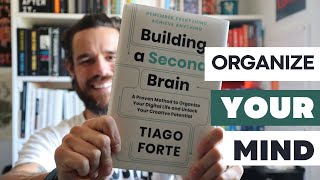
In this YouTube video, Matt Ragland introduces and walks through Tiago Forte’s “Building a Second Brain” methodology, highlighting four foundational concepts that underpin the system. He begins by describing the overall idea of a “second brain” – a digital external repository for personal knowledge – and emphasizes its transformative impact on his own life. The first concept is digital note‑taking, where he discusses tools like Evernote, Notion, and Roam, and explains progressive summarization as a method for repeatedly refining notes to surface the most valuable insights. He then presents the CODE framework (Capture, Organize, Distill, Express), detailing how each stage builds on the previous one, and connects the “Organize” step to the PARA system (Projects, Areas of Responsibility, Resources, Archive). Ragland illustrates how the PARA categories help structure information for both work projects and personal life tasks. Throughout, he stresses that the system is not limited to creative content creation; it also supports everyday tasks such as home repairs or parenting. The video concludes with a giveaway of five copies of the book, instructions for entry via likes, comments, and Twitter shout‑outs, and a call to subscribe and join his newsletter for deeper dives.
Chapters
One of the most transformational concepts that I've been exposed to over the past 5 years is this idea of building a second brain. This book by my friend Tiago Forte is the distillation, is the expression of everything that he's talked about over the past 5 years. And I think 12 or 13 cohorts of his live course of the same name, Building a Second Brain. It is a foundational process for me. And I'm so excited to talk to you about this book because I'm going to walk you through what I believe are the 4 most foundational concepts in the book, but it's absolutely worth buying and going through, highlighting, rereading, talking to your friends about, talking about in the comments below. Now, the foundational concept of this book is to obviously build a second brain. There are 4 other frameworks that you need to know that are sprinkled throughout this book that really form the true foundation of how you actually build a second brain. So I'm gonna take you through those and spend about 1 minute on each one. Look in the description below and also in the chapter markers if you wanna jump around. The first foundation of building a second brain is note-taking. In fact, I would say this is the most important foundational concept in building a second brain. Now, Tiago is really big on taking digital notes. He's been a big Evernote user for a long time. I use more a mix of Notion and Roam, but we're not gonna get into that right now. But basically every, every thought that he has that passes his, like, kind of internal critique past the initial capture, he will then start to develop inside of Evernote through a process number 2 called progressive summarization. So I'm going to bounce back and forth between these two for a moment, but notes are things like highlights. It could just be something that he jots down. It could be like with Evernote's great optical character recognition OCR feature, which is still really good for them. He might take pictures of things. The Web Clipper for Evernote is really great. So basically, the notes that he is taking are being dumped into Evernote, which then he will go through and progressively summarize to take out the most important bits and pieces to use as parts of other notes. So these two foundational concepts in building a second brain are really closely tied in Tiago's process. It's how do I capture notes and what is the progressive summarization of the note, the highlight of the piece of information, even personal unique idea that I have had. I want you to remember that all of these foundational concepts are really closely tied together, and they all work in unison with each other, because the third foundational part of building a second brain is Tiago's CODE system, his CODE framework. Now, that's an acronym. It stands for Capture, Organize, distill, and express. And throughout this process, capture we've already talked about, that's kind of the initial note. The O in organize is something we'll talk about next, which is his paraframework. The D is that progressive summarization, distillation of the note, of the highlight, of the idea that he had. And then the E is for expression, which means that he is going to Express it oftentimes publicly through maybe a blog post, a podcast, a YouTube video. But that expression could also come out in a book proposal. It could also come out in a sales call. It could come out in a webinar. It could come out in some kind of other internal training. I'll admit one of the things I don't talk enough about when it comes to the expression or the communication of ideas and notes is how much use they have outside of the creator economy or creative content. It's true that my notes will often become YouTube videos, podcasts, or newsletters. I think the same is true for Tiago, but I've also noticed that I'm taking notes on how to better grill. I'm taking notes on how to do repairs around the house or things that I need to do with our newest child that is now a part of our lives. And so there is so much use for capturing, critiquing, and then eventually communicating the notes that you have, even it's just for something that you will use for a project or something that you are researching different resources for. That leads me to the fourth foundation of building a second brain, and that is the PARA framework. Now, PARA stands for Projects, Areas of Responsibility— that's just one A— and then Resources, and then finally Archive. I'm only going to spend literally 1 minute on this, but it's a giant concept and something that I spend an entire week on in my own cohort course is like just explaining PARA to people. But projects are things that have a definitive end date. Areas of responsibility are things that are ongoing. Uh, resources are just things that you're learning about, and then archives are things that you're no longer working on. So that is an incredibly short distillation of what PARA is. But if you want to learn more, check out the resources that I have below that will help you learn more about how to use PARA in your own life and work. Those are the 4 foundational concepts of building a second brain: note-taking, progressive summarization, CODE, and PARA. If you learn those 4 elements of building a second brain, you will be well on your way to developing a workflow for how you actually capture, take in, and organize, distill, and express the different ideas and information that you bring in every single day. We live in an age of information overload, and Tiago is the best person that I have come across, not just in developing these frameworks, but in also communicating them, unsurprisingly, in a really clear and easy-to-understand way. So I highly recommend his book, Building a Second Brain. Again, it's been really foundational and transformational for me. The course has— I took it a couple of years ago, and I've been using elements of Building a Second Brain in my own life and work ever since. To celebrate the release of Building a Second Brain, I'm going to give away 5 copies of the book. I will do my best to ship anywhere in the world, but I reserve the right to not if it costs too much money. Sorry. But the way that you enter is by giving this video a like and a comment below, and bonus entry if you also reach out and say that you're entering the giveaway, just something nice about me or the book. Tiago on Twitter. I'm @MattRagland on Twitter, and Tiago is actually @ForteLabs. So that is how you can get in touch with us. That's how you can enter the giveaway. Comment on this YouTube video, like, subscribe, and then also bonus entry if you go on to Twitter and give me a shout out @MattRagland, Tiago @ForteLabs, and link to the video. Okay, regardless, check it out. It is well worth the $20-ish bucks, or whatever it is on Amazon or from your local independent bookseller. Absolutely get it. I'm probably going to do a deeper dive on this in another video or just for the newsletter. You can also sign up for the newsletter below. So thank you so much for watching. Enjoy this book. Let me know what you think and have a great day.