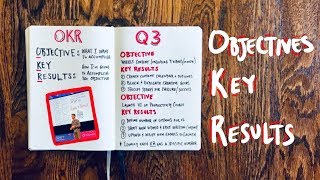
In this solo Bullet Journal productivity video, Matt Ragland introduces Objectives and Key Results (OKRs) as a straightforward, measurable quarterly planning framework. He explains that an Objective defines what you want to achieve, while Key Results specify how you’ll measure progress toward that objective. Matt then shares his personal Q3 2019 OKRs for his creator work: (1) weekly content production, with key results such as creating a content calendar for 12 pieces, blocking creative hours, and defining stakes; and (2) launching version 2 of his productivity course, with key results including defining lesson count, shooting and editing videos, and writing launch emails. He emphasizes the importance of making key results quantifiable, citing John Doerr’s Measure What Matters as a deeper resource. Matt reviews his Q2 performance, noting a job change from ConvertKit to Podia, the impact of that transition on his content output (5 of 8 planned videos completed), and the extensive effort required for his Craft & Commerce talk (≈40 hours vs. the anticipated 15‑20). He reflects on June’s positive personal experiences—family time, health, and creative work—while noting that material purchases did not drive his happiness. He showcases a minimalist bullet‑journal layout used for tracking days, habits, mood, and a one‑line journal, describing how this simple system helped him stay tethered. Finally, Matt encourages viewers to try OKRs, sign up for his weekly newsletter (mattragland.com/thinkers), and stay tuned for updates on his course and membership. He invites comments and questions to shape future content.
Chapters
Hi everyone, my name is Matt, and welcome to another Bullet Journal productivity video. In this episode, we're going to be going over OKRs, which was a greatly requested topic and video coming off the last quarterly review video that I did in April. So, we're coming up on July, it's Q3 of 2019, and so I'm gonna talk to you a little bit about OKRs at the beginning, and that stands for Objectives and Key Results, and how I think they're a really good quarterly planning system for you to set you up for success. And then I'll go over a little bit of my Q2 review and what I want to accomplish in Q3. So this might be a little bit shorter video. I say this at the beginning and I'm never really quite sure, but however long it is, I hope you enjoy it. And let's go ahead, we're gonna start with OKRs. Let's go. So what is an OKR really? We're gonna start there. And really what you're thinking about here, let me go ahead and zoom in, is that the objective is what I want to accomplish, and the key results are how I'm going to accomplish the objective. So it's a very straightforward, logical, measurable way of thinking about what I want to do and how I'm going to do it. Let me show you how this would specifically work and what I'm doing about it for Q3, and then we'll jump into reviewing Q2 a little bit. So how this works in practice is that I have two personal OKRs for the third quarter of 2019. And I say this because I have separate ones for work, but this is for YouTube, written content, everything that I do in terms of like productivity bullet journal content. And so my first objective is weekly content, and that could be a video on YouTube. That could also be a, the weekly email newsletter that many of you get if you want to get that go to mattreiland.com/thinkers. You can find that link in the description as well. So what are the key results? If this is my objective, what I want to accomplish, how do I do that with the key results? And the key results that I would be measuring and checking off, the first one would be to create, create a content calendar and outlines for each piece of content. That would be, say, about 12 pieces of content. And then I need to block and dedicate creative hours in my week. And then this is kind of an optional one, but I think it's really valuable. I can talk more about it. I'll probably talk more about it in the newsletter in the coming weeks. But specify the stakes for failure or success. Second OKR is you may have heard me mention this some in past videos, but I want to launch the second version of my productivity course. I did a really early small group at the beginning of the year. And like you'll see in the Q2 review, I didn't do anything with it then. And so I I really want to revisit this in Q3. So what are the key results for it? Well, I want to define the number of lessons for version 2. I need to shoot new videos for it and edit the written content because I'm changing up the structure of the lessons. And I also need to update and write new emails to launch the content, to launch the course. And you'll see a little note right here that ideally each key result has a specific number or something measurable that you can point to. It could be as simple like yes, no, I completed it or I didn't. Like this one, define number of lessons for V2 or create content calendar and outlines. That just comes down to did I do it or did I not do it? And for creative work like this, it's easy to think about it. Most of these are more like I completed it or I didn't, or I reached instead of 12 pieces of content, I got to 10. And so you can kind of think of it in both of those different ways. Is it a percentage that I'm looking to reach, or is it just a yes/no completion? If you want a little bit more specific reading on it, then there's a great book called Measure What Matters by John Doerr, and he is a venture capitalist who helped Google and a bunch of other places, but most specifically Google, get their productivity and alignment across the company Going with OKRs, a little bit of extra reading if you are interested. So that is a good starting primer for OKRs. Try them out going into the next few months and let me know. We'll revisit this as a community going into Q3, going into Q4. So be ready for that. Now let's take a quick review back through Q2 for me. So let me say this as a preface to my Q2 review, even though we kind of got into it a little bit, it's gonna look pretty messy and unproductive because literally when I shot this video at the end of March going into early April, I had no idea and was not planning on switching jobs. And switching jobs from ConvertKit, which I love, to Podia, which I also love. I'm very fortunate to be able to work into great places with great people on great products with great customers. But I wasn't planning on any of that. It wasn't on my radar at all. And now let's look at Q2. And the thing that I wanted to do, so let's just go through this real quick, is objective number 1, so, and these are my key results, see, doing the same thing. But I wanted to do 8 new videos in Q2, I ended up doing 5. And so that is not quite successful, but it is like a pretty, it's more than half, which I'm pretty pleased with. The part of Q2 that really fell apart completely for me was that I was working on a course and a membership for all of you. And I really, because of the job change, and because of the conference talk, really didn't do anything. So this is just getting migrated, in bullet journal speak, to Q3. And then objective number 3, I wanted to give a world-class talk at Craft and Commerce. And so it went really well. Thank you for all the kind words, well wishes, emails, and DMs that you sent me, wishing me luck and congratulating me afterwards. It went really, really well. All of these things that I wanted to do, I did, and that took me way longer than I expected. I was like, I'll spend a couple hours on it per week and then I'll be ready to go. I probably ended up spending close to 40 hours on that talk of practice and preparation and rehearsal and really everything about it. I drew all my own slides for it, and so that ended up being very, very, very time-consuming. I thought maybe it would take like 15 to 20 hours of prep, practice, rehearsal, but in actuality, in reality it took at least twice that. I'm still keeping— let's go over to July, just the July early layout. I'm still keeping this same minimalist, really simple bullet journal layout of the days of the month and the day and the corresponding days of the weeks right here. So I'll put in more events right here, so like Independence Day here in the US, going on vacation, and then very simple habit tracker, mood tracker, one-line journal right there. One other thing that I wanted to point out that I noticed, and this is just more of a, just a thing about life that I noticed, is that June has been a really great month and it's been busy, it's been crazy. A few things that have been important about it for me that I just noted is, you know, what made this month great is that I had a lot of time with family and friends. We went camping in the mountains. The talk went really well, worked out a lot, you know, just, just stayed really active, healthy, was making things for you, writing emails, making new videos. The talk again, the slides for it, I got a lot of compliments on. And so, and then just making these little notes in the journal. I didn't do as well in my like page a day Baron Fig, but just the one line helped me feel tethered and helped me feel connected and helps me remember everything that happened. So June was a really good month, and one thing, like I said, the thing that I noticed is that I had a lot of healthy living, lots of interaction with people that I love, and just lots of great experiences. And that it wasn't related to buying things, it wasn't related to things, making purchases, anything like that. Like, I still, like, I still really enjoy buying some things, but in terms of like it making me happy or influencing my happiness it hasn't really been a big part of that. I'm really looking forward to the third quarter of 2019 because after so much personal shake-up, a lot of good things, but still a lot of different things that happened in Q2, I feel like I'm getting back into a rhythm of work and life that I can really start to be consistent again with creating content for you and being really dialed in at work now that I'm getting more comfortable at Podia. And one of the main ways that I do this is with OKRs. I have a different set of OKRs, or KPIs is another kind of word for it that we're not I'm not going to get into, but I have a set of OKRs at work and I also have a set of OKRs that I have for the work that I do with all of you as well. And that's what I showed you today. So I hope this was helpful to you. Let me know what you think about OKRs in the comments. And if you have any other questions, please ask those as well. I would also encourage you to sign up to the email list. It's just mattrogland.com/thinkers. I send out a weekly newsletter. And if you're interested in this course that I've kind of been teasing out and talking about a little, then that's the first place you're going to hear about it and that's where you're going to get the best price if you are interested in a course, in the membership, in anything that I might be releasing, will be releasing for the second half of 2019. So thank you so much for your support and encouragement. I love sharing all these videos with you. Keep asking questions. It's one of the main ways that I know that I'm creating the right content for you. I hope you have a great rest of your week. And I'll see you next time. Thanks, bye! Here at sound check. Pretty crazy.