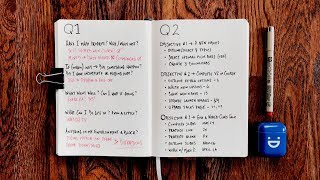
In this video Matt Ragland walks viewers through a structured quarterly review process using a Bullet Journal. He introduces five essential questions to assess progress, diagnose setbacks, reinforce successes, trim low‑value activities, and eliminate environmental blockers. Matt illustrates each question with personal examples from his recent quarter—publishing a productivity course, relationship dynamics, fitness routines, and technical skill development—highlighting both wins and areas for improvement. He shares practical habit tweaks such as reducing TV time, relocating his phone, and maintaining a weekly planning ritual with his wife. The video also explains how he incorporates the Objectives and Key Results (OKRs) framework into his personal planning, setting a top‑level objective (e.g., eight new videos) and tracking weekly key results to stay on course. Throughout, Matt encourages viewers to write down their answers in their Bullet Journals, consider using OKRs, and stay engaged via his newsletter and community channels.
Chapters
Hi everyone, my name is Matt, and welcome to another Bullet Journal productivity video. In this episode, I'm going to be showing you how to do a quarterly review of your goals in the Bullet Journal. Now, if you saw any of my yearly planning videos from the past 2 years, or any of the ones that I've done since then, I'll link to a bunch in the description below, But this is going to show you how you can stay on the path and stay consistent. Going to show you an even more important part of the process, which is reviewing your past quarter so you can do some course corrections and make subtle changes or big changes that help you get on the right path or stay in the right direction going into the next few months of the year. So to start out, I have 5 key questions that you need to be asking yourself as you review and think about how you can make some changes. The first question that you need to ask yourself is, have I been making progress in the past quarter, or in this case, so far this year? And just to give you a little insight on how I'm doing, the main thing that I wanted to do from a, like, personal, like, professional standpoint was get my first course published and shipped and available to some of you. And many of you took me up on it. It was amazing to see people go through it and interact with you and get your feedback on everything. And if you weren't able to join this time, don't worry, it's going to be re-released sometime this summer or a little bit later this year. So keep an eye out. You'll know about it on the email newsletter. And so that was a really big win for me. The other thing that I had kind of mixed results with, the relationship with my wife, and I only say that the relationship is good. We didn't do as many date nights or date days at all that we planned on doing. So that was a little tough. Now, One thing that has been really great is our communication is going really well, and one of the big reasons for that is every Sunday night at about 8 o'clock, we spend about 30 minutes planning the week, planning our meals, and just talking about the week behind us, the week ahead. We try and do like a midweek check-in also. The second question is, if something didn't go as well, why was that? Did I like make a decision that impacted it? Did I have incomplete information? And for me, the thing that I kind of fell down on, like improving my technical competency at work, I was learning MySQL and, or MySQL and Python, and I just kind of stopped doing that after about a month. And no real reason, I just got caught up in some other things at work. And yeah, just so you know, happens to me too. I failed to prioritize it. There were other things that I thought were more important. And this was the other thing, the productivity course that I was just describing, it took up a lot more of time than I had originally planned, and I wanted to do a really good job for the people that were in the course. So I do want to kind of recenter my technical learning going into the second quarter. So that's an example of looking at and saying like, okay, this is something that still means a lot to me. I didn't make very much progress on it. Here's why I believe that happened, and let's make a change and an improvement going into the next quarter. All right, number 3 is what went well and can I keep doing that? The thing that I was able to get back into that I was really appreciative of is just getting back into a workout routine, especially having a new baby. Everything is just kind of flying all over the place for the first couple of months. And so right about the beginning of March, I started going back to CrossFit, and that has felt really good. And so I want to keep doing more of that. And also the other thing that I started right in February, so kind of mid, you know, mid-cycle is I started writing weekly email newsletters to all of you that are on the email list. So I feel really good about both of those things, and I definitely want to continue to make them a priority going into the next 3 months. The next question is a really important one, and it's asking yourself really simply, what can I do a little bit less of, even if, like I said, it is a little bit, that allows me to do more of the things that I care about? We started to do this a little bit kind of in February and into March, but we just stopped watching as much TV as we were, and I wouldn't say we were watching a ton, but we went from like 30 to 40 minutes-ish a night to like almost nothing at all. I know that's gonna ramp back up a little bit now that Game of Thrones is almost back, but that's only one night a week, and so really trying not to just default to flipping on the TV because that has allowed me to read a lot more in the last few months, and I've really enjoyed that. The last thing that I want you to ask yourself is, Is anything in my environment a block? Like, is anything getting in the way of me focusing on what matters or doing something like implementing a system or a habit that could be like literally life-changing to me? And something for me that I've tried to consistently do is not have my phone be in a visible place when I get up in the morning, not even having it out in the kitchen or downstairs. I'll try and put it upstairs and just let it stay up there. And charge. I do have my Apple Watch if anyone, you know, texts me anything urgent. But other than that, I don't need to have my phone near me. And that, again, it allows me more time to write, read, journal in the morning, and just really focus on those things that I know— like, if you ask me, those are higher priority things for me. But if I see the phone, it's like, you know, tractor beam just pulling me in. That was a really bad tractor beam, but bonus points to you and lots of hand claps in the chat if you can name the movie that that little line is from. So those are the 5 questions. They're really important. I think you'll get a lot out of them, and you'll probably have some of your own that come up from that, and I would encourage you to write those down in your bullet journal and go follow them as well and see where those answers take you. Now, this is something that a lot of you may do already with your work. I know it's something that I am in the process of doing right now. We use a system called OKRs, which stands for Objectives and Key Results. What I'm doing this quarter is I'm using the OKR framework for my vlog and the work that I do on productivity and mindfulness with you. What I like about OKRs is, especially if you're using them personally— now, they work really well in a team environment as well— but if when you're using them personally, it allows you to set your top-level objective, like for me, make 8 new videos this quarter, and then set the key results that are going to ensure that week by week, month by month throughout the quarter, you're staying on the path and you're completing those key results that allow you to make progress on your objective. And the idea is once you complete all the key results, you should have completed the objective or at least gotten really close to it. There are of course some variables, and you may not hit full 100%, but the goal really is to hit those key results so you achieve your objective. If you want to know more about the OKR process, I could do an additional video on that, but just let me know in the comments what you think about this planning process. Like I said, I do it in my bullet journal, and taking 30 minutes to make sure that you stay on the right path for the next 3 months, which keeps you on track for the entire year, is a really valuable use of your time. So I encourage you, take those 5 questions, think about how you can set up yourself for success, looking at it from whether you've watched some of my past videos, thinking of as like, this is what I want to do for the quarter, this is what I want to do for the month, and this is what I need to do each week. Or day to help me reach those goals, or you want to use something that's maybe a little bit more structured like OKRs. And again, if that is interesting, make sure you sign up for my email list. I'm going to be talking about that a little bit more in upcoming newsletters, and I may do an additional video for it if it sounds like it is of interest to all of you. Thanks again for watching. If you like this video and you're new here, make sure you subscribe. We talk about a Bullet Journal and productivity tips and mindfulness, the way that you can focus on the things that matter to you and get your head out of your apps. If you do really like this, please sign up for the email newsletter. It's going to be linked below in the description. I send out a weekly email with— I call them themes for thinkers, so they're a little bit of prompts to help center you and think about what matters to you each week. All right everyone, hope you have a great rest of your week, and I'll see you soon in the next video. Thanks, bye!