Planning your week won’t help you - do this instead
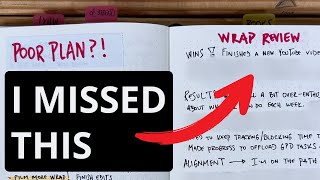
Matt Ragland teaches a weekly review method called RAP/WRAP that takes 10-15 minutes and tracks Wins, Results, Alignment, and Pivot. He shows how to use it with a bullet journal or notes app, pairs it with his GAP planning method, and walks through his own week as an example.
Chapters
For years, I thought that planning my week was the key to getting more done. I would set my goals, I'd map out my tasks, I'd protect my time, I would do everything exactly like I was supposed to, but still something was missing. The problem was that I was so focused on planning the week that I never took the time necessary to review the week that I had just completed so that I could have a better idea for how I was planning the week ahead. I was so focused on making perfect plans at the beginning of every week that I never stopped to ask myself at the end of the week, Did that plan even work? And that's when I realized I was kind of doing planning backwards. And once I realized that, a whole new level of productivity and calm opened up to me. That's what I want to share with you today. In this video, you're going to learn my RAP review method. It's a simple 15-minute practice that changed how I review and plan my week. Let me show you how it works. The main takeaway that I want you to have from this is that RAP is a simple 4-step method that you can implement at the end of every week to help you better review and then preview the week ahead. It will make your Sunday, Monday, beginning of the week plans much more effective because you'll better understand how the week in review just went. WRAP is an acronym, and I'm going to give you a quick breakdown of what each letter stands for. W stands for wins. This could be personal or professional. What went well? What do you want to celebrate? It's really important to celebrate your wins. I want to make sure you focus on that. The R stands for results, and what you are doing here is reviewing, recapping your results from the week that you just completed. I wanna point out here that it's really important for you to approach this review and especially this results question as a reporter, not a judge, just looking at it independently, objectively. This is what I intended to do at the beginning of the week. This is what actually ended up happening as the week comes to a close. Now, if results are very data-driven and yes or no, this did or didn't happen, the A stands for alignment and it is a little bit more, you can call it woo-woo if you want. It's a little bit more anecdotal than analytical. Because you're asking yourself, is the work that I'm doing in alignment with the type of work that I want to do, with the type of life that I want to live? And you might think that's a big question to ask yourself at the end of every week. And I'm not saying that you have to make mega changes in your life every Friday, Saturday, or Sunday, but it is important just to ask yourself like, ah, this is a little out of alignment. So if you're asking— if you're seeing that something's a little out of alignment, how can you make something a little bit more in alignment in the week ahead. This flows really nicely into the P in RAP, which stands for pivot. It could also stand for progress, but if you're noticing that your results are out of alignment with the type of work that you want to do, with the kind of life that you want to have, then you need to be willing to pivot a little bit going into the next week. Now that you know the structure of RAP, let's talk about how to implement it in your weekly planning and review process. Because RAP isn't just about writing things down or like leaving a voice memo for yourself, just recapping everything. It's about making more informed decisions and plans about what you want to do in the coming week because you've taken literally just 10 to 15 minutes to think about how last week's plan and performance went. There's 3 simple steps in this RAP process, and you can make them as simple or as elaborate as you want. I usually opt for the simple method and then can expand or elaborate on my responses if I have the time and I have the energy to do so. The first step is just to create a simple layout in your bullet journal sheet of paper. This is also like— this isn't just for pen and paper productivity. That's what I talk the most about. But you can also do this in your note-taking app of choice. When I write this down in my bullet journal, I usually give myself a little bit more space for the results and the pivot. Sections of the wrap. It's not that I have fewer wins, but yeah, I'm ambitious and I like to get things done. I've realized that I tend to be a little harder on myself when it comes to results. And then I think a little bit more about the pivot or progress that I want to make in the coming week. And so that way I can give a little bit more space, but this is just for me. This is something that I've realized about myself over several years of running this weekly review system. And just keep in mind, when you're doing this, keep it simple, keep it to bullet points or just single sentences. This doesn't have to be a long journal entry. You don't have to necessarily get to the root of anything right now. You just have to get your ideas. You just have to get your thoughts. You just have to get your view out on paper. And then the third step is to identify one key pivot that you want to make in the coming week. This isn't about changing everything all at once. That would feel overwhelming. And then you'd be like, ah, this doesn't work anyway. Just pick out one thing. And I usually think about this in terms of ranking, like, what is the thing that is most important that will make the biggest impact for my life and for my work? Or if I don't quite have the motivation or the willpower right now to like make a big change, to make a big impact, maybe just look at it and see, hey, what is the simplest, maybe the easiest pivot that I can make going into the next week? That way you can build momentum and then maybe in 2 or 3 weeks you're like, heck yeah, I see how this is working. It's— I'm making progress. I'm able to make positive pivots. I'm more in alignment with the work that I want to do and the person that I want to be. Then you can look at it and say, okay, this thing that I've been kind of putting off, this is going to make a really big impact for me. That's the pivot that I'm going to make in the week to come. One of the biggest things that I've learned from using the RAP method is that planning and even reflecting on its own isn't enough. You need a solid system for organizing your ideas, tracking your habits, and making sure you're staying aligned with your life goal and vision. And if you're looking for a powerful way to manage all that, I want to tell you about LifeHQ from my friend Mike Schmitz. I've known Mike for several years and he's one of the smartest and most intentional guys I know. And even though we focus mostly on analog tools here, what I love about digital tools in this instance is that it allows you to track large amounts of data or inputs. Over time. LifeHQ is a complete Obsidian vault that comes pre-built with the workflows that you need for everything. Journaling, habit tracking, task management, and long-term planning. And LifeHQ is actually built on frameworks and systems that Mike has been building in his own life for a number of years. LifeHQ will help you align your actions and your ideas with your bigger vision so that you can stay focused on what really matters. One of the things that's most helpful about LifeHQ is that it comes with a blank vault, with all the plugins, all the settings already installed. You don't have to waste any time setting things up or get confused about where things fit. You can just start building your system on a solid foundation. As a special bonus and resource, Mike has also included his entire values-based productivity curriculum and his creativity lessons. This is over 60,000 words of content and 90 video lessons. So if you love the idea of the GAP and the RAP and the OMG goals that I've talked about in other videos, but you're looking for a solid digital system to align everything and track it and back it up over time, LifeHQ is an amazing resource for you. Check out the link in the description below and use the code MATT at checkout to save $50. So I want to take you through a normal wrap review for my week. And of course, we're going to be kicking it off with the wins. I finished a new YouTube video this week. It's actually this YouTube video, so that's pretty meta, but I'm also far enough ahead on the Create 30 Challenge that I'm doing for the Hey Creator community that I lead., and then also recording and building playbooks for help. And we'll talk about that a little bit in the results. So let's get into that. I'm still a little overenthusiastic about what I can do each week. And some of that is the realization that I'm spending too much time on administrative tasks. And so when I look at my time tracking, when I look at my time blocking, when I look at where I'm spending my time, when I look at the results of the week, I see, ah, you really shouldn't be posting replays to the community anymore. And there are some tasks. That you know you can hand off to other people that will allow you to spend more time on like high leverage work on YouTube, things that keep me really excited and interested and also provide value for the company while driving more revenue. And so I need to make sure that I'm continuing to track and block my time so that I can stay dialed in. So it's, it's nice to kind of approach it and see how this is working together. I, analyze the results and I make a pivot, and we'll talk about that more in a second as well. The alignment piece is exciting to me because even though this week wasn't quite as aligned as I want it to be, part of that was because I was sick and then the kids were sick and nobody was sleeping very well and people weren't feeling very good. But last week I felt really good and I did an exercise or an exercise program every day and that that feels really good to me. That's something that is an investment in myself and things that I'm excited about. I'm also reading a lot more. And so that shows me that I'm in alignment with the kind of life that I want to be living and the kind of work that I want to do. Okay, finally, let's talk about the pivot. I have to prioritize the Hey Creator Summit and make it happen. Honestly, I was a little like ashamed that it was delayed. I was a little overwhelmed by the scope of it. I lost access to some help on like who is going to assist me with this. And so I— that, that was real, but I let it bother me for about 2 weeks, 2, 3 weeks more than it should have. And so making a pivot to emphasize that as priority number 1, getting that restarted at the beginning of next week. And I've already talked about this, but pivoting some of my time and attention to make sure that I'm building playbooks, you know, recording screencasts, writing, you know, SOP, standard operating procedures, to make sure that people, that people can come in and work with me. So that's an important pivot moving into next week also. Now, what do you do once you've actually completed your wrap review? How do you turn these insights into a more effective plan going into the next week? Because I want to make a key distinction here, like the wrap is about reflection and review. It's not necessarily about planning. What it does is it informs the plan that you're going to make for next week because you have more information and you understand more of what you can do or less of what you're capable of doing. And that can be okay, especially if you look ahead and say, hey, 3, 4 weeks in a row now I haven't like hit the results that I planned for each week. I probably need to either like work a little bit more so I hit the goals that I have for each week, or I need to be more realistic and say, hey, instead of having 4 major goals each week, I could probably only do 3, or maybe I can only do 2. That review from the reflection in the wrap will help you better inform and plan the week that you have ahead. So one way that I do this is with my GAP planning method, and I have another video about this. You can watch it in the card that's going to pop up. There's going to be a link in the description and on the end screen of this video. But I just talked about how I usually do 3 or 4 goals each week that connect to the bigger goal or objective that I have for my life, for the bigger projects that I'm doing. And if I notice that I'm only getting 2 or 3 of those done throughout each week, then when I go into my gap planning for the week ahead, based on the wrap review that I just did, if I'm consistently only completing 2 of those goals, but finding like 3 that I was like, oh, that'd be great to get it done, but I'm just not doing it. Then I have to be more realistic and say, okay, I can only plan out and protect time for 2 of these major goals. I can only do that effectively and feel confident about it if I've been doing the weekly review, the wrap review, and understand based on results, I'm only doing 2 of these things. So you might as well save yourself some angst at the end of the week and just plan out those two. Another way to think about how to transition your wrap review into the gap preview for the week ahead is let's say I did plan out three goals and I only completed two of them. Well, that one that was left undone, I need to look at it a lot more intentionally and say, is this something that really needs to be done? And if it is, whether I just ran out of time or something came up, or maybe I'm I'm afraid of doing it, or I'm just being lazy. I need to look at it and say, if this really is important, this third goal that I didn't complete this past week, well, this goal needs to go to the top of the list in the week to come. And that's something that, again, like the wrap helps me see this goal that I've been kind of pushing off. I need to ask myself very clearly and intentionally, is this something that I really need to get done? And if so, it needs to be my top priority in the week ahead. My challenge to you is to try the RAP this weekend. Just take 10 or 15 minutes, open your notebook, open your note-taking or project planning app of choice, and just put 2 bullet points in each of these sections: wins, results, alignment, and pivot or plan to progress. I bet you'll be surprised at how much clarity it gives you as you begin to now plan the week that you have ahead. Drop a comment below and let me know one win that you've had from this past week. I'd love to hear from you. And if you're not subscribed to the channel yet, please subscribe, rate, and review. Wait, no, that's for podcasts. Subscribe and ring the bell. That's what we're doing here on YouTube. I have like over 100,000 subscribers. I still get that mixed up, but it really helps the channel grow and you'll get more videos from me. I'll be like at the top of your feed. So if you enjoyed this, make sure that you subscribe to the channel. And hey, don't forget that if you want to see how I plan the week after I've reviewed the week, using the GAP method, check out this video. You're going to learn everything about the GAP, how it works with the WRAP, and vice versa. It's a nice little flywheel of productivity that you can use to have productive, effective, fun weeks.
More from Matt









Journal reading 📖 Reflectjons on how I’m living & how it aligns with the vision I have for my life.

You don’t have to listen to me. But you do have to be intentional about the systems in your life.
