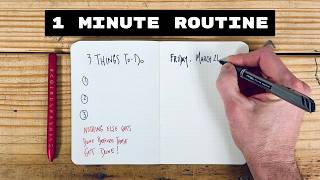
In this instructional video, the speaker argues that the key to making digital productivity tools less overwhelming is to start each workday with a brief analog routine. He first outlines three fundamental problems with digital tools: information overload, high setup cost, and lack of natural limits, which together cause distraction and mental clutter. To counter these issues, he proposes a three‑step habit that is performed before opening any device: (1) write down three top priorities for the day in a bullet journal, pocket notebook, or on a whiteboard; (2) use the same analog surface as a buffer for new ideas or tasks instead of immediately creating digital entries; and (3) finish each task with a quick reflection or plus/minus score to reinforce learning and maintain focus. The speaker emphasizes that analog tools provide physical constraints—such as the bottom of a page—that make task lists feel more real and limit over‑commitment, thereby reducing cognitive load. He explains how this routine integrates with digital work: planning and prioritizing happen on paper, execution happens in apps. The habit is presented as a one‑minute, low‑friction practice that can save hours each week. Viewers are encouraged to try it for a day, then commit to a week, gradually building momentum. A free 5‑day email series is offered for additional support, and the video ends with calls to comment, like, and subscribe.
Chapters
Most people think that the best way to be productive is to go all in on digital tools. In a lot of ways, that makes sense. It's incredible what you can do with digital productivity tools. But what if I told you the key to making digital tools work better is actually an analog tool? In this video, I'm going to show you a simple trick that makes digital productivity smoother, easier, and a lot less overwhelming. This is a system that I use every single day, and by the end of this video, you'll know how easy it is to implement too. To understand why this works, let's start with the biggest problem that digital tools create and how analog helps you solve that. Digital tools are incredibly powerful. We already talked about that at the beginning, but they come with a hidden flaw that if you're not careful can lead to incredible overwhelm and confusion. There are 3 aspects of digital tools that make them hard to use if you're not careful. The first one is overload. You open up your laptop, you swipe open your phone, and all of a sudden you have 10 different apps open or 10 different tabs. I can't add 10 10 tabs would actually be kind of nice. The amount of information and tools that you can harness at any given time actually makes it pretty challenging and leads to a lot of the overwhelm that is a big challenge for using digital tools. Another aspect of this overload that many people face is the setup cost of using a new tool. Notion may be amazing, but most people that I've talked to have a lot of trouble just getting it set up because there's so many things that you can do. So you're not really sure what you're supposed to do to start. Another challenge of digital tools can be the lack of focus. There are notifications, infinite scrolling, and the temptation to switch between tasks that keep you from the focused deep work you need to do in order to move your projects forward or grow your business or write that book that you've been wanting to do. A third one that I don't think many people consider because there is a benefit to this thing that I'm gonna tell you is there are no natural limits in digital tools. And on one hand, that's great because you can put literally everything that you want into a digital tool. The downside can be like when you don't have those natural constraints that we have with pen and paper, it can lead to a lot of lost information and a lot of like digital clutter. And these kind of natural constraints that you have aren't as useful. Let me ask you a question. Have you ever sat down to be productive, to get a specific task done, only to get lost in notifications and distractions and seeing this other thing like, oh, it'll only take a few minutes, but then you task switch and this other thing that you originally sat down to do doesn't get done for another couple hours or may not even get done that day at all. So what's this trick that I tease you with at the beginning of this? It all starts with using analog tools like the Bullet Journal, like a pocket notebook, like analog note cards in a very specific way. And it actually all starts before you even open up your laptop or swipe open your phone. Here's the trick. Before you use any digital tool, I want you to use your analog tools to set the stage for your focused work. There are 3 steps that I go through to make this happen. Step 1 is to write down your intentions and priorities for the day. And it's really simple. All you do before you open your laptop is write down 3 priorities, 3 key tasks that you want to get done today. And you have to do this before you open your laptop and distractions start to creep in. And definitely even before you start to like swipe through your phone and see like check your email or Slack messages. The second thing that you can do, and we talked about this in the like infinite scrolling pocket notebook video, is that you use your notebook, or I also use a whiteboard, as the buffer between like me coming up with new ideas or having new thoughts instead of opening up a new page in Notion or going to Reminders or doing anything else where I can get distracted. I write it down in my notebook or I write it down on the whiteboard. The third step is that I end each task with a really simple reflection. It could also just be like a plus or minus score. How did it go? What was something that I learned? This helps me keep my mind on the task at hand and helps me improve continuously because I'm keeping my attention on the task and on the page rather than going off to the next thing right away. So this is just a small thing. You don't necessarily have to do this one, but it is a way to kind of keep your mind centered on the tasks that you have rather than just like skipping along to the next one right away. When I skip this setup, my day automatically feels a lot more scattered. When I can state my priorities at the beginning of the day, I'm able to stay a lot more focused and productive, and often I get a lot more work done in less time because I'm not getting as distracted. Let me be clear, this trick isn't about replacing digital tools. I owe a lot of my career to digital tools and software. But it does help me make those digital tools work better for me because I'm not relying on them entirely to do work and track work. I'm often like planning and tracking in my notebook or in my bullet journal. That helps me stay more focused on what the task actually is. And going back to that concept of there are like clear constraints on the page. So if you start writing a bunch of things down, I promise you, if you were to like fill up a page with stuff that you got to do there, you probably— unless we're just talking about like a little, a lot of little like tiny tasks, you would not be able to finish everything that you write down on a page. And so like, that's a sign. I even if I get to like halfway down the page, I'm like, I'm not going to be able to get to do all of this. But if I'm just making a list in a like Notion page, that can— I'll put 100 things on there, like without even thinking. And my mind just doesn't like— I can't wrap my mind around it the same way. It doesn't feel as real. When I write things down in my notebook, it literally feels more real. And there's a like, there's a little alarm bells that go off in my head if I'm writing too many things down, at least like to get done in a particular day. So one way to describe that is I make decisions about what to do in the notebook, but then I execute on those decisions with the digital tools. I'll record and edit a video. I will write the newsletter. I will like record a screencast to help my team know how to help me with different tasks. These are all done with digital tools, obviously. But deciding and prioritizing what I'm going to do, that's all done on the notebook. That's all done with analog tools. It also helps me reduce the cognitive load, like just the, the, the mind overwhelm, if you will. I mean, writing things down first really reduces mental clutter, and then I have a good like visual of seeing it. I often will leave my notebook open near my computer so I can just keep looking and saying like, this is the next thing you got to do. This is the next thing you got to do. Because I've already written it down. I've already prioritized instead of like looking around, oh, someone emailed me, I guess I should do this thing. Oh, I got a Slack message, I guess I should do this thing. Oh, someone sent me a DM. Oh, I saw this like notification. All those things still will and will get done at some point. But I've already made the choice. I've already made the decision about what to do this day. And you know, a lot of times even the next day based on what I've written down in my notebook. And like I said about constraints is that analog tools have a natural stopping point. It is like the literal bottom of the page. Can you start writing on the next page? Yes. But when you are writing a bunch of things down on paper, it just hits different, literally. So I'd be like, I'm writing down a lot of things versus when you're just like, heck, if you're copying and pasting a bunch of tasks that takes no time, like almost no cognitive load, but kind of in a bad way. You're just like, I'll just throw it in there. How often do you look at that stuff? You may never look at it again. And I understand that, that, you know, you still kind of have that risk, but like when you write down a dozen things in a notebook, you feel it, you know, that it's kind of a lot to do. I can copy and paste 100 things into a Notion page, be like, ah, you know, throw it in there. Maybe at some point, probably not. This is literally a 1-minute habit that saves me hours of wasted time every single week. And the best part is it's so simple that anyone can do it. This isn't setting up new software. This isn't installing a template. Literally all you have to do is write down what your priorities for today are and start working on them. You do that, you will change your life. Not in a matter of years, probably not even in a matter of months. You will change your life and grow in confidence in literally a matter of days. If what you do is write down 3 things that are important to you to do every day, and you do those day after day after day after day, you will not recognize yourself in a matter of weeks or months. In a year, you'll be a completely different person. Of course, I want you to try this for 1 day, but I want you to commit to doing this for 1 week. And I'm not even going to ask you to think about like, what is the most important priority? Don't put that pressure on yourself just yet. Write down 3 things that you need or want to do today and just focus on getting those things done. If you're only able to get one of them done, that's kind of— that's in some ways a good sign. Then the next day, I want you to write down just one thing and do that one, and then add on a second. Build some momentum, create some belief in yourself that you're the kind of person who says they want to do a thing and then actually go goes out and does it. If you want some encouragement, guidance, inspiration in this, I have a free 5-day email series. I'll send you a short email every morning for 5 days. I'll send you one like literally right when you sign up and then for 5 days after that, that way you can feel like you got a buddy and like, that's my real email address. If you want to hit reply, I'll shoot you an email back and cheer you on. But let's like involve each other. In this as well. Go ahead and leave a comment if you're going to do this. If you've been doing it and you're back here checking on this video, come back and cheer other people on. Tell them what a difference this makes in your life and in your work. If you like this video, if it made a difference for you, please subscribe and like the video. Like I said, leave a comment. It really makes a difference in more people seeing these videos and getting these kind of tips and strategies in their own life. Thanks for watching. See you next time.