Use this Tech-Free Strategy to be more Productive
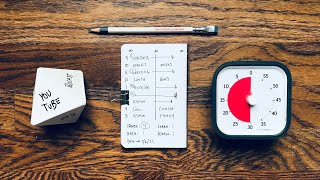
Matt Ragland walks through three time-management methods for creators and small-business owners. Track your time in 30-minute blocks using a bullet journal or tools like Toggl. Then use Google's 70/20/10 rule (70% core work, 20% new opportunities, 10% wild ideas) or Jim Collins' 50/30/20 rule to see if your hours match your goals.
Chapters
One of the fastest, easiest, and most effective ways to be more productive is to have a better understanding of what you spend your time on. But this can feel a little silly a lot of times, and it's something that we don't do very naturally in our day-to-day life and work. Hi everyone, my name is Matt Ragland, and in this video I'm going to share with you 3 effective time management methods which will help you better track, organize, and understand the amount of time you're spending on different activities and tasks in your life and in your business. You ready? Let's go. The first thing that I recommend doing is tracking your time. Now, you can do this in a few different ways, but the easiest and fastest way that I like to do it is just by making a simple time grid in my bullet journal or in a tiny field notes pocket notebook that is really easy for me to use and transport anywhere that I'm going. I want to be really clear about something. When I talk about time tracking, I don't mean that you need to track every minute of every single day. If you're using this from a work perspective to understand how you're best using your time in your job or in your side hustle or some other hobby that you enjoy, then what I would do is track your time in 30-minute blocks. And again, this doesn't mean that you're saying, okay, well, from 9 to 9:10, I was focused and working on this particular project, but then I was on Twitter for 5 minutes, and then I went back to it, and then I had to check this email. I'm not talking about that. If you were, say, 80% focused on a particular project or task during that 30-minute block, or you had a very strong intention to do so and weren't that distracted, then go ahead and write down what you were doing for the most part for that 30 minutes. For example, I will often start my workday with 30 to 60 minutes of writing, and even if I do check Twitter or scroll through Instagram a little bit during that time, as long as I am returning quickly to the writing, then I still define that— like, I still define and track that amount of time as being spent on writing. It's a lot like meditating in the sense, because I would still say that I'm meditating for 30 minutes if I sit in place and I try and focus on my breathing for 30 minutes. And even if my mind wanders, that doesn't mean that I wasn't meditating for that amount of time, as long as I returned to the breath and returned to the practice. Think of time tracking in the same way. There are a few effective ways to track your time digitally, And one of the common ways that I do that is just in my Woven Calendar. Now you can see the video where I went through entire like time tracking tagging with the Woven Calendar. I think it works really well, but you can also use a time tracking app like Toggle or a— where is it, where is it? Here it is, the Timeular Dice. You can track every hour of your day if you want. It'll give you a really clear vision of what your doing all the time during the day and give you an idea of where you could find some extra hours in the day. But what I normally recommend doing is tracking just your work time, or maybe just tracking what you're doing during your assigned side hustle time, if that's something that you're working on as well. Now you have enough data to start to move into the next method of time organization, or something that I like to call attention allocation. This next idea is called the 70/20/10 rule, and it comes directly from Google. It's how they manage their time and the amount of time that they spend on different projects inside of the company. The 70% time is spent on the core business functions, things that actually keep everything, you know, everything else in Google running. 20% of the time is spent on exciting new opportunities, and then 10% is spent spent on just wild new ideas, things that you're not quite sure, but they seem really interesting. That's what 10% time is. So one way to think about this, as you have the data now from step 1 on the amount of time that you've tracked, I'm looking at it and saying, all right, am I spending 70% of my time on what really helps move the business forward? For me, that's YouTube videos and coaching. If I'm not spending 70% of my time with a task or a project that supports continued YouTube growth or more coaching and courses, then that is something that I really need to think about. Now, 20% of my time can be spent on exciting new opportunities like the podcast or a new course that I might want to develop. And 10% of time is something that I've been thinking about for a couple of years and really need to focus my 10% time on, but it's building a Kickstarter campaign for a journal idea that I have. But look at it this way, it would be silly of me to spend a lot of time on a Kickstarter project at the expense of not posting on YouTube anymore or not doing any coaching. Those are the core parts of the business that make everything else run. You see the distinction between each of these? And what makes it really exciting is that without the 10% time, without the 20% time, the business can start to not be as interesting as it once was. The 20% and 10% time is how Google furthers innovation and continues to develop new projects, products, and ideas that will help them grow and stay ahead of the competition in the long run. It's the same thing for me. A Kickstarter for a journal could end up doing really well and become an entirely new business all by itself, something that does become 70% time. The third time management method that you can use is called the 50/30/20 rule from Jim Collins, who wrote Good to Great and many other business and leadership books. I actually heard this on the Tim Ferriss Show podcast. It's one of my favorite episodes of Tim's show. And in this episode, Jim starts talking about how he keeps this— I think he keeps two stopwatches with him. And what he's doing is he's always tracking the number of creative hours that he spends he spends each day, and his goal is to always spend at least 50% of his time on creative work. And I found that really interesting. Spending 4 hours a day, 4 to 5 hours a day on creative work. What would that really look like? You spent half your day making stuff. And now that I'm doing this work on my own, it's a really compelling idea to me. Now, what do the other, what do the other 2 numbers mean? Well, 30% of the time Collins talks about he needs to be researching, he needs to be teaching, he needs to be learning himself, things that propel his creative work time. And the other 20% is where he does administration and management. Now it's really interesting to think about work and time in this way, because when you think about it, the creative time, the creative work that you're doing, that 50% time, Those are things that often only you can do. And so it's really effective use of time. The 30%, the learning, researching, teaching, is the fuel that continues to power your creativity. It helps you learn new things so that you can be talking about new concepts or further develop ideas that you already have. Without learning, researching, and teaching and having that feedback loop, your creativity will suffer. Now the 20% time, that admin, sometimes, you know, boxes still need to be checked and emails still need to be responded to or sent out, but not allowing that admin time to go too far overboard with the real work that you need to be doing with creativity and with researching, teaching, and learning. The way that 50/30/20 can work with step 1 of tracking your time— let's just set aside the 70/20/10 rule for a moment. Is just look at the time you've been tracking and start asking yourself, what kind of work is this that I'm doing for each of these hours? Is it creating something? Is it researching and learning and teaching something? Or is it more an administrative work? I want to make a really important clarification right here because something that people often try and do when I talk about these 3 concepts is combine them all together at once. And what I would do, what I'm recommending, is spend the time tracking your time. First and foremost, that's most important. That will give yourself the data to understand how to use it going forward. And then pick either the 70/20/10 rule from Google or Jim Collins' 50/30/20 rule and decide which one you're going to use as the initial filter and organization method for the time that you are tracking. Now you can do the fun work of kind of rearranging your schedule, your time, the things that you're doing to make sure I'm creating, I'm researching, I'm learning. Yes, I need to spend time on administration and make sure that these things keep going. Think about the 70-20-10 rule. Now, am I spending enough of my time on these core aspects of my business? Am I giving myself permission to spend time on developing new exciting opportunities and crazy, crazy ideas that could really propel my role, my career, my job, my business forward for a really long time. Once you start tracking your time and applying either 70/20/10 or 50/30/20 to your daily review, then you can just make a simple entry on the sheet of your Bullet Journal or of your Field Notes notebook, or one thing that I've started doing is creating a simple spreadsheet. I use Airtable for this, but you could use any kind of spreadsheet or database that you want, and I can create this simple spreadsheet for most of the core tasks and projects that I do every single day and every single week for my business. Let me know in the comments below which method, which rule resonated the most with you. Do you think you'll start with 70/20/10, or do you think you'll start with 50/30/20? What do you think about tracking your time regardless? Do you think that's kind of OCD and weird? That's totally fine. Ask any questions that you have in the comments, and you can also find links to a simple time tracking grid in the description below. Thank you so much for watching this video. I'm excited to help you take more control of your time and really understand how you're spending it so you can be intentional about the people, the projects, and the purpose that matter the most to you this year. Thanks again for watching. I'll see you in the next video.
More from Matt









Journal reading 📖 Reflectjons on how I’m living & how it aligns with the vision I have for my life.

You don’t have to listen to me. But you do have to be intentional about the systems in your life.
