What's in my bag? The EDC of a Bullet Journal Guy
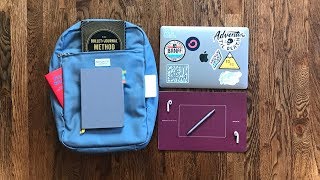
In this video Matt Ragland walks viewers through his everyday carry (EDC) setup that supports his Bullet Journal workflow. He begins by introducing the Baron Fig Canvas Slimline Backpack, highlighting its clamshell opening, slim profile, hidden zipper pulls, and multiple interior pockets. He then details the range of notebooks he carries—Field Notes Signature Sketchbook, Baron Fig notebooks, Leuchtturm1917, and Scoutbooks—explaining their dimensions and why he uses both larger and pocket‑size journals. Matt shows how he organizes the backpack: laptop in a padded sleeve, a Mastermind Dot Grid Desk Pad for brainstorming, Strategist note cards for book insights, a ruler with foam backing, and a dedicated pocket for an Anker power bank and dongles. He reviews his pen collection, including the Baron Fig Squire, Pilot G2, Pigma Micron, and Staedtler fineliners, describing their writing qualities. The video delves into his note‑card system, modeled after Ryan Holiday and Robert Greene, where each card records a quote, source, page, date, topic, and optional follow‑up notes. Matt explains his workflow of keeping a larger Bullet Journal for task‑oriented planning separate from a smaller notebook for daily reflections. Additional accessories such as Bose noise‑cancelling headphones, rubber bands, and a ruler are shown. He wraps up by teasing a forthcoming full review of the new Bullet Journal Method book (release Oct 23) and a giveaway, encouraging viewers to join his email list and comment with questions.
Chapters
Hi everyone, my name is Matt, and welcome to another Bullet Journal productivity video. In this episode, I want to show you exactly what I carry on a day-to-day basis with the Bullet Journal, and how I go through things, what I choose to carry with me, what kind of goes in the pockets versus what goes in the pack, and the different things that I'm using to carry all of it. So it's going to be showing you the different journals and notebooks and pens and other things that I have, and and the everyday carry backpack that I've been using from Baron Fig that I think you're really going to like as well. Speaking of which, I've got the— let me zoom out a bit for you. I totally forgot what it was called, if it had a name. The Canvas Slimline Backpack. What I really like about this Baron Fig pack is how slim it is. You can see how it really hugs the back, and I'm going to show you the, like, the ins and outs and the guts of this thing. I really have enjoyed it. The team did a great job. So shout out to Joey, Adam, and everyone else that works at Baron Fig. And I'm going to show you this thing. I've really liked it. And also this, this kind of video, it's one that I haven't really done before, but I wanted to show you, like, every time I do one of these videos, someone always asks, like, what kind of pens do you use? What kind of notebook is that? Where do you keep it all? What kind of bags do you use? So this is also an homage to my friend Chase Reeves, who has an incredible bag channel, you should absolutely check it out. But this is going to be, this is going to be a fun video. We're still going to get into some bullet journal stuff, but I want to show you everything that I'm carrying on a day-to-day basis, even if like I'm just here, even if I'm just here at home or if I'm going to a coffee shop. Let's get to it. I'm staying here. I want to give you a look at how this Baron Fig backpack looks and works and some of the cool zipper features and functions that they have with the pockets. Because as slim as this thing can look, and it is like, that's not very, that's not very much. I mean, you can see, you can see even with a good amount of stuff, it's still like is really slim. So it's a good slimline bag. First, I want to show you these new Field Notes that I just got for my birthday. And let's zoom in a little bit. You can see they're on the smaller side. When you look at notebooks these days, they normally come in one of two sizes. It's either this, uh, good, you know, bullet journal and a full A5 size— I think that's the right one— or the smaller pocket size. The— this Field Note notebook, I think this is the— this is the Signature Sketchbook, kind of fits that middle ground nicely. So a little bit bigger, you can see the three 3 different sizes here, and let me just move the backpack for a moment. You can see the 3 different sizes here and how they kind of line up against each other. For the main Baron Fig, we're looking at about 7.5 inches by 5.25. This signature, Field Notes signature, is— I mean, I could just look at it right here. 4.25 by 6.5, so a little bit smaller and certainly thinner. And oh, hi! I wasn't expecting to see that. What does Field Notes have to say to me? That's fantastic. A lot of you know that I work at ConvertKit, which is email marketing for creators, and so I love that for a physical product right here, the notebook, they also have a like printed basically join our email list. fieldnotesbrand.com/thelist. So I think that's pretty awesome. But this is a, you know, just blank sketchbook. So a lot of it's really, you know, whatever you want to, whatever you want to make of it. And then you have a normal— this is like what Field Notes made their, made their name on, this kind of smaller size, which is— so these are, you can see, a little bit smaller even still. 3.25 to 5.25, so a little bit smaller. One of the things that I really like about this bag is how it opens with this clamshell design. You can see that, you know, no more than a foot in terms of width on your back. But again, right from the beginning, these zippers, they're nice and sturdy. Is that it opens, you can see, nice and flat. My camera, camera lens isn't quite wide enough to capture it. You can see that it lays out nice and flat. And let me show you the different pockets that are in here. Now I'll say it's not an overly padded kind of tech backpack. You can see that from how thin it was when I showed you that shot. And it's 100% canvas cotton. It looks It looks great. I get— I've gotten several compliments on it. But let me show you the pockets and kind of the organization here, because for a really slim pack, it does have a lot of things that you can carry. Of course, you can see that it's easy to slide in the Bullet Journal, and let me show you how. So just a few, a few spots here that we can go ahead and check out. I'll show you some of these. Other products in just a second. But right all the way, you can see that I've already got the laptop in here. It's nice and hidden. These pockets have a little bit of— these dividers have a little bit of padding right here, and same thing on the back, but I wouldn't say it's going to protect it that well. It's a Mastermind Dot Grid Desk Pad. I really like it. It's fantastic for taking notes and kind of brainstorming. Some different things. And so I do it for like meeting, meeting notes a lot. Because if I wanted to, now this, this pocket back here, again for the laptop, you could put, and I often do, put the Mastermind Pad right here. I could also slide in the Bullet Journal here. You can see it fits this very, and of course it fits really well for the For the Baron Fig notebook. Let's take a look at the Leuchtturm, and I think it still— yeah, still fits in just fine, even though, as we've talked about in previous videos, the Bullet Journal— the Leuchtturm is a little bit bigger, and you can see that it's a little, little wider. I will say, because the COVID of the Leuchtturm is smoother— you can see that gloss on the light right there— It actually goes in maybe a little smoother, even at a larger size, than the Baron Fig one does, since it has kind of this nice cloth texture. But both pretty smooth, pretty easy. And then we have this smaller pocket right here, and this will, with effort, fit— and I often do— the larger, you know, the one that I— the one that I use for journaling, for daily journaling. But if you're using something like these smaller pocket notebooks, they go in here really easily. So you can see I got a couple, couple in here. This one's a little bit wider, but both of them, they can fit in here pretty easily. So you can get a couple of notebooks in there, and I often, I often have one in there. I have enough of these that I'll commonly just keep one in here so that I always have a notebook just in case I forgot to bring one. Another thing that could fit in here are these Baron Fig Strategist note cards. I've really started to like these as well. I've got— I can talk about this. I've got just like— so these would fit in really well right here also. I'll show you where I actually keep these in just a second. There's another Baron Fig notebook. It's just a soft cover and slides in really easily here, or it could come down here. Pretty good amount of room. Let's say this pocket is deeper than it looks. It's actually, yeah, about 8.25 inches of depth right here, about 5.5 here. So 5.5, 8.5, and then right about 12, a full 12 inches. So got your computer in there. And this is, you know, this is without having, say, like all of the actual, like space that you can keep just in a regular, in a regular backpack. And so I could very easily, if I didn't want to stretch these pockets out too much, or just wanted to keep like the smaller, the smaller ones in so it just doesn't stretch. As much. Have 2 books here, here, however I wanted to organize them. Notebooks, books, all right here. All right, let's take a quick look at this, the top, the front panel. And one of the things that I really like about this Baron Fig notebook is how they use the pockets and the mesh here. And so you have your pretty normal, like, this is where I keep all of, you know, the pens and everything, extra cough drops that I want to have with me. This is a smaller Baron Fig. I really like their rulers, by the way. They're nice and slim, and you can see it has like a foam coating on the— or a foam strip on the back. And this is really nice because when you're writing, when you're making your— it won't slip. At all when you have like this foam backing. So if you're going to pick up a ruler, this is a really good one, but make sure it has that foam backing. You'll really appreciate that as you're like outlining things. I want to show you this as well. This is the Baron Fig Squire pen. It writes wonderfully, and it's just, it's very, it's very smooth. It's very classy. So highly recommend it. All the pens, small things go up here. Another little pocket that I like is right down here. It's very similar to the pocket size up here, but what I keep down here is this Anker charging block, and this thing, this thing is hefty, but this will keep, this will keep a MacBook going pretty steadily. So I keep that down here. I just try and keep it, keep it in that space. Just in case, this thing that I keep all my cords and dongles and stuff in. But there's a connector cord for this Anker, and I'll commonly just have it all set up like this. But that way I can always make sure that I have a charge. Okay, the other two little— these two little pockets right here, these are really smart. These are what Bare and Fig call swing pockets.. And so I just have like headphones in right here, and then I have quick access over in this pocket to those Strategist note cards that Baron Fig has. This is just a Field Notes rubber band. I like their all-purpose banzo rubber. And what's cool about these pockets is you can see that they're really easy to access from right here, but then Let's flip around, my friends. Zip all this up and get these two in here. Zip all this up. And now let me zoom in here for you. This little, this little zipper pull right here. Now check it out. Voilà! Same headphones. So I really like this. Same thing over here. Again, these are like their hidden pockets. You can see I've got my note cards right there. The only downside, and Chase brought this up too when he reviewed this Baron Fig bag, the only downside to this, to these pockets, is that the zipper pulls are nicely hidden, but that is That also can mean that they're— they really can be a pain to grasp. This thing's a little slippery, and maybe if there's some texture on it, or even just a little bit either longer or chubbier, just easier to grab, because they can— like, I come— it commonly takes me a couple of pulls to actually like get, get a pocket open. And then you just have a normal like front pocket right here, and this thing has quite a bit of depth to it as well. Now let's talk about what I'll actually carry and use in a given day, whether I'm working from home or from a coffee shop or maybe a coworking space. There are some things in here that I showed you just from a functional standpoint that I may not bring with me every single day, but let's do this nice clamshell open. And I will say, like, right from the jump, I won't always carry this with me or these. So these two things stay more at home, or if I know I'm going to have a particular meeting. But this is pretty normal right here. So I've got a bag for all of my dongles and cords here, local company in Tennessee. The other thing is, of course, the Bullet Journal itself. And I'm going to be doing a full video on my books and kind of reading habits in the future. So keep an eye out for that. So book, bullet journal, cords, dongles, a ruler that I'll normally keep slid in here, and of course the laptop itself is all going to be in here, all being used every single day. You know how I use a bullet journal, and here's some ones from the past. Make sure that you make sure that you check out any of the videos that I have in the past. Here's something that I'm kind of using right now to go over some new videos that I'm going to be making. And then also a little sneak peek for all of you. You can see this is the— currently what the year, the rest of the year looks like. So, Hopefully I'm going to be able to get all these done for you next week. Again, this Bullet Journal book is releasing on the 23rd, so I'm going to have a video for you about some of my thoughts on it. One thing that I wanted to show you also, because I've gotten a lot of questions about this, is, you know, why would I carry the larger Bullet Journal and also this smaller, this smaller one. I do encourage you to check out the video on like daily journaling and why that can be such a game changer. I do like to personally keep, like, what, say, of, like, my journaling notes separate from, like, the more task-oriented Bullet Journal. Okay, so that's just me though. If you're wondering why I have these two, like, together like this and banded together with this, again, Field Notes Bando rubber, again, love these things. It's because I'm almost out of space here. So I've only got a couple, only got a couple pages left. And so what I'm doing in just this smaller notebook is I'll probably have a couple of these that I start to like add in extra just context. And I also have liked just carrying one of these simple flexible little notebooks around because they go into my back pocket so easily. And I'll make like little notes throughout the day, like I was listening to a book,. And we can just easily take this out of my pocket. And this is a note from The Bullet Journal Method. Notebooks are beholden to the imagination and needs of their owners on page 44. So, and of course, y'all know about time tracking and how much I enjoy doing that. So just started getting into like this next little book. Scoutbooks is a notebook printer. That I really like and hope to collaborate with in the future. But this is why I'll have a smaller notebook here, and then even like as I'm running out of space, still like keeping these banded together so that they're, they're still in one place, easy to find. Could do the same thing with this, but like I said earlier, I like to keep a little notebook just snug in here also. So these are all things that I will carry every single day if I'm going somewhere. The note cards I use occasionally also. I will normally use these note cards— I will use these note cards mostly for like book notes. And so this is from the Leonardo da Vinci book. This is from Rules for Life. I really liked this. 12 Rules for Life, a technique for listening: repeat the other person's idea or statement back to them full and to their satisfaction. I think this is a really good way. I've tried to do this in friendships and my marriage. Something that I'll do another video about is how I make these note cards. This is kind of my own take on how Ryan Holiday and Robert Greene do their note cards, is that you write either the quote or the note anything that you can reference it to, like page 519 of the Leonardo da Vinci book, the date, and then kind of the topic up here. You can also flip around and add in some more notes on the back. Seek knowledge for its own sake. Doesn't need to be immediately useful if it's interesting. So this would be the quote from the book, where the book that it was, the page, the date, the topic, and then if I had any follow-up notes personally. So here's Another one. This was from— gosh, see, I didn't even make a proper note on this because I don't— I'm not— I know I didn't read In Over Our Heads by Robert Keegan, so maybe this is just a note that I needed, wanted to make. But again, Life Books, the reference right there. So this must have been in another— a reference to another book in the original book that I read. So I need to look at that a little bit. A little bit more. So, and then just a bunch of work notes on here as well. So these Strategist note cards are things that I'll take out maybe not every day, but especially as I'm going through and I'm reviewing a book that I've recently, recently read. I'll take these out and use those for really bringing in the, really bringing in the notes and concepts from a book that made a lot of sense to me and really resonated. Of course, you saw I use these Bose headphones every day. They're fantastic noise-canceling headphones. And then let's take a quick look. I've already shown some of these to you, but the pens that I'll use, some of these are just like Apple, Apple Pencil. This is a good starter thick pen, the Pilot G2 1.0 or G2 10. It just has a nice thick tip that you can get a really clear line on. These other ones are Micron Pigment Micron Archival Ink, and I use these a lot. They don't smear easily, they write really smooth. I like them a lot. And then another one that you saw before, which was this Baron Fig Squire pen— I mean, it is— it has some heft to it. It's really smooth. It has a nice a nice click motion to it. It doesn't quite— that, like some other click pens do. So is this— this is not a click pen, but it's just so smooth. It feels really good in the hand, like it balances well. And so I highly recommend this pen, and just, it looks so good. Another set of pens that I use regularly are these Staedtler fineliner pens. Let me get— not— oop. And these are fantastic as well, especially from a color perspective. They create a really nice color. And then I also use— there are more Pigma Microns in color as well. So it just kind of depends on which one. Any of those, all of those will be linked in in the description below if you want to check those out. So, big fan of their products, their people, everything about it. Highly recommend this bag and everything in it. All right everyone, thanks so much for watching this video. I hope you enjoyed this review of the Baron Fig backpack and everything that I'm using in my everyday carry for a Bullet Journal. And if you have any questions about different things that I'm using or techniques that I'm trying out, make sure that you ask in the comments below. Let me know what you thought about this video, and next week I'm going to be doing a full review of the new— I was just looking over here to make sure that I had it— a full review of the new Bullet Journal Method book that is coming out on October 23rd. So I have loved this book more than I thought I would. I thought it was just gonna be like, like, hey, here's how you make your bullets and stuff, but it's so much more than that. And Reider, if you watch this, thanks so much for sending me a copy, and I'm going to be doing a giveaway for it. And this is just well, well done. And so I can't wait to share that with you next week. Be on the lookout for it. If you want to know early about the giveaway for this and for a Leuchtturm1917 Bullet Journal, make sure you get on the email list. They're going to find out about it first. Just check out bulletjournalguy.com, or there's going to be links up here, end screen, all, all that stuff. So, uh, yeah, wonderful people to get to work with all the time for this kind of stuff. Thanks so much for watching. Give this a like and a review or a comment. Subscribe if you're new here. We do all kinds of videos like this, teaching you how to be productive with a lot of like analog tools like the Bullet Journal, other notebooks. You're, you're going to see it all. So Thanks so much for being here. Thanks for watching. I'll see you next time. Bye.
More from Matt









Journal reading 📖 Reflectjons on how I’m living & how it aligns with the vision I have for my life.

You don’t have to listen to me. But you do have to be intentional about the systems in your life.
