Why you should limit screen time... and what to do instead
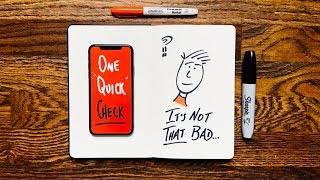
Matt Ragland spent two hours daily on social apps before using iPhone's Screen Time settings to cut that in half. He walks through setting daily limits per app, deleting ones accessible on desktop, then redirecting freed time to reading and learning. The point: attention is a resource worth protecting from apps designed to steal it.
Chapters
Today we're talking about one of the most incredible, amazing pieces of technology ever created and how it's taking over your life. I got a second, I got a second, don't worry about it. It's just, I'm just checking something real quick out. It's fine, it's fine. Of course I'm talking about your phone. It's amazing, it's incredible. There are so many things that you can do with it, but if you're like me, then slowly, little by little, it might be chipping away at everything that you really care about. Out in actual real life. Now, I don't want this to come across as an anti-phone, Luddite, kind of don't care about technology thing. I love technology. I'm semi-obsessed with it, and I love my phone. It's the most— like I said, it's the most incredible piece of technology that I've personally ever owned, and that includes a computer. And even from a YouTube perspective, I love my iPhone because I made the majority of my first 50 videos using the iPhone, no extra mic, no like fancy camera or anything, just me walking around saying, hey everybody, my name is Matt, welcome to this week's video or today's video. Not even to mention that many of you are probably watching this video on your smartphone. But here's what I am against now. I'm against the amount of time, attention, and focus that our phones take away from us every single day. So what I'm showing you today is how to cut your screen time in half with just a few simple steps. Nothing drastic, but enough to let you use your time productively and spend more time on the things that you love and care about. Before I get into the specifics, a quick note that this video is sponsored by Visible, a new kind of phone service that's totally customer-centric and accessible from an app. I thought personally this was a really unique partnership. I want to help you cut back on screen time to focus on what matters, and Visible has a streamlined service and customer connection. We've always thought phone service requests and trips to be an unavoidable time suck, but Visible has a simple design and setup to give you back hours of your life. Honestly, I was a little blown away when my phone and SIM card arrived overnight after the order, and I was able to get set up really quickly using the Visible app. I didn't have to go to a store. I didn't have to wait in line. I didn't have to do any of those things. Best of all, it's only $40 a month, one flat fee for everything that you need. I used to pay $110 a month just for my line. We're talking about unlimited data, messages, and minutes. A hotspot on Verizon's 4G LTE network. So here's the deal. I was spending at least 2 hours a day on my phone with about 75% of that being things like Twitter, Facebook, Slack, Instagram, and email, and even Amazon and Zillow a little bit. We're thinking about moving, but probably won't. What's insidious about all of this is I don't consider myself a heavy phone user. 2 hours a day is okay, but I could have done a lot better And what I really didn't like about it, how I was slicing up so much of my time and attention into these little 5-minute slivers of just like scrolling through Instagram, scrolling through Facebook. So I didn't notice it as much, but I was picking up the phone 4 or 5 times an hour, sometimes 4 or 5 times a minute, just like, just that twitch, you know, just trying to get rid of that twitch. I personally burnt out on all of it in February and took the entire month off from social media and deleted a bunch of stuff off my phone. And to be honest, once I got past the initial FOMO and kind of shakes, and the twitch kind of started to wear off. It felt really great. So what I'm going to show you how to do is take back control of your attention, of your focus, of, you know, honestly, your life. I don't think of phones as a bad thing at all. They're an amazing piece of technology. But there really are, especially a lot of the applications that we use, are designed to steal large chunks of your attention throughout every single day. And that, that to me is the problem. The screen time numbers were very illuminating for me. Like, I know if you were to ask me that I want to spend more time with people, work, projects besides just flipping through my phone. So while a quick check a couple of times an hour doesn't seem that bad in the moment, it's continuing to take away our attention in small slices, feeling of like, oh, I got it, I got to check something, I got it, I got it, I got it, I got it, I got to check something. I got it, I got it, don't worry about it. It's just, I'm just checking something real quick. It's fine, it's fine. Because what are we really looking for when we check these updates? Sure, sometimes you want to see what your friends are up to, but I know a lot of times for me, I was checking to see how many hearts did I get, or how many likes, or how many retweets. I was looking for external validation, and that is something that social media, and even like you wonderful people on social media or YouTube, really shouldn't give me in the fullest sense. And that was the thing that was standing out to me. I was like, I need to be validated outside of an app refresh. We're looking to screens and pixels for validation when there are so many things in our life that can do that for us in a much healthier way. What I found ironic as I was thinking about this is a lot of you have noticed and appreciated, and I appreciate, that you enjoy the minimalist, simplistic nature of the Bullet Journal as compared to a lot that can feel very artsy and intimidating, and in, you know, any of those things, just like, oh, I can't do that, so I shouldn't Bullet Journal at all. That is not the case, but I'll tell you this: I I would rather you spend 2 flippin' hours a day fancifying your bullet journal than, like, spending time flipping through looking at other people's bullet journals and, like, feeling bad about it. This is the core question that I ended up asking myself: if I was spending 2 hours a day on my phone and I could cut that down to an hour, what could I do with that other hour, even in, like, small slices, even in, like, 5 to 10 minute slices? Because with these simple limits and constraints, you can take back a significant amount of your attention every single day and give it back to the people and projects that truly matter the most to you. And even if you did want to get really artsy with your bullet journal, or you wanted to pick up a new habit or skill, what could you do on 30 minutes a day? How many more books could you read on 30 minutes a day that you're currently giving to your phone that you could, with a few simple steps, take back that attention and time in your life? So if you're ready to take the next step, or you're just the kind of person who likes to go super hardcore on things, here's what you need to do. So let me show you how to do this. Go ahead over to the Settings app on your iPhone. It'll be very similar on an Android. Let's scroll down to Screen Time right here. What I would do first is go ahead and tap on your time for the day and go ahead and hit the last 7 days because it's going to show you all the apps that you've been using. So you can see I've been using Safari a little bit more than I probably should have.. But let's look at, say, Twitter, which has always been kind of a problem for me. Let's go ahead and tap on Twitter, and it's going to show me how much I'm using each day, a rolling average, number of notifications. Now what I can do is I can adjust or add the limit right here. So go ahead and tap on just Twitter, and I can edit the time, like bump it up to 15, down to 10, whatever I want to do there. The only other thing to really note here is that you can also set up time limits for apps as a group., and so you can see that I have everything in here, a lot of individual app times, but then I can also come in and say, uh, social networking, I only want to have like 30 minutes a day on that. And if you really want to go hardcore on it, go ahead and tap on all apps and categories next and say you're only going to spend 1 hour a day, and that is everything on all apps and categories. The benefit of doing this is that it will free up your mind in a way that is honestly a little difficult to think about or even imagine right now because our minds are so clogged with other people's noise. When I did this, I deleted Twitter, Facebook, Gmail, Chrome, Amazon, Slack, all of my top apps, totally gone. Now you may have noticed that I didn't say Instagram, and it's true, I still have Instagram on my phone. I'll talk about that in a second, but I asked myself this question when I was thinking about which apps to keep on my phone, and the question is this: can I find this information on my computer within like 2, 3, or 4 hours, say within the same day? And if the answer was yes, then it was gone from my phone. Now Instagram is really only truly appreciated and used properly in a mobile setting. And so what I did was I limited my screen time, my app time on Instagram to 15 minutes, which was basically enough time to make a post, make a couple of comments and see how it was doing, but not enough time that I could just endlessly refresh and be like, ooh, did I get, did I get another like? Did I get another heart on this? That sounded funny. The reason that I feel so strongly about this is because your attention matters, your focus matters, and it belongs to you. We do a pretty bad job a lot of times in just willy-nilly giving our time, attention, and focus away. To people who don't care about it as much as you should care about it yourself. Social media companies aren't evil, but you should realize that their business is incentivized to grab your attention and keep it as long as possible. So their business interests don't align with your personal interests and, you know, for some people, probably overall health. Your phone is an insanely cool piece of technological equipment. It's amazing. It's incredible. I mean, just think about what it would be even if it didn't have any of the, like, apps that so many of us spend so much time on. It would still have a camera, you could still watch movies, you could still listen to music and podcasts and look things up on the web and have your calendar. You do all of those things on your phone and that would be incredible all by itself. The most important thing to remember and realize is that you control your time and attention. You control what you give to the phone and don't let the phone or the applications inside of it control you. Personally, I think it's really cool that Visible was up for sponsoring a video about strategic use of your phone. I just think it says a lot about how they would treat their customers. Visible's removed a lot of the traditional time-wasting types of things that phone companies really get you with and cause you to lose entire days over. I'm talking about things like retail stores, call centers, and service reps to just make your phone service simple. What's important is to choose apps that make your life easier and more fulfilling without adding mindless screen time to your day. All right everyone, thank you so much for watching this video. I know it's kind of ironic, a video about spending less time on YouTube or any social media platform showing up on YouTube, but I hope you take it to heart and keep more of your time and attention and focus for yourself because you, you're the one that matters in this. So make sure you don't take that for granted and give your attention to the people, the projects that matter the most to you. Have a great day, and I'll see you next time. Bye.
More from Matt









Journal reading 📖 Reflectjons on how I’m living & how it aligns with the vision I have for my life.

You don’t have to listen to me. But you do have to be intentional about the systems in your life.
