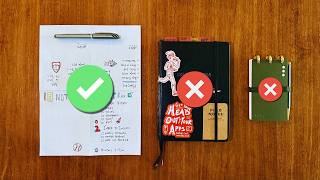
In this informal instructional video, the creator proposes a minimalist weekly planning system that replaces bulky analog planners with a single sheet of paper folded into eight panels. The presenter walks through folding the paper into quarters, allocating six panels for each weekday, one for notes, and one for a weekly review. He introduces the GAP method—identifying 2‑3 weekly Goals, listing Action items for each goal, and scheduling Protected time blocks to work on those actions. The video contrasts this low‑friction approach with more elaborate systems like Bullet Journals, Field Notes, and analog cards, emphasizing flexibility and the value of using multiple tools rather than insisting on a single perfect system. The creator cites inspiration from Van Neistat and mentions a future binder‑archiving workflow. Throughout, he encourages viewers to adopt the paper method, subscribe to his newsletter, and watch a dedicated GAP‑method video for deeper instruction.
Chapters
You know, I love the Bullet Journal, Field Notes, and Analog Cards. But what if I told you there was an even simpler way to plan and track your work each week? A tool that was big enough for a week of work, so a little bit bigger than a note card, but much easier to carry with you than the big A5 Bullet Journal. I present to you A piece of paper. Oh, oh, pardon me. Look, I shared this on my newsletter and I got a bunch of replies about this. And by the way, if you're not on the newsletter, I share early stuff like this all the time. So make sure you subscribe in the description below. The reason that I tried this is because, you know, sometimes the Bullet Journal just feels a little intimidating. Or like, oh, I wrote down a bunch of— like, I planned out last week and I didn't write everything down yet. So like, I feel kind of bad starting out a new week even though I didn't finish the last week. And now there's empty space on my bullet journal and ah! And it may also just be that like, you don't want to buy one or you have one on the way or like, ah, it's in my shopping cart. I just haven't pulled the trigger yet. So instead, the sheet of paper. You can find, you can find a sheet of paper, right? So let's do it. Grab that piece of paper. We're going to fold it up. I'm going to show you what to do to turn one simple sheet of paper into a productivity powerhouse that will help you reduce overwhelm, stay focused, and achieve your goals. Let's do it. First thing you're going to do with your sheet of paper is to fold it into quarters. That will give you 8 squares front and back, and so that means you have enough for your goals Monday, Tuesday, Wednesday, Thursday, Friday. That's 6, and then we've got a notes or extra task page and the wrap review page. So if you use both sides, you have space for everything that you need to do, plus extra space for planning the goals that you have for the week, reviewing them, and then making some additional notes. I usually have enough room for notes on each daily square as well. But like I said, if I go way over this, then usually it's because I'm either writing down too many like tiny tasks that don't really need to be written down, or I'm putting too much on my plate and I know I'm kind of headed for burnout and I should probably push some of these to another day. You're probably wondering, why do this at all? You're the Bullet Journal guy, you love the Bullet Journal, you also love Field Notes, analog cards, the whole thing. Here's the thing, like, sometimes you just got to be comfortable with understanding that you're going to use a few different systems. And as long as you're tracking and writing and doing the things that matter to you, you probably got to get over just trying to have like a single, like, solid system. Because I can tell you, once I let go of the need for everything to be perfect with my like productivity notebooks and papers, my business papers— shout out Chase Reeves— then I got more done and I felt a lot better. So I'm just giving— I'm just giving you options here. Yeah, I'm a bullet journal guy, a Field Notes guy, I'm an analog cards guy. Sometimes I'm just single piece of paper folded up 8 different ways kind of guy. I think being your best self is doing the things that feel right to you and being able to trust those things. Find that lane for you, find your groove, feel like brave enough to trust it, and then just write it down and get it done. Now on the very front first page, you're going to write down your standard gap layout. So what are the 2 to 3 goals? In this, I usually just do 2 goals. What are the 2 goals that you have for this week? What are the action items? And then the P for Protect— when are you protecting time to work on those actions so that you can achieve your goal? And then moving, you know, across thing like you're just opening a greeting card, open it up Monday, next day Tuesday. I do like to kind of pre-plan in my protected time, and that's pretty much all that I write in for a given day. But like, say for a YouTube video, I'm going to do some planning and filming on Tuesday. So I go ahead and write that into Tuesday and Thursday. I'm recording this part on a Thursday and it's during protected time that I already had. Not gonna lie, I first saw a version of this from Van Neistat, who is Casey Neistat's brother, one of my— both the two of them among my favorite YouTubers. There's no real set format to these things. They evolve and shapeshift from list to list. And he does a similar, like, foldable productivity sheet. He's also where I got the idea to use binders to save them, very middle school style. I also like this because of its portability and its visibility. Obviously, it's easy to put into literally any kind of pocket, and I can also just like lean it up on my monitor really easily. But now you can— very backlit, I'm sorry. But now you can also see that I have it propped up right here. I could also get a little bit lower. I can move it around. The point is that I am always looking at what I need to do. And yes, I also do this again with the Bullet Journal. This isn't again, like talking about replacing the Bullet Journal, but it is about having additional options and also about removing and reducing friction to getting your ideas and your tasks out so that you can get a move on with the work that you want to be doing and the life that you want to be living. When you're done with this page for the week, it doesn't really matter. And I like to save them for a little while. I just either put them in a shoebox to save. I also have a binder on the way, very middle school, but I have a binder on the way. 3-hole punch this bad boy and it goes into the archive for 2025. Hey, so I didn't really cover the GAP method that I talked about on this video. You just saw some examples of it. If you want to go through the GAP method and use it to plan and perform in your most productive week ever, pen and paper, no apps, no overwhelm, no distraction, just watch the video here and you are going to learn all about it. You're going to have a great week. Sign up to the newsletter as well. Reply and say hi. Glad you watched. Thanks. Bye.