You don’t need discipline if you do this ONE thing
Matt Ragland argues habits don't require discipline if you make them tiny enough. Research from Stanford shows putting on running shoes leads to more running than asking people to run. Start with minimal effort actions you can do consistently, use a physical habit tracker, and pair new habits with ones you already do.
Chapters
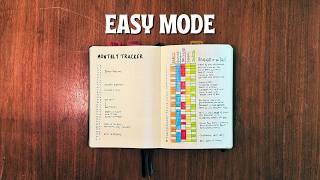
The problem most people have with habits is they think that it takes a lot of discipline and willpower to be able to get the thing done, that it takes a lot of effort and energy. And that's not entirely wrong, but it's also not entirely true. I'm going to show you how common beliefs around discipline and willpower when it comes to habits are not the full story, and that starting, sticking, and building strong habits isn't as hard as you've been led to believe. Now, this has been proven from research at Stanford and Harvard and many other well-respected institutions., and I've used it in my own life to build a lot of strong habits. And you can do the same thing as long as you're willing to accept one simple truth. This is Analog Action, so go ahead and grab a notebook and pen, and I'm gonna show you these science-backed strategies to build lifelong unbreakable habits. The common approach to habits is to think of it as a challenge of discipline and willpower. But what I've noticed and what the science shows is that this is actually doing it on hard mode. Like if you're trying to build a workout habit. And so you go do this really big CrossFit workout and then you're exhausted and you're sore and literally maybe you get sick and you're like, I can't keep doing this. The other tough thing about this is that if you go really hard in the beginning, you're actually not seeing any results other than being sore. And then your body is interpreting that as a bad outcome. And again, you're like, I'm not going to do this. Another way we've talked about habits on this channel a lot is through journaling. And you could apply the same hard mode thinking to journaling, thinking about, say, the Julia Cameron Artist's Way of 2 to 3 free-flowing pages per day. I'm gonna tell you, that's not the easiest thing to do. Even if all you do is write down for 3 pages, this is not the easiest thing to do. I have nothing to say. You are still like kind of mentally realizing that this is kind of dumb. That's how I think about it.. And so I don't keep doing is like, I'm not gonna sit down and literally write, this is dumb for 3 pages. Instead, think about these things on easy mode instead. Now, all of you can come up with your own version of what easy mode is, but I would encourage you to really think about what is easy mode, and it could actually be a lot easier than you think and still be very effective. If we take the big workout example, Maybe it's just go for a walk around your neighborhood. Or if we take the journaling example, instead of 3 brain dump pages, we're just doing 1 highlight of the day. These things are very effective with building momentum and doing something that you can repeat day after day, which builds belief and confidence in yourself that you're the type of person that can sustain and build this habit. Because here's the simple truth that a lot of people ignore or just don't think is actually true, even though it is, that if you stick with something long enough and consistently enough, even if you don't do it in large quantities or for a long time each time or every day that you do it, you will become better at it and you will build that belief and confidence. There's actually a study about this that Professor BJ Fogg at Stanford called the Tiny Habits Study. And what he literally did, and this is why I said earlier, this could be even quicker and easier than you're thinking. He had people do a running study. So, you know, a type of exercise. And he wanted to see how many miles or how many minutes people in the study would run. And so he told one group, all you have to do is go out and run. Let me know at the end of the month how many minutes or how many miles or whatever that you ran. And the second group, he said, the only thing that you have to do— you are in the running group, but really the only thing that you have to report back to me on is did you put on your shoes, your running shoes, not just like regular shoes, and then report back to me if you also ran like a certain number of minutes or miles. But the only thing you have to do is literally put on your running shoes. And the crazy thing is that the people who were told all you have to do is put on your running shoes, you don't actually have to run. To get credit for checking the box that day. The other group had to actually go for a run, but the second group just had to put on their shoes. And wouldn't you know, the second group actually ran more than the first group did, even though all they had to do was put on their shoes. And this is the simple truth that I want you to be willing to accept, even if it feels a little silly, is that if you can take that first small step, then you will be literally on your way to building positive momentum in the kind of life that you want to be, the kind of life that you want to live, and the kind of person that you want to be. So let me show you what we're going to do with a tracker here in the Bullet Journal. And I got to be honest with you right from the beginning here that when I made this tracker, this color-coded one is not normally what I do. Honestly, I made this just because I knew it would look better on the thumbnail than just having the like black and white one. But this is what a lot of people do with their trackers is this kind of grid style. And all you have to do is take out a ruler or some other like straight edge object and just start making a bunch of lines. I don't normally do this because it requires me to make a bunch of lines, but to be perfectly honest, this takes me more time than I want to spend on it, but at the same time, it takes less than 10 minutes to do this entire grid. And obviously, if you have fewer grid lines, then it'll take you even less time. You can also see my standard, uh, monthly layout here, which is the day of the month in one column and then the day of the week in another column, and then the highlight of the day to the right. Now, if we go back a couple of months, I'll show you another one. This is normally what I do, even though, as you can see, I did not do a very good job with my one-sentence highlight in January. But this is more what I do instead of worrying about specific grid lines. I basically just let the dot grid be my grid line, and I just make little X's to indicate if I did the habit for that day or not. Now, we can also look at another thing is like if you want to give yourself a little bit more information about what you're doing in your habits, you could do something more like this, which is almost like a little description box or like mini journal on each of these. Like for me, these 3 core habits that I want to practice every single day. So you can see I'm writing down like, hey, jiu-jitsu at 6 AM, workout in the garage, went for a ruck while pushing Hallie. I read Running Man by Stephen King. I read Project Hail Mary by Andy Weir. I'm reading Iron John. But this gives me a little bit more information than just checking the box, just coloring it in, or like just making a little X. Next to it. So remember this: don't put yourself at a disadvantage by putting your habits on hard mode or having an environment that kind of encourages you to do the thing that you don't want to do. Instead, put things on easy mode, quick and easy mode, and make sure that your environment is optimized to support the habit that you want to build and get rid of the habit that you want to break. I also encourage you to make this simple habit tracker in your notebook or in your bullet journal. This way you won't be tempted by another app and you can not use your phone any more than you have to or more than you're tempted to. Again, like for me, that's another habit that I'm trying to break, just the little, little twitch towards the phone. And if there's something that I can write down and track in my notebook instead of on my phone, then I'm going to do that. I think you should too. Check out this other video that I have about habits. There's another thing in there that I didn't talk about in this video called the tow truck trick. Where you're kind of pulling along a good habit with a, like, normal boring habit. So make sure you check that out. You're gonna find it useful in your habit building process as well. Thanks for watching.
More from Matt









Journal reading 📖 Reflectjons on how I’m living & how it aligns with the vision I have for my life.

You don’t have to listen to me. But you do have to be intentional about the systems in your life.
