Ask Me Anything (AMA) with Daniel Krassenstein
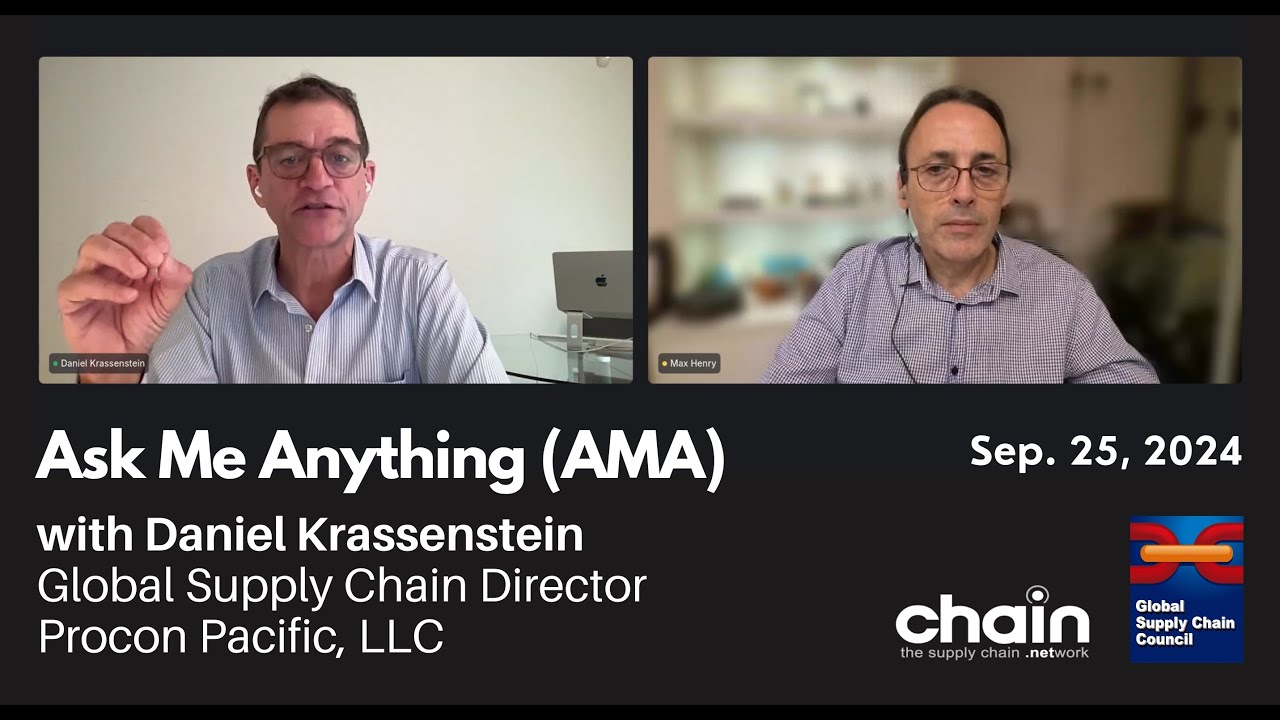
In this live AMA hosted by Max Henry, founder of the Global Supply Chain Council, veteran supply‑chain practitioner Daniel Krassenstein shares 40+ years of experience across Asia and the United States. He recounts his career path—from early Mandarin studies in Taiwan, ocean‑freight roles at Sealand and Maersk, to running a Chinese‑based manufacturing operation and later shifting production to Vietnam, India, and Mexico. The discussion covers the feasibility of de‑risking from China, operational and financial challenges of moving to Vietnam, India, or Mexico, port and logistics considerations (e.g., Mundra, Nhava Sheva, Singapore, Malaysia), credit terms, trans‑shipment risks, and the impact of geopolitical tensions (US‑China trade, tariffs, immigration). Krassenstein explains sustainability and CSR practices in India, the role of the Regional Comprehensive Economic Partnership (RCEP), and the limited current use of AI in procurement. He also advises on structuring global sourcing teams, the importance of maintaining decision‑making hubs (e.g., Shanghai) while locating boots‑on‑the‑ground staff near factories, and handling corruption under the US Foreign Corrupt Practices Act. Throughout, he emphasizes a balanced “China‑plus‑one” approach rather than abandoning China entirely.
Chapters
All right, we're live, so let's see if people are coming. Okay, so if you're just arriving and just joining us, uh, just give us a few minutes. We are getting everybody to, uh, to board and join the session. So give us a few minutes and then we'll get started with Daniel shortly. Thank you. All right, well, we're waiting for people to arrive. I just want to welcome all of you to this new session. So as you know, this is the first time we do this Ask Me Anything session with the Global Supply Chain Council. My name is Max Henry, again the founder of the organization. So how does the AMA work? I mean, it's very simple, very straightforward. We have been inviting Daniel, you know, to join us today, who's going to introduce himself. Daniel has been, you know, working around the world and focusing on supply chains, global sourcing, and logistics for a number of years. And I felt that he had, you know, a lot of experience and some great expertise on all those topics. So the idea again of this event is that this is your event and we want you to ask questions. So anything that you have related to those topics that we have already proposed on the event page is good for Daniel. Daniel is happy to respond and provide advice and give suggestions. So feel free to ask questions using the chat, which is located at the bottom right corner of your screen. There's a kind of a bubble that you see, and when you move your mouse on it, you will see there's a chat. You can ask a question at any time. We will prioritize those questions and take them as they come. All right, but before we get started, I'd like maybe to give a chance to Daniel to introduce himself briefly, and then we have a few topics that we can start with while we're waiting for your questions. So Daniel, welcome, go ahead.
Yeah, thank you. So I'm Daniel Krasenstein. I'm an American who's spent most of my adult life overseas, which is unusual because For those that are not familiar with the United States, it's a huge market which is very homogeneous, English being the lingua franca, English being the most common language, and US currency being the single currency. Spanish is the number 2 language, but US is very dominant and the market is very large. And so for the last 75 years post-World War II, most Americans are really intra-focused, focused within the United States where their production and for their sales. It's not like other countries in the world that are so reliant on global trade. So, it's quite insular. It can cut itself off from the world if it needs to. So, I came from that environment at age 21, moved overseas to Taiwan. I was a Spanish speaker because I'd studied it in high school and college. I thought I was a Spanish speaker at least. And then, my father gave me very sage advice. He says, go learn Mandarin. And this was back in around 1982, '83. And he had been to China a few times and he saw the future. And I took his advice and moved to Taiwan and stayed there for 3 years, got my Mandarin fluent, or at least quite conversational, business conversational, we can say at that time. And then followed my career path. I ended up getting into the ocean freight industry. I was hired by Sealand. In Taipei. They moved me then to Chicago and then to New York and then to Jakarta, Indonesia for SeaLand Service, which is now part of Maersk Line. Later I went to work for Inchcape, who took advantage of my Mandarin and moved us to Shanghai, where I was part of a management team running an 82 Scania truck long-haul container haulage company with a Class A forwarder license and 2 warehouses. We did the, the back office consolidation for H&M department stores out of Sweden. We did their China production consolidation, warehousing, and export. And we did the inbound for Volkswagen where they were bringing CKD from Germany into China. Then TMM Mexican Line hired me and took advantage of my then fluent Spanish, moved us down to Panama where I ran Central and South America and later Mexico City headquarters where I had P&L responsibility for global ocean freight divisions of TMM Mexican Line. Until they got acquired by CP Ships, which I believe is now part of CMA CGM, I believe, or Hapag-Lloyd, I forget which. And then all this time I had owned a company on the side making ballpoint pens, and these pens were primarily used in the US pharmaceutical industry. So we would print Viagra or Lipitor on the side, the drug names on the side of our pens, and give them to doctors as gifts. So I disrupted that market back in the late '80s, directly manufacturing in Taiwan these pens and directly selling it to the ad agencies who would sell them to the drug companies. So, I cut out about 3 levels of middlemen and better quality control, better transparency of logistics, and did very well in that market until 2008 when US Congress decided that gifts to doctors should be illegal because it was considered corruption. And that's why US healthcare costs are so high, which is not true. But it shut down my business. So then I joined the company I work for now in 2008, a Chicago-based company called Procon Pacific. And they hired me in Shanghai, where I had been living at the time, to look after their China operations. And that was fine for about 8, 9 years running operations in Shanghai, where my factories were all over Jiangsu and Shandong Province primarily, and a little bit in Chongqing until labor costs in China started to increase, and social welfare costs from maternity to, um, unemployment tax to cleaning up the exhaust from the factories, it just drove up the cost of operations. The overhead and labor in China tripled, quadrupled, went from $200-something a month US for a typical blue-collar worker at a factory to today over $1,200. So essentially what I did, I took my lower, lower-end, less risky production, and I started experimenting with placing some orders in Vietnam, placing some orders in India. And what I was— the most important lessons were it was a heck of a lot cheaper, but a heck of a lot more risky. And what you had to learn, you had to— and we're going to get into some of the Q&A on these points, but it exposed me to how different Southeast Asia and South Asia were to a now quite mature China in terms of procurement. And it's not just quality control, it's price transparency, cost transparency, it's, uh, of course quality control, it's order predictability in terms of lead time, it's how do you get the cargo from factory to port, it's how reliable are the vessels, are there transshipments, and so many things in the learning curve. And how do you manage it? And over time, who who is an ideal partner for you? Who's a good who do you have good relationships with? And that's a trial and error. And which clusters should you go clusters should you go for? For example, in Vietnam, do you go in the north towards Hanoi area? Do you go in the south towards Ho Chi Minh? In in India, do you go to eastern India like northeast where labor cost is a bit lower close to Bangladesh in Calcutta in West Bengal, or do you go in the southeast to Chennai or Madras in Tamil Nadu, or do you go to the west? And there's pros and cons of each depending on your priorities. So it's a learning curve. So that's where I'm at now, and I think that's a good lead-in to where we are today, Max.
Okay, great, great expertise, lots of experience across, you know, Asia and, you know, in the US. So let's, as I said, so people are joining us still, still now. Again, if you have a concept of EMA that you have any question for Daniel, feel free to ask your question using the chat, the chat bubble which is located at the bottom right of your screen. But let's get started. Daniel, there's a lot of discussion and a lot of debate right now about, you know, de-risking from China. You know, how realistic do you think companies— how realistic it is for companies who have invested for all those years. We're talking about 15, 20 years in some cases. Most companies have put enormous resources, time, and money into the China market, you know, and trying to diversify their suppliers. So do you think this transition is as feasible as it seems?
Yes and no. Let me clarify. It really depends on what industry you're in, Where is your consumption market? Where are you selling to? Your size of your company, your position in the market, and your own cost-risk balance, right? So think about this. China in its own right today in 2024 is a huge consumption market. So for those companies that have been in China for the last 10, 20, 30 years and they have the $500 million, even $30 million capital investment within a factory there, if not more, you're not going to just leave because what do you do with your sunk investment? What many companies, many successful companies— and this has been done in a lot of surveys from the American Chamber of Commerce in Shanghai, where I also passed board of governor— we did these studies surveying a lot of the, at least the American companies. I'm sure the German Chamber and Eurochambers have done similar type of studies. The most successful companies operating in China have consumption markets within China, within Asia, to Europe and North America, and to the RTW, the rest of the world. So you have a balance of where you're selling to. So the first part of my answer to you is, Max, is where are you selling to? Because if China and nearshoring Japan and South Korea, perhaps Taiwan, perhaps Southeast Asia, nearshoring is an important market for you, it behooves you to stay in China to a certain degree. If, however, United States in particular or European Union in particular are your niche markets, then it's quite important to understand the geopolitical risk of your various countries' relationships with China and what's— how's it look in terms of tariffs today, import duty tariffs today, and what are expectations for a year from now, especially in the United States if Trump were to win. But don't kid yourself, the Biden/Harris Democratic Party as well has quite anti-China rhetoric, and I expect duties to go up for them as well, even though they're not talking about it. So for the United States as an example, if the US is your ultimate market, it's very important that you're cognizant of Where is those— where are the duties going? Because that's a major added cost. So where are you selling to? How big are you? In other words, if you're a small, medium player, you might not have the wherewithal to shift away from China. China still has economies of scale where they can produce widgets a lot cheaper than other countries if you're buying in quantity. And if you're buying in smaller quantities below MOQ or you're buying 1,000 units or 100 units and not the tens of thousands of units, You might not have the ability to escape China because China might be your only country of origin who's willing to sell to you at that quantity, although it might be through a trading company because factories probably don't want to deal with you in those quantities. I would say back to your question, Max, where's the trend line? The trend line for sure is to diversification. It's friendshoring, nearshoring. Friendshoring would be an India, a Vietnam. Nearshoring and slash friendshoring would be a Mexico. There is some onshoring, which means bringing— for the United States as an example, bringing factories back to the United States. But that's very limited to mostly automated manufacturing or final assembly to avoid duties and to de-risk, because then they know they have inventory of the components and they're not reliant on a border to bring product in. I would say that Southeast Asia, primarily Malaysia, Thailand, Vietnam especially, the infrastructure has improved a lot and the global connectivity has improved a lot. Southeast Asia, primarily India, labor cost is very low. It's still in the $200 to $300 US a month labor level for most of India for production. And the infrastructure is slowly improving depending on where you are. If you're in northwest Gujarat, which is where the Port of Mundra is, or if you're in Maharashtra where Mumbai/Bombay is located, the infrastructure's improved dramatically. But overall, to answer your question, depends on your industry, your size. But so far, the big winner in diversification honestly has been Mexico. And it's interesting that a lot of the movement to Mexico has been by Chinese companies who have the foresight to realize They need the US market, but the US doesn't want them anymore. So they're figuring out, okay, then we're forced to go into Mexico for our maquiladora type of manufacturing. And for Europe, I think it's probably a similar type of answer. And that could be in a Poland, in a Romania, in a Turkey, nearby countries that have good relations with the EU, but much lower labor costs that China could set up EV manufacturing and other type of products. Does that answer your question?
Kind of? Yeah, thank you very much. Yeah, again, if you have any question for Daniel, feel free. This is an AMA. This is your event. So please ask question to Daniel using the chat. You can type your question in the chat and Daniel would be happy to take it.
So I like random questions. Bring it on. Bring on the random questions.
Yeah, bring it up. Any questions, you know, related to those topics. So for companies considering shifting procurement or their supply chain to countries like India or Vietnam, you know, what do you think are the key operational or financial challenges that they should be prepared for given their longstanding reliance on China?
Sure. Some of them I touched on earlier, but I'll review real quick. Again, it depends on the industry and the product you're making, but like most products, you're reliant on raw material and you're reliant on semi-finished products. So if you were to go to a Vietnam or an India or Mexico or Turkey, dig deeper, understand upstream. Where are they procuring their raw material, their polypropylene, the polyethylene? Where are they getting their motors and their glass and the parts that are critical for the manufacturing? If they're buying those from China, be very careful on country of origin rules if you're selling to the EU or the US. That if that's a high-value component and the other components and the labor are less than 50% value, that will still be treated as a made-in-China assembled elsewhere type of product and could still be subject to duties and punitive duty damages. So know where the product's coming from, both in terms of cost and in terms of risk, because there's been times where an origin country— and let's use Vietnam as an example— where they're bringing in a BOPP film, a technical term used in our industry, a certain component coming in from Shandong Province in China. And if there's lack of space from between China and India or China to Vietnam to bring those components in, you could have a delay in your production waiting for a semi-finished product. Make sure the factories elsewhere in Vietnam and India and Mexico, they're familiar with your routines and your SOPs. Talk about credit terms. In China, I was easily getting 60 to 90-day credit terms from my suppliers after FOB on board date. I wouldn't have to pay them with no deposit, no LC, just based on trust and wire transfers. 60+ days post, um, selling is when we were due. In India, I can stretch that to 105. So understand credit terms, understand the container routing. For example, from a Shanghai or a Shenzhen, or let's say a Yantai or Hong Kong into LA, is a straight shot, 11 to 15-day sailing, all else being equal. If you're going from an India to a New York or Chicago, 'cause understand the further west you go in Asia, the more likely it is using transatlantic as compared to transpacific is the logical routing. Well, now with the Houthi rebels shutting down the Red Sea entrance through the Suez, we've been forced to route our cargo under Cape of Good Hope, which adds a couple more weeks of sailing time, but also throws new risks. For example, there was an MSC vessel just 2 weeks ago with one of my containers on board— luckily didn't get damaged— that lost a few dozen containers overboard in bad sea conditions south of Cape Town. And it caused a major delay for us. Luckily, we did find out our container wasn't damaged, but just one more variable. You can imagine how many variables us global supply chain practitioners have been dealing with since COVID It's like one after another. What's on your bingo card? What's the next new risk? Well, now you got to deal with weather patterns, right? So understand those risks, understand how the cargo flows. Is it a direct sailing or does it do a transshipment? A lot of the containers sailing out of India If it's East Coast, excuse me, out of Calcutta or Chennai, there are no direct sailings to the United States. Everything must transship over Colombo, Sri Lanka, or Singapore. If you're out of West Coast, Mundra, Narasiva, the 2 big monster container ports on the West Coast, which are quite modern, primarily those are direct sailings to the US East Coast, New York, Norfolk, Charleston. And for Europe as well, going into the key European-based ports or Mediterranean ports. So understand the routing, understand various variables, anything from moving a container from a factory to a port in a, in a Jiangsu Province to Shanghai or a Guangdong Province into Yantian. Those are routine.
Okay.
In a place like in India, it's not necessarily routine, especially during monsoon season or when there's strikes, which in a democracy do happen on a regular basis. Sometimes the vessels would do— I learned a new word in English recently, it's called a preponement. This is an Indian English word which means the carrier, for whatever reason, even though they told you October 12th was the, the port gate cutoff, you arrive by October 12th at midnight, you're guaranteed on board as long as you have a proper booking. Well, arbitrarily they decided to prepone the cutoff to October 10th. Sorry, you arrived on October 12th. You're sitting for a week and you're paying storage charges. So things like these random type of things happen, guarantee fees. And one final thing to consider if you're considering shifting from China to elsewhere, your China supplier still has to survive. So what are they going to— how are they going to react if you're a key customer? They could react by talking to your competitor and saying, hey, I just lost my big customer. Are you willing to work with me? Or they could decide to set up an office in New York or Hamburg and start going direct. So just don't think they're going to stand still. They could take action to you making action. So maybe it behooves you to keep your toe in the water, keep some business in China with your key suppliers, maybe just reduce the percentages a bit so they're not going to turn around and screw you.
Okay, great. A lot of advice here. And again, if you need clarification on what Daniel just said, just feel free to comment in the chat. So Questions are coming in. This is great. So let's start with a question from Louis, who's saying— was asking, talking about geopolitical risk with the Patriot bombs and the US discussing banning Chinese software and hardware in cars, do you see the world evolving into the US supply chain and China supply chain? If so, how will this impact SMEs?
Great, Louis, great, great, great question. Very timely. I might not be the right person to answer this, but I'll give it a shot. Again, like I've used as a caveat several times, depends on your industry. You've already said for an SME, so obviously you're talking about a smaller size player. I don't like it because I've lived in China for 20+ years. I've lived in the US for 20+ years, and that's my home country, and I have an affection for both countries. I'm not happy about the way things are going. I'm a free trade, laissez-faire kind of guy, and I'm an anti-war kind of guy. So I don't like the way things are going, whether it's economic war or hot war. But things are absolutely— the trend lines are definitely going in the wrong direction, which means— I guess the premise of your question is, will there eventually be a non-China affiliated supply chain? Primarily led by the US and Western Europe, and a China-led supply chain, perhaps with Russia, North Korea, Syria, Venezuela, and other players who are less friendly with the global order, if you will. Yeah, I do see that more and more. I see the RMB being the primary currency of that. It could be an e-commerce version of that. I see the US trying to protect its own supply chain. And beyond military, I'm just talking about consumer goods. So I do see more and more of a division of us versus them. So yeah, I do see that in this new proposed ban on Chinese software going after the Chinese EV market. It's a sideway of shutting down EVs coming to the US and Europe. Although I think Europe is probably going to cave first. I think the German automobile industry is too reliant on China. for its export market and is probably willing to do some joint ventures with Chinese battery makers and Chinese software makers. So you could see some Chinese-German hybrid cars hitting Europe. So the answer to your question is you did use the word US. I do see the US supply chain separating from China's supply chain. Europe will probably end up being a hybrid type of supply chain.
My opinion. That makes sense. Yeah. Okay. Great. Next question from Shandan is asking, do you think Mexico can be looked at as an alternative source compared with India and China with quality in focus?
100% yes, especially because you use the word quality. But I would add to that risk diversification because quality you can control. Mexico is so close to the US. Although it's a different language, different culture, North American over the last centuries have learned from each other and they work with each other. And it's a huge amount of US investment already in Mexico and Japanese investment. So quality standards are already there throughout Mexico if somebody wants to make things the right way. The concern is cost. If cost was not a factor, Mexico would be producing 3 times as much as it is today. But if you look at Mexico as an origin of manufacturing, you are doing some cost reduction in terms of logistics. You're certainly doing a reduction in terms of risk. But the labor cost in Mexico is— I don't know the exact number, but if it's $1,200 a month for a laborer in China today and $300 a month for a laborer in India today, and let's say $750 to $800 in Vietnam today. I'm guessing Mexico's in the $3,000 range.
Wow.
2.5 to 3 times as much as China. Maybe it's not that high. Maybe it depends on industry and skill. Maybe it's close to $2,000, but it's certainly more than China. So if you're gonna consider moving to Mexico, unless you have better information than I do, and I'm doing a little bit of guesstimating, I think the labor cost in Mexico is really going to drive up your cost. But again, it could be the niche specialty you're involved in, the technical expertise required. China could be equally expensive for that level, therefore Mexico might be a wash. So yeah, I would say if quality is your focus and US is your market, Mexico is a no-brainer. If Europe is your market or other markets, it may or may not be. You might find the Mexicos of Europe like the Turkeys or the Romanias that I alluded to.
You mentioned earlier that Yeah, that a number of Chinese companies are moving some of their manufacturing to Mexico. Are those Chinese companies more competitive when it comes to cost and labor costs in particular?
I don't know firsthand, but my assumption would be they're bringing in components from China and/or raw material. So they already have an advantage of material cost.
Yeah.
And they simply have to transport it from a China to a Mexico, which is not hard to do, and it's not as expensive as you think it is. Bring it into Mexico for assembly, perhaps adding some components coming from other countries, including Mexico itself. So it's adding to the labor pool in Mexico, which is a good thing for Mexico. I would say that would certainly have an advantage of purely buying from China and perhaps purely buying from Vietnam. But it would not come close to the labor cost advantage India has. If you can figure out the solution in India or parts of Eastern Africa, which will be the next India, you can't beat the labor. So it really depends on your product, how labor intensive it is. If it has some level of technology where somewhat automated lathing or automated tools making the product, Mexico is a very— it's quite a viable solution cost-wise, especially if some of the components are still coming from China.
Okay, great.
Or if coming from the US for that matter, the components could be coming from the US for assembly in Mexico and right back again. There, it's a, it's a quite competitive opportunity for US-Mexico cooperation.
How hard do you think the US government could go if, you know, they want to block, you know, Chinese-made products in Mexico? I mean, if they already put adding tariff on EVs, for example, from direct import from China, but they could do the same thing on those Chinese companies making stuff in Mexico and apply tariffs as well and, and, and just penalize them. Do you think this could happen as well?
Well, you have a couple rules in play. You have WTO rules, you also have the new NAFTA rules, USMCA rules, in terms of what the US can and can't do to not be in violation of those trade treaties, number one. Number two, A lot of it— and the geopolitical is the key term— a lot of it depends on how hot the US-China relations negatively get.
Yeah.
Whether it's a concern about Taiwan's viability with its semiconductors, whether it's about China's play elsewhere in the world, what's the reaction in the US in terms of anti-China sentiment? And who's in power, whether it's Trump or Harris, and the relations with US and Mexico with respect to fentanyl and opioids. And there's so many different factors at play geopolitically which could impact the US's reaction to China, to Mexico manufacturing. One very— another geopolitical point which is hot in the US elections right now is immigration, primarily illegal immigration coming from Latin American countries, not Mexicans themselves, but people coming from Honduras and Guatemala and Venezuela Yeah. Or other countries, or Haiti or DR, who use Mexico as a transit point. What something that Reagan did very astutely back 30-something years ago, it was the Caribbean Basin Initiative. Essentially cut the duties and quotas against garments coming from certain Latin American countries to create jobs in those countries in final assembly. So you had a lot of peace goods coming from Taiwan and South Korea at the time into Latin America for final assembly. And then they would sail from an El Salvador up to an LA or from a Costa Rica or Guatemala up to Houston or New Orleans at duty and quota beneficial terms. And it created a lot of jobs there. And therefore, the concern of illegal immigration went way down as their economies improved. So the US really has to weigh that carefully. If it wants to reduce the number of illegal immigrants crossing the border, instead of building a wall, maybe the better solution is help the economies in those Latin American countries with more jobs. So it could be shooting itself in the foot by putting duties against Mexico if it causes less jobs in Mexico and therefore more people wanting to immigrate. So it's really all tied to geopolitics.
Yeah, it makes sense.
Yeah.
Again, if you have questions for Daniel, feel free to post it now on the chat. We have more questions to take, but I just want to remind everybody that you can do so and we'll take your questions as they come. All right, next question. This is from Sanjeev, who's asking, who's saying, given the stress on sustainability, will it make more sense to source locally? How do you think supply chains will change based on this?
Well, Sanjeev, good question. I think a lot depends on cost of storage. In other words, do you make to order or do you make to stock? Are you producing for your own inventory and then trying to sell it on a predictable basis, or are you receiving purchase orders and doing back-to-back purchase orders with the factory? So if it's the latter and you're doing make to order, that means you keep less inventory. It's much more difficult to source locally. Your costs go way up. You think about your cost of storage, your cost of money, and sitting on inventory. it's quite expensive for that solution. Certainly you're reducing risk, but your costs go way up. So again, it depends on the size of your company and your risk aversion and what industry you're in. Sourcing locally certainly reduces stress, but can you still make a profit? And that's the challenge is you hit a key question there. And a lot of companies are doing a hybrid solution to that. They are still producing overseas, but they've increased their storage— what was it— safety level of how much inventory they have in stock, safety stock, to handle those bottlenecks and those unexpected bottlenecks and risks along the supply chain. At least they have enough inventory to carry them instead of for 2 weeks, now for 2 months. And they've increased their cost accordingly. They haven't gone to a pure sourced locally, but they've increased their safety stock levels.
So companies have spent a lot of time and money upgrading their suppliers in China on sustainability, and the government also has played a very strong role in it. Do you see it to be a really big issue in places like India, for example, as companies slowly are trying to diversify and also working with new suppliers in places like India? Is there a lot of challenges around sustainability of those factories?
Sustainability is much more relevant in Europe than it is in North America, and let's say United States in particular. Even though large US companies talk, talk the talk, they don't always walk the walk. What I mean by that is in their quarterly reports, the first thing people look at is what's the profit. How much margin? How much dividend? And probably the second thing is risks. Third or fourth would be sustainability. You know, what's your ESG score? Which, or, you know, how you doing? In Europe, it's first and foremost. It's right up there. You want that triple bottom line, including how green are you. A place like India is very interesting. If you look at the history of a company like Tata and you understand the key role that CSR played in its founding, And where we are today in India, if you're a certain size company, and it's majority of medium and larger companies in India, you're required by law to spend 3% of your earnings on CSR projects and ESG and philanthropy charity type of projects, vetted philanthropies, not just pretends. So India does have sustainability written to its DNA, and it's really up to you as the sourcing practitioner how important that is to you and your own company's values and do your due diligence. For example, Max and I were speaking before today's chat about a philanthropy I'm on the board of called Delivering Better Lives, where we've done several projects in India and I've done them with our factory suppliers. So I basically— I'll give you a perfect example. I went to one of our suppliers in Gujarat and said, If I had $5,000 to donate to a charity in India, something not giving away food, but perhaps helping a kitchen, not giving away medicine, but perhaps helping a clinic, something in infrastructure, how would I spend that money? And like that, one of my suppliers said, we're already doing this. We have a great project for you. So we ended up buying 20 tricycles for handicapped individuals to improve their mobility because they were already doing this. So absolutely, India believes in sustainability and CSR and ESG goals inherently. It's part of their DNA. But it's really up to you to look for those companies and don't just look at their brochure, they say it, but actually dig deeper and visit those facilities. I visited the hospitals where they're donating equipment and realized this one supplier was really doing it. So it's up to you. It's up to you to do your due diligence on that one. But yes, it's possible.
Okay. Thanks. All right, we have a question from Kartik as well. So he said lots of valuable lessons in just a few minutes for a session. My question is to understand more about China Plus One strategy. Which location any company should look for a free pair partner as a central warehouse for APAC? Maybe he's talking about regional DC.
Yeah, so when you say regional warehouse in APAC, As a— I'm assuming that means for distribution within Asia Pacific. So regardless of where you're manufacturing, let's say you're manufacturing in China and India. So where would you put your centralized warehouse? And I guess there's a 2-part answer. One is for distribution within Asia. The other is for consolidation and the distribution globally. I'll handle it both ways, if you will. So A lot of companies have shifted from China/Hong Kong to Singapore just because of its central location and its predictability and low-risk factor, because it has a lot of protection from many navies, including its own. It's very modern, and it's geographically centrally located. But Singapore is not cheap. Singapore is expensive. So as an alternative, many companies are looking at Malaysia. Malaysia is very near Singapore. It takes advantage of Singapore's great efficiencies for container ships, but it's lower cost and it has good relations with both China and India and Vietnam for that matter as part of ASEAN. So Malaysia might be your answer. Thailand could be an answer. I think the answer would be to get away from East Asia. and get a little bit more central. That's why I'm leaning towards ASEAN country as a solution to that. In terms of— that's for distribution within Asia. In terms of consolidating Vietnam and China and India and finding a central origin to then distribute globally, that sounds really challenging. And it sounds like quite costly and perhaps not necessary. I think you're better off looking at China plus one country, and let's use Vietnam as an example, and building enough economies of scale so you can fill containers quickly from various suppliers within country and shipping direct from a Haiphong or a Ho Chi Minh to a Hamburg or a Los Angeles instead of trying to combine Vietnam and China as single origin consolidation. So distribution within Asia, I would pick an ASEAN country. Distribution globally, I think I wouldn't try. I wouldn't try to do multi-country consolidation. I think there's enough sourcing within each individual country without asking for more headaches from customs to freight variability with intra-Asia. I think you're asking for too much trouble there unless you're of scale where you have the ability to handle that and you have enough volume. Most people probably couldn't handle that.
You mentioned also the ports in India. If you were to manufacture or source in India today, which port would you prefer to use?
Yeah, simple answer, Mundra. M-U-N-D-R-A. It's run by the Adani Group. It's in western Gujarat itself, is a large state, industrial state. That's where Modi comes from, so it's got a lot of good connections with the federal government. It's quite modern. It has trains, container trains, passenger trains too, but it has container trains that go right from the key production areas of Ahmedabad and Baroda, uh, directly into Mundra Port. Mundra Port, uh, has 3 different large terminals or 4 different large terminals, uh, ultra-modern gantry cranes, deepwater port. So Mundra is a simple answer. We've been using it for years. I've gotten private tours of it because I used to work for Sealand, and a buddy of mine who's high up, a captain, used to work for Maersk Line. He did me a favor and gave me a private tour of Mundra Port. And it's more modern than most ports in the United States, let's put it that way. And it works very efficiently. The only bottlenecks sometimes happen is outside of its control, either because of monsoons or because of issues regarding holidays or non-port factors within the state of Gujarat. But Gujarat is an excellent business manufacturing community. It's a little slightly more pricier, pricey than other parts of India, but you're talking minor. It's worth it to manufacture in and around Gujarat and take advantage of the port of Mundra. Second place I would give to Naharshiva. The other advantage both Mundra and Naharshiva have— Naharshiva is the port from Mumbai— is they're close to where a lot of manufacturing is, and the deepwater ports with direct sailings to most key ports in Western Europe and North America. So you don't have to do transshipments. So back to your question, Mundra number 1, Naharshiva number 2.
Okay, great. Thank you. All right, we have another question from Marky who's asking, with your experience in Vietnam, it's quite often to encounter difficulties about customs or bribe requests. Any tips for handling those situations?
Yeah, first off, don't. Just, just say no. Don't give into corruption. It's a never-ending funnel that takes you deeper and deeper. You don't want to go there, and you don't have to go there. I would say be very careful who you're picking as your local partner. You really shouldn't have to deal with those issues if you're buying on an FOB basis. I'm making an assumption there because we typically leave the manufacturing And the transport to port and the export customs to the local Vietnamese, Indian, or Chinese factory.
Yeah.
So we don't buy ex-works except for when we're doing air freight, and that's an exception, which is easier to handle. For ocean freight, we buy FOB only, so we don't have to deal with corruption. And if there's any issues where somebody hits us up for a bribe, we refer them back to our factory and say, we're not involved in this, we don't pay bribes. And it makes us second-guess, do we really want to do business there? Or with that supplier, if somewhere along the supply chain somebody's asking for money, that probably means somebody took a shortcut. And you don't want to do that because it always comes back to bite you. We have not ever had to. In fact, it's part of my responsibility as an American citizen working for a US company, part of the Foreign Corrupt Practices Act. It's a US Act of Congress where I have to sign a legal letter that said I will curtail corruption. I'm ultimately responsible if there is corruption in our supply chain. Do I look after it? I've had situations where I smelled something didn't seem right with part of our supply chain. I took action immediately, and that person was fired, and we didn't have to deal with that again. So you have to take a very hard line against corruption. Don't take shortcuts. It's just not worth it.
But sometimes your local supplier will do it just to facilitate.
I don't want to. I make it very clear to them. In fact, it's in our purchase order. We have— I have many. I have, like, 26 different boilerplate clauses within every purchase order. So it's a paper that goes with every PO. Every single PO, I said, essentially is a contract. And bribery, corruption is written within our purchase order, as well as subcontract manufacturing. Like in some countries, to subcontract to another factory because they're overloaded, or it's cheaper to manufacture at a local prison. We have that prohibited in our purchase orders and our QC inspectors are tasked with verifying manufacturing location. We want to see the semi-finished components. We want to watch the manufacturing to make sure nothing is subbed out. So bribery and corruption have many, have many forms. It's not just paying money to somebody. It's also dealing with nefarious forces. You just have to avoid it. You have to do your due diligence and be able to look in the mirror when you're brushing your teeth at night and know that you were not feeding the evil, you were sticking in the right path.
Okay. Marky is adding, by the way, any sharing about the application or practices related to RCEP?
RCEP, please help me with the definition.
Yeah, Marky, if you can define RCEP just quickly. All right, hold on, we'll take again a question from Marky after. Louis is adding, by the way, the US FPCA applies not only to US citizens, it applies to anyone working for a US company worldwide.
Louis, you're absolutely correct. The Foreign Corrupt Practices Act holds any employee of a US company accountable for involvement in corruption. So you're absolutely correct.
Okay.
Thank you for the clarification.
Question from Naijun. He's asking, he or she asking, how do you see the rise of artificial intelligence transforming the global procurement scene? And how to prepare for it as a supply chain professional? Good question. Yeah, what's your take on this?
You're asking a 60-year-old guy with 40 years of global supply chain experience about AI. Wow. I might have to call my kids. I need to call my kids on help on that one. They're in their 30s. They know how to answer this one. I know what artificial intelligence is. I've used it as a toy/tool, but not in business yet, although If you saw my to-do list, I keep a daily task list. On there under one of my tools is figure out how to use AI within my job. I know it's coming. I'm sure my suppliers, whether it's vendors in quality control, vendors in logistics, are already using AI as part of their product to me. And it's probably identifying errors, identifying anomalies, And probably popping out a recommendation to you of be careful of this one. So instead of having a clerk go through papers and papers looking for anomalies, they can now use an AI tool to go look through your database and look for things that stand out, look for the tall piece of grass which shouldn't be there. Right? So in that sense, it's already there. How to use it as a supply chain professional? I'm sorry. I'm gonna take a pass for now and do better education. And when we do this max 1 year from now, I'll be better prepared for that question. When, when, Naijun, I don't want to BS you, I don't know the answer to that one. I'm sorry.
Okay. All right.
Somebody else probably does though.
So I just, I was looking online for the RCEP and it looks like it's a Regional Comprehensive Economic Partnership, which is a free trade agreement among the Asia-Pacific countries. So yeah, so there's basically, you know, probably tax and tariff incentives for that. Yeah, this is what Marky is asking.
Okay, Marky, that's a good question. You've educated me. I would say it sounds like it's a free trade accord involving a lot of countries, but especially China, but not the US. Right. And I'm looking at a clarification Kartik just shared. And yeah, I was correct. So it's basically ASEAN, China, but plus Australia, New Zealand, South Korea, Japan. And it makes perfect sense. You don't want to ever put all your eggs in one basket, right? So if you're in Australia or New Zealand, where you're highly reliant on China as a consumption market for your wine and your wool and your milk, right, you don't want to piss them off by cutting off their import. So they're exporting. So essentially, if you want to export, they want balance of trade. They want to export to you too. RCEP, I don't have a lot of experience in it because it doesn't affect the US not being a player to it. It's not part of Western Europe as far as I can see. It's more ASEAN, Australia, New Zealand, more Pacific countries. Japan, Korea, I see is involved in it too. I think that has a— I mean, it's one of the largest growth markets in the world, and that is Asia selling to Asia, right? Not involving Europe, not involving North America. Asian— as the countries of Asia's middle class grows and its consumption market grows, it's more and more important. So it's critical to a lot of these countries to be part of RCEP. I get that, but it doesn't affect me. And I don't know how would it affect US or Europe supply chain other than maybe components are coming in or raw materials are coming in cheaper. But ultimately, if it's for export out of that region, I'm not sure if the RCEP benefits would still apply. I'm just not familiar with it. I'm sorry.
Okay, Mark, if you listen to that and if you have a use case or an example of how you're actually using RCEP, just feel free to share it so we can maybe look at it and comment on it. All right, we have another question. I'm not sure whether you can answer that, but this is from Sanjeev. Can you highlight the startup ecosystem boost provided in China versus the other discussed regions, especially when it comes to automotive or industrial tech products? Do you have any experience with the startups in those industries?
Yeah, I do not. I'm gonna have to take a pass on that one. It's just outside of my experience. I apologize. Okay, good question, Sanjeev. Maybe AI can answer that one.
Exactly. Yeah, so Just one more question about, you know, I would like to go back about, you know, procurement and global sourcing. I mean, we've— there were a lot of talks also previously, you know, in China, a lot of our big companies were establishing, you know, at that time, remember, we were doing events on IPOs and global sourcing office. And, you know, how do you see the global sourcing team evolving? And based on your experience, where a global sourcing team should be and how should it be structured today? If you are a company, are you looking to have and bring all those category leaders and all those global sourcing experts? You know, what would be your advice for companies who are looking to establish this?
Yeah, I'll use my own company as an example. So again, I was initially based in Shanghai. I had a— I still have a WOFI, a wholly foreign-owned enterprise, in Shanghai. Because we were doing domestic trade as well. I had my staff in Shanghai for 15+ years, very experienced, very intelligent, multilingual. They know what they're doing. And as I started shifting production to Vietnam and later to India, I still kept my office, I still kept my staff in Shanghai because they were familiar with the US standards, tolerances, and communication norms. They understood our database. They understood our quality control standards, our PO processing, our pricing systems, logistics. So I had great staff with great experience. So why get rid of that even though you're manufacturing in another country? You just have to teach them to adapt. So to this day, all of my ocean freight decisions, all of my quality control coordination, All of my RFPs pricing, all of my PO preparation still takes place in Shanghai, even though 95% of my production today is in India. One, it's because of continuity. Two, it's because of familiarity and trust. Because think about this, I'm going into a new country, whether it's Vietnam, India, or Ethiopia, wherever I'm going to be manufacturing next. And I keep your eye on Ethiopia. Do you see that as a potential— Ethiopia and Kenya as future countries for manufacturing, for labor-intensive production? When you go into a new country and you don't have boots on the ground, you're, you're dealing with issues of corruption that was mentioned earlier. I don't want to deal with that as best I can, being a responsible person. So why would I move away from the powerful decisions which are corruptible, including ocean freight decisions, quality control decisions, pricing negotiation. Why would they move away from trusted employees in Shanghai and move that elsewhere and take on a new risk? So think about continuity and familiarity. Think about risk aversion and where you're doing it from today. If you're doing it from London or Paris or New York today, or Shanghai, Tokyo, or Taipei, why change it? That should be the first question. Why change my HQ or my decision-making location to— you don't have to move that local. What you do need to move local is order expediting and factory evaluation, factory visits, and quality control in terms of inspection. Not decision-making, but inspection and reporting. I myself recently moved from Los Angeles where I'd been living for the last 5 years after Shanghai to Lisbon, Portugal. And I did that for several reasons, but the work logic, the work justification— I wrote this down to share it with you. When I, when I was living in Los Angeles, the only good thing I had was a 2-hour time difference with my headquarters in Chicago. But with India, I had 11.5-hour time difference. Yes, there's an extra half hour in India. And with China, I had a 14-hour time difference. And it was very difficult to operate using WhatsApp and WeChat respectively for India and China. When I'm asleep, when they're working, they're asleep when I'm working. Now that I'm in Portugal, I have a 5-hour time difference from Chicago. I have a 4.5-hour time difference from India and a 7-hour from China, which means for most of my day I'm overlapping with key stakeholders in what I do for a living, which is very advantageous. The other key answer to your question is I myself, as the global supply chain director, personally vet every single factory. I visit them for the first time, and our key ones I visit 5 times a year. So I myself was just there last month. I'm going again in December. So I go at least once a quarter, plus 1 or 2 more. And my trend— my time of transportation to get from LA to Ahmedabad used to be 27 hours door-to-door. Now I've cut it down to about 16, 17 hours. So think about where your key decision, your key players are located and where you're manufacturing. You want them to be able to personally visit on a regular basis. So a key part of— back to your point, a key answer is you need to have eyes and ears on the ball, be close by what's going on for order expediting, what's falling behind schedule. You need to know it better than your factories even know it. You need to alert them Hey, you're telling me this is shipping on October 2nd, but you haven't even started production yet. Show me your raw materials, your semi-finished products. Show me your production scheduling. You have to go to that level of transparency to cut through the BS. And I do that on a regular basis. Our third-party QC inspectors do that on a regular basis. I'm actually beefing up my staff now to add more boots on the ground, not to do simply quality control inspection, but to actually check inventory levels and to read through the production planning and scheduling books of our suppliers to make sure what the salespeople are telling me matches what their own ops people are telling me. You have to go to the level of detail for production control and for logistics, but not for key decision-making, if that answers your question.
Okay, yeah, that's great. Thank you very much, Daniel. Okay, so it's time that, you know, it's about time we wrap up. There's another question from Shandan about India versus Mexico, China, Vietnam, but I think we will, uh, quick, you quick take, maybe you quick answer on that one, 1 minute, if you had to, to respond to, to Shandan about this, Daniel.
What does USP mean? I said what, what USP India has over Mexico, China, Vietnam?
Yeah, what, what India has over Mexico, China, Vietnam? I'm not sure.
Well, the obvious answer is labor, abundance of labor, and inexpensive labor. And it's a growth market with a lot of government support coming from Delhi for manufacturing, improved, ever-improving logistics, diversification from China, unique selling proposition. Okay, got it. So a feature and a benefit. Exactly. So I answered it correctly. So essentially, labor cost, No labor shortage, improving infrastructure, good relations with every country in the world except for some of its immediate neighbors in terms of trade. So India has a lot of catbird seed advantages over China. Vietnam doesn't have many enemies today, but it is, in my opinion, we don't manufacture in Vietnam today because in my opinion, labor costs tripled from when I first went there to what it is today. It's in the $800 a month level for labor, for blue-collar labor. And I believe it's at overcapacity. So much mobile phone manufacturing and high-tech went in there that it could no longer afford to manufacture the low-cost goods, in my opinion. And I think it had some congestion issues as well. Mexico, fantastic place for manufacturing, but it's got labor cost issues.
Yeah.
So as long as your logistics costs compensate for that and your de-risking portfolio requires that, Mexico should be part of your answer. So I think overall, in a summary kind of answer to a lot of these questions, Max, I think the ultimate answer is all of the above. You want to keep China for certain component part of your manufacturing. You want to add Vietnam, India, and Mexico for certain parts of your manufacturing and diversify a bit. Depending on where you're selling to, depending on your position in the market and how much investment you already have in those markets, I think it would behoove you if you have the ability to diversify, but don't quit China, just de-risk a bit.
Great. Thank you very much, Daniel. It was great having you for that first AMA session. Thanks again also to all the participants for asking those fantastic questions.
Great questions.
Yes, we had some great questions. Again, the session is being recorded, so if you missed part of it at the beginning, you'll be able to rewatch, you know, very shortly, I think within the next few hours on the event page. So you can again get all the best from Daniel within that discussion. Thanks a lot, Daniel. We look forward to again to have you next time.
Thanks, Max. Signing off from beautiful Portugal. Thanks, buddy.
Thank you. Take care. Bye-bye. Bye.