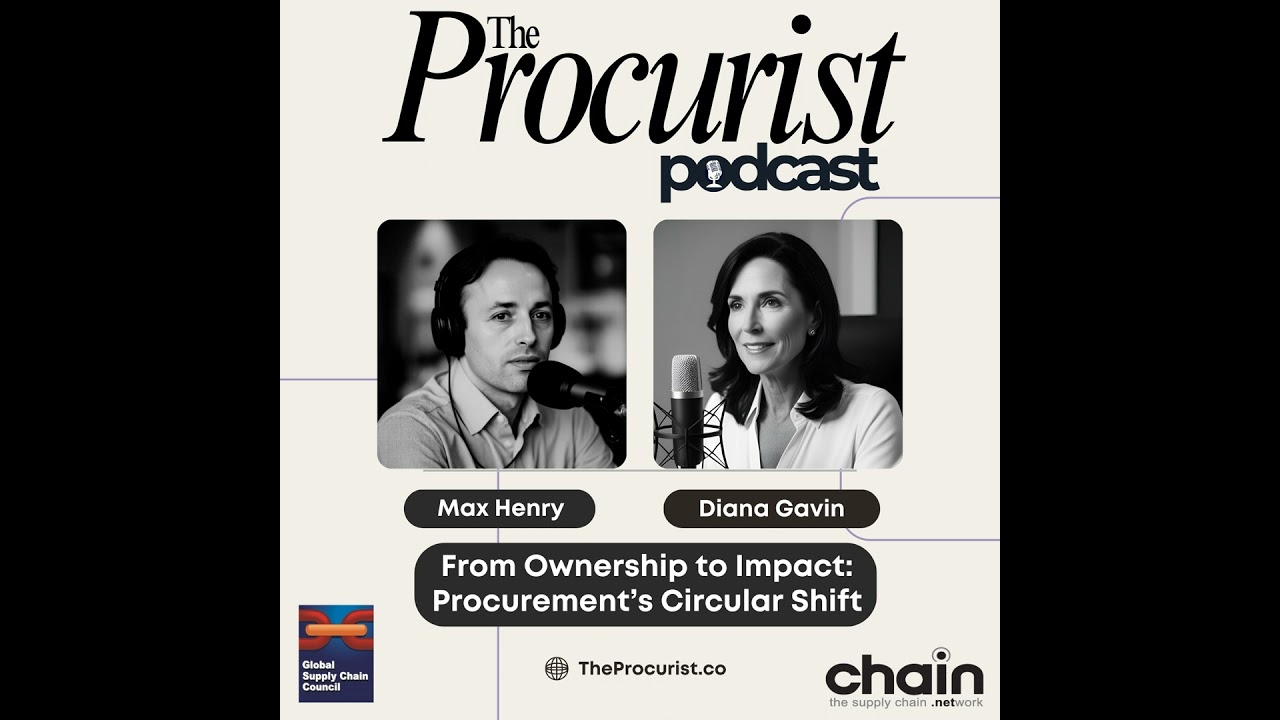
In this episode of The Procurist, host Max Henry interviews procurement veteran Dinah about the sustainable revolution reshaping procurement. Dinah describes a fundamental shift from a linear, ownership‑focused model to a circular, lifecycle‑centric approach, where procurement manages value across a product’s entire life. She illustrates this with service‑based models such as lighting‑as‑a‑service, where suppliers retain ownership and handle recycling. The conversation then moves to AI, which Dinah says will automate routine tasks like tender management and basic negotiations, freeing procurement teams to act as strategic partners. This strategic shift demands new skills: leadership, ecosystem management, and deep sustainability knowledge. Dinah outlines the biggest hurdles—mindset change and the need for infrastructure (collection, recycling, digital tracking). She debunks the cost myth, arguing that circular models often lower total cost of ownership despite higher upfront spend, delivering long‑term savings and innovation value. Finally, she offers practical advice: start with pilot projects, build internal capabilities, and collaborate across the ecosystem to accelerate the transition.
Chapters
Welcome to The Procurist, a show dedicated to exploring the evolving landscape of procurement and supply chain management. I'm Max Henry, and today we're diving deep into what many are calling the sustainable revolution in procurement. Dinah, it's great to have you with us today.
Thanks, Max. It's wonderful to be here. You know, I've been in procurement for over 2 decades now, and I have to say, I've never seen such dramatic changes as we're experiencing right now.
Let's start with something that's been on everyone's mind lately— the shift towards circularity in procurement. What are you seeing in terms of this transition?
Well, um, it's fascinating, actually. We're seeing a complete paradigm shift from the traditional linear economy model, you know, where we extract, manufacture, use, and dispose, to something much more sustainable. Companies are now realizing that procurement isn't just about buying things anymore, It's about managing entire life cycles.
That's really interesting. Can you give us some concrete examples of how this is playing out in practice?
Sure, take lighting solutions, for instance. Instead of just buying LED bulbs, companies are now purchasing lumens— actual light output as a service. The supplier maintains ownership of the physical products and handles all the recycling and replacement, It's a complete shift in mindset from ownership to service-based models.
And what about the role of artificial intelligence in all this? I mean, we're hearing a lot about AI transforming various business functions.
Oh, absolutely. Look, AI is going to fundamentally change how we handle transactions in procurement. You know, those routine tasks like managing tenders and basic negotiations? They're likely going to be automated through AI systems. This will free up procurement professionals to focus on more strategic activities, like managing supplier ecosystems and driving innovation.
That's quite a shift in responsibilities. Do you think procurement teams are ready for this transformation?
Well, it's going to require a significant evolution in skills. We're looking at procurement professionals becoming more like strategic partners. They'll need strong leadership capabilities, ecosystem management skills, and a deep understanding of sustainability principles. It's not just about cost savings anymore; it's about creating value across multiple dimensions.
Let's talk about the challenges. What are the main obstacles you're seeing in this transition?
The biggest challenge is probably mindset change, both within procurement teams and among suppliers. Um, we're asking people to completely rethink how they view ownership and value. Then there's the technical challenge of building the infrastructure for circularity, you know, collection systems, recycling capabilities, digital tracking. It's, it's quite complex.
And what about costs? Many organizations worry that sustainability initiatives will increase their expenses.
That's actually a misconception. While there might be some upfront investments needed, Circular economy models often reduce total cost of ownership. Think about it— when products are designed for multiple use cycles, they might cost more initially, but the long-term savings are significant. Plus, there's the value creation aspect through innovation and new business models.
As we wrap up, what's your advice for procurement leaders who are just starting this journey?
Start small, but think big. Begin with pilot projects in specific categories where circular models make immediate sense. Build capabilities gradually, invest in your team's skills, and most importantly, collaborate closely with suppliers and internal stakeholders. This isn't something procurement can do alone. It requires an ecosystem approach.