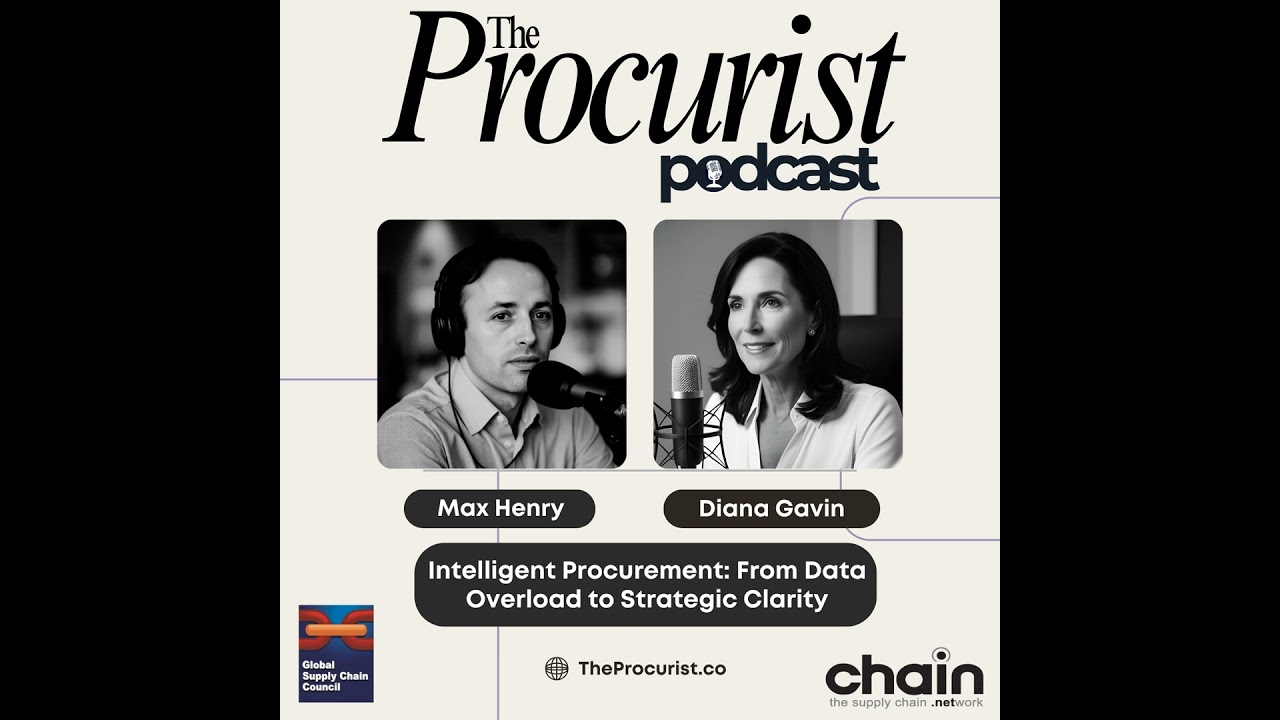
In this episode of The Procurist Podcast, host Max Henry interviews digital transformation specialist Diana Gavin about the current state and future of AI in procurement. Gavin explains that procurement has become a strategic function, yet its technology stack remains fragmented across ERP systems, supplier portals, market feeds, and analyst reports, leading to a paradox where teams are "drowning in data but starving for insights." She clarifies that AI is not a monolithic solution but a toolbox: rules‑based AI excels at structured tasks like invoice matching, while predictive AI supports price forecasting and risk assessment. Gavin outlines five key AI impact areas—smart data acquisition and enrichment, predictive analytics, AI‑driven advisory services via natural‑language interfaces, context‑aware intelligence delivery, and dynamic multimodal content. Emphasizing human‑machine collaboration, she argues AI should act as a decision partner, handling data processing while humans provide judgment and strategic insight. For organizations beginning the AI journey, she advises starting with frequent, high‑impact decisions, assessing data readiness, selecting focused use cases, and involving end‑users early. The main hurdles are organizational—clean data, change management, trust, and governance—rather than purely technical. Looking five years ahead, Gavin envisions procurement becoming more proactive and strategic, with AI surfacing opportunities and risks earlier, accelerating decisions, and freeing teams to focus on value creation, all under human leadership.
Chapters
Welcome to The Procurist Podcast. I'm your host, Max Henry. Today, we're diving deep into how artificial intelligence is transforming procurement decisions. Joining me is Diana Gavin, an expert in digital transformation. Diana, Biro's recent report highlights some fascinating developments in this space. What's your take on where we are with AI in procurement?
Thanks, Max. You know, what's really interesting is that procurement has evolved into this incredibly strategic function, but the tools haven't quite kept pace. We're seeing teams trying to navigate market volatility, drive efficiency, and deliver strategic value, often simultaneously, with systems that are, well, frankly outdated.
That's a great point. I've heard many procurement professionals say they're drowning in data but starving for insights. What's causing this disconnect?
Well, the main issue is fragmentation. You've got data scattered across multiple systems— ERP, supplier portals, market feeds, analyst reports— and they're rarely talking to each other. Teams spend more time collecting and organizing data than actually analyzing it and making decisions.
So, how does AI fit into solving this challenge? I mean, there's so much hype around AI right now. How do we separate what's real from what's just, well, marketing?
That's actually a crucial question. You see, AI isn't a one-size-fits-all solution. We need to think about it as a set of technologies, each suited for different types of procurement decisions. For instance, rules-based AI works great for structured tasks like invoice matching, while predictive AI is better for forecasting prices or assessing risks.
Could you break that down a bit more? What are some specific applications where AI is making a real difference today?
Sure! I'd say there are 5 key areas where we're seeing significant impact. First, there's smart data acquisition and enrichment. AI can automatically gather and validate data from multiple sources, Second, predictive analytics, helping teams forecast market shifts and supplier risks. Third, AI-driven advisory services using natural language interfaces. Fourth, context-aware intelligence delivery. And fifth, dynamic multimodal content formats.
That's fascinating, but I have to ask about the human element. There's obviously some concern about AI replacing procurement professionals. What's your perspective on that?
You know, that's, that's actually a misconception. The goal isn't to replace human expertise but to enhance it. Think of AI as a decision partner. It handles the heavy lifting of data processing and pattern recognition, while humans bring context, judgment, and strategic thinking. It's really about human-machine collaboration.
So what would you say to procurement teams that are looking to start this journey? Where should they begin?
Start with a real problem. Don't just implement AI for AI's sake. Look for decisions that are frequent, high-impact, and currently difficult to make with confidence. Then assess your data readiness, choose focused use cases, and involve end users early in the process. It's really about Building that foundation first.
And what about the challenges? What should teams be prepared for?
The biggest challenges usually aren't technical. They're organizational. You need clean, standardized data. You need to manage change effectively and build trust in AI systems. And most importantly, you need to ensure there's proper governance in place. It's really about creating an environment where intelligent systems can deliver sustainable value.
Looking ahead, say, 5 years from now, how do you see AI transforming procurement?
I see procurement becoming much more proactive and strategic. AI will help teams spot opportunities and risks earlier, make faster decisions with greater confidence, and focus more on value creation rather than just cost savings. But, and this is important, it will still be human-led, Diana, this has been incredibly insightful.
Any final thoughts for our listeners?
Yes, I'd say don't wait for the perfect moment to start. Begin with small, focused initiatives, learn from them, and scale what works. The future of procurement isn't just digital; it's intelligent. And the organizations that embrace this transformation early will have a significant competitive advantage.