Will AI Replace Human Creators? | Marina Mogilko, Sam Lessin, Megan Lightcap
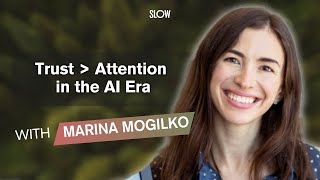
Marina Mogilko built a ten-year creator business by earning trust with immigrant parents, now expanding into a kids-snack brand. She uses AI tools like Claude and text-to-video to scale content, but warns that as AI makes content cheaper and faster, trust becomes the only thing that actually matters.
Chapters
Marina, thanks for joining us. You were, as we talked about a bunch, the first person we invested in, in the Creator Fund, which we're psyched about. And, you know, it tells— we'd love to hear kind of how life's going, how your creator career is evolving, what you see happening in the industry. Give us the inside dice.
Yeah, absolutely. Thank you. Oh my God. So many things have happened since, what it was, 2021. So 4 years, I feel like, The creator economy is evolving at such a fast pace because when I started 10 years ago, there was nothing, like literally nothing for creators. Now we have banks, conferences. I feel like Cannes Lions is all about creators this, this year. And, uh, creators are invited to interview top CEOs and founders. It's just amazing. The industry is evolving. On my end, I'm Always experimenting with new things, as you know. So we're— tomorrow we're officially launching the audio version of the podcast because it's been taking off. We're doing more interviews. I was signed by an agency in Hollywood. They're doing my outbound, and Monica Khan is my manager, and she's been doing an incredible job motivating me and bringing in some good deals. I'm working on launching my snack brand for kids with a founder who's done it before, so I'm not really and like product side or more the marketing side? Yeah. Oh my God.
Well, so I, I love to dive in on that for a second. So like, you know, when we, you and I were talking originally, like way back in the day about the creator model and how to back creators and support them. And you know, at the time, one of the things I thought was most intriguing about, you know, backing you was this combination of you were a great content creator, you had grown big audiences, you cared about the content, you were content and community first, but you also had a background as an entrepreneur.
An entrepreneur, right?
Like you had actually built companies before and like, that's kind of this rare and very important combination. You're now turning around, you're building a new company, right? In this, in this food company. I, I would love to hear the story of like how like that came about, you know, how you ended up doing that and how you're thinking about that as kind of like, because again, you're both as a creator, as an, and as an entrepreneur, you've been evolving.
Yeah. Yeah, absolutely. So, so first of all, I'm originally from Russia, so I came to this new culture, American culture, and, uh, I was surprised by the quality of food, especially for kids. Um, my daughter started school this year, and I saw the lunches, and I'm like, uh, heated pizza, you know, blue popsicle and chocolate milk, and I wasn't too happy about it. So I started complaining on Instagram, things that I do. And then I saw another big creator launch his version of Lunchable, which is like— and it was packed with additives and everything that's not healthy for the kids. So I complained again, and then my co-founder reached out and she said I had the same problem in Canada. And then she moved to another part of the world, launched her healthy snack brand, and now she's moving back to Canada. She's like, let's do something in the US. And I'm like, absolutely. And you've launched 180 products before, um, and you have this expertise, and I'd love to support you in this journey because I feel the pain. And a lot of people— and I just saw how my community instantly reacted because there are a lot of immigrants in the US who are consuming my content, and they have the same problem because they grew up in a different culture and now they're raising kids in a completely new environment, and they're seeking things that they understand, and they want the best for their kids as well. And so this is, um, This is something brand new for me. And I always wanted a physical product. And, you know, I see also as an entrepreneur, I see all of these billion-dollar stories when creator gives the initial push to the product, but then you need to build a good product. You need to go beyond this initial push from the creator. You need to build a distribution network and everything. And I feel like with Hailey Bieber, the Rhode story, she was generating like most of the sales in the first year, but then year 3, I feel like 70% of the sales were generated by 8,000 content creators that they hired to mention the product. And I feel like it's amazing. You, you kind of tweak the products with your audience, touch the pain point, you understand what it's going to be, and then just go ahead and, um, take over the market. So that's, that's the goal. Well, if, if—
that actually answers— I mean, just even as your investor and someone who's excited about your success, like, one of my questions when I saw you do this, I'm like, this is great. Like, you have great instincts around these types of things. You've built companies before, you have an audience. I was like, I was like, I wonder how much, like, Marina's existing audience is, like, aligned with the product, right? Like, and, like, is this, like, It's fine if the answer is it's not, but like, it's obviously better if it's like your people and you're solving problems for your community because you just know it better and have the built-in distribution. It sounds like that's the angle, is there's like a bunch of immigrant moms who are just like, I have this— I like know what's possible in the country I'm from, and this is terrible. Is that the right way to think about it?
They're complaining the most, yes, because in France they're served like 3-course meals and everything is prepped on site. So they're very, uh, health conscious. So you know that I'm always working on several things, but this is my biggest bet right now. We'll see. We'll see how it goes.
So much of the content that I think has like deeply resonated with your audience as a creator is kind of like these shock and awe moments of like pieces of American culture that are so normalized, right? For people growing up in the States, but for immigrants, you're like, you know, the hospital bills or whatever. And I mean, correct me if I'm wrong, but I think that's the content that has like, you know, been your most— these like step change moments of growth.
Those are definitely the viral moments. I feel like my first viral moment was when I posted how much we paid for having a baby in California.
Having a baby in California.
With an insurance. Totally. It covered everything. Yeah.
And so I think, you know, this kind of product idea, product story is such a natural extension of some of the things that people love you for and talk about. So yes, I just to say what Sam said, but differently.
So, so you've got the product company. One thing is also that, that is different about kind of you, you like a very multi-channel approach, right? To like how you, can you, I'd be curious to hear you talk a little bit about how that's evolved and like how you think about that. 'Cause that, that's like somewhat unique, at least from my understanding, is like the number of different kind of channels and communities you manage versus it kind of being like one central tentpole.
Yeah. It's just having those multiple personalities, you know, being Russian, being now American, being an entrepreneur, being Being someone who's passionate about languages, I feel like honestly, I feel very pressured in 2025 to even create more content. And we're trying to utilize all the AI tools on the market just because I see bigger creators. Like you take Gary Vee and he's al— he has always been producing 300 pieces of content a week, but he used to do it with a big team. They're just, you, you don't have to have a big team anymore to scale yourself. So we are launching. Several experiments to see if my team is just able to take my idea and spread it across LinkedIn, X, newsletter, short clips, TikToks. I feel like as a creator, because there is so much more content online these days, you just have to be everywhere. Yeah, there's a lot of pressure, honestly. Like my team and I, in the past 2 months, it's been like experimenting with the new AI tools every single week.
Well, you, I mean, I have to say, you years ago came to me and we were talking about AI tools and experimentation and things like that. So like you've been ahead of this. I mean, I'm kind of curious, like, do you think that this year is ramping up even more or is it kind of more of the, like, how, how does this year compared to last year compared to what you think next year will be like in terms of technology has evolved, right?
The video generation aspect is so much better. The text to, sorry, uh, video to text and then regenerating text. It's so much better. Claude is perfect. ChatGPT is almost perfect. They're like, These technologies are amazing and people are building products on top of them. And it just became so much easier to create good content without creating it really, but just like tweaking with all the, playing with all the tools. The progress is incredibly fast. It happens incredibly fast. And I feel like every 2 weeks something changes.
So I'm actually curious, do you think, you know, as a content creator who pays a lot of attention to these types of things, like, do you think we're at a point of like maximum evolution? Not necessarily the tools won't keep getting better, but like in terms of how you as a content creator have to think about changing your business and your approach and you'll kind of nail it and then it will all kind of like, I wouldn't say calm down, but like you'll know how to do it. Or do you think we're gonna have years of like every year you have to re-rip out and rethink about content strategies and things like that?
Unfortunately, the latter, 'cause I was just talking to my creator friends like 5 years ago. We would figure out something that's working for our channels and we would think, oh, we're good for the next couple of years because this is working and we'll continue doing that. These days we're like, okay, this is working, but then in 2 months everything changes and you're like, okay, this is no longer working. I need to figure out how to market this thing that I'm doing. Just because I feel like content becomes commoditized even more every single week. It's easier and easier to create content. Yes, we're consuming more. But I feel like the supply is growing at such a fast pace and you have to be visible among all of the other creators.
So just to push on that though, I mean, like the other thing that, you know, you know, we think about a lot with the Creator Fund and how we approach this stuff is just like, that's true, but the currency is as much trust, right? As it is like content, right? And like, so if you think about kind of, you know, your approach and like why people be like, oh, that's great that you have this food you're working on for your kids or things like that. And like, there is this like well of trust that you've built over a long period of time. Like, I understand you have to stay present, of course, but I am kind of curious if you think that's also gonna get more pressured or if you feel like these kind of communities become more durable over time.
That's a great question. I feel like I've, because I've been online for 10 years, That really helps. I feel like starting today would be different just because people just don't know me. And there are so many kids who grew up watching my channel. Now they're adults and they graduated from their colleges and they come up to me and say like, hey, I owe you this career. And I'm like, wow, this is amazing. So I feel like having those 10 years of content creation definitely helps. It's just, I feel like if you're producing a video like a podcast these days, you can't just rely on the algorithm to push it to new audiences. You have to market it. So your or your long form becomes your product that you actually, and you have to build the marketing system for more eyeballs to come and see your final product. Because what's the point of flying over to Paris to interview a CEO and then getting like 10,000 views? Like, it's, it's not worth it. I need to build a marketing machine around that. And it's not like I am just creating AI-generated content. No, I'm taking my original ideas. It's just a matter of repurposing them in the right format for different platforms. But Definitely. And this is also how you build trust because you build trust through long form. You don't really build trust through short videos, right? Or like viral X videos. It's just the top of the funnel. And then people consume your actual product, your long form, and this is how you build trust. So, but being there for more than 5 years definitely helps. Uh, you know, people remember you and yeah, it's the best.
I love it.
Have you thought about, I guess, kind of on this question of trust, like, do you see in-person stuff playing a bigger role?
It's Uh, it's a great thing to do to connect with the audience and also get a reality check because sometimes you're just relying on the comments or like the engagement metrics, which don't really mean what people actually think about you. And then you see them in real life and you're like, oh, this is why I'm creating content. Um, and doing those things for your mental health and for connecting with your community is vital. At least like I try to do at least 3 times a year.
Fair enough. What was the last thing you saw that like blew your mind?
Oh my God. So many things. One of the things that I saw was, uh, have you heard of Google Beam? The 3D call computer? It was crazy. So I did this demo where I was sitting in a room and I was alone and there was this computer in front of me and suddenly lights up. And I see a person sitting right in front of me and it feels surreal because that person looks absolutely real. We have the eye contact. And it gave me, like, I was, didn't feel like I was comfortable because this person just appeared in this room and it was crazy. Like, if this technology comes to content creation, that's like another level of connection. That's almost like an in-person conversation that we were having there. So that is mind-blowing. And of course, AI, always, I'm always trying to build new tools. I'm experimenting with, uh, Lovable and Replit all the time, like trying to build things because we're built like an AI bot that helps people write text, and we have 4,000 users, which is pretty cool. But I feel like there is something more I can build. So that's, that's always in the back of my mind.
Fair enough. Are there places like where you're worried about AI actually competing with content creators and influencers versus enhancing them?
Absolutely. Sometimes, especially when I talk to scientists or people who are at the forefront and they're like, yeah, maybe in a year you just open your social media app and, uh, content is generated for you by a person who you like, or using the, the personality that you like, talking about subjects you were just discussing or just searching for. And then why would you need an actual person? You actually would need an actual person, but it's like, we will be competing with those AI-generated creators. That's one thing. The second thing, like overall in general, like how the world is gonna work. Like if AI is already creating content, would it create like spot an idea, a business idea, generate the whole product, market it and sell it? It's just sometimes I get these thoughts like, where are we actually going? And it, it kind of excites me because, you know, I get the tools, I get to become a better human, a more productive human, but at the same time, I'm a little bit scared. We'll see what, what happens in a couple of years, because 2 years ago, or like 3 years ago, we wouldn't imagine driving or riding a taxi without a driver. Now, I don't imagine being in San Francisco, not taking a Waymo. This is how fast we adopt these things. And, you know, we're already testing robots. We had a robot dog in our house and my kids were absolutely excited. They're like, can we ride it? Can it take us to school? It's just, you know, it's, it's too fast.
Cool. Well, anything else we should capture or things like that?
What do you think?
Um, I think the scarce commodity is gonna basically be trust, right? Mm-hmm. Um, not content. I think entertainment will become extremely dominated by synthetic content, uh, from like a just make me laugh perspective and it'll be fine. It'll be good. But I, I do think the scarce commodity is trust and that's why I think like thinking very deeply about what communities people inhabit. Who's the personality they trust? You know, what are the companies to build around that? You know, that, that's kind of, I think what, where we go is like the world is already very confusing to people. Uh, it's gonna get more confusing. Uh, you know, people are gonna really seek out those niche communities in a bunch of ways and then seek out people that they gonna, you know, have either a personal relationship with or like, you know, brands, um, you know, that maybe they don't personally know, but like they really do like rely upon in like deeper and deeper ways.
Yeah.
That's how I see things playing out at home.
Absolutely. Yeah. Yeah.
But the thing is, you know, for content creators, it's complicated cuz on one hand, so much of the growth and engagement or whatever has, it's content, content creators. It's like, and the content's gonna get cheaper to create, which means it's gonna be more competitive, which means you need more of it. You know, figuring out the right balance in that for the person that's sustainable and like is gonna be really interesting and challenging. You know, that's why I kind of ask about, is this a moment in time where the whole pipeline of how you create changes, but then it's gonna improve, but it's basically the same, or it will be constantly turning over, right? I think it's a really interesting strategy question and like where the world goes.
Yeah, I feel like the baseline still stays the same. It's just the top funnel aspect, 'cause you have to break through the noise.
Right. And then I just think it's like, this goes back to the whole like just double down on the core communities, you know? Like if you become the person who's the most trusted among immigrant moms in the US, like that's an incredibly important community and thing people identify with and like a voice that they want to hear from, right? There'll be a thousand synthetic voices saying a thousand things and you won't know who to trust. But if you can kind of build those relationships at scale, that's quite valuable.
Yeah, absolutely.
Amazing. Marina, thank you as always. Good to see you. Enjoy Paris.
Good to see you. Thank you.
Talk to you soon. We hope you enjoyed this conversation. This is the general outro where we say, like, comment, feedback, share, send us notes. We don't care if you disagree with us. Peace.
More from Megan
Why This VC Is Investing $60M Into Creator Entrepreneurs | Megan Lightcap, Slow Ventures
Where Slow Ventures Is Looking To Invest in the Creator Economy with Megan Lightcap
#18 Megan Lightcap & Yoni Rechtman — Investing In Creators, Small Business, & The American Dream
Investing $60M to Find the Next Mr Beast—The Future of Influencers, Creators, VC with Megan Lightcap