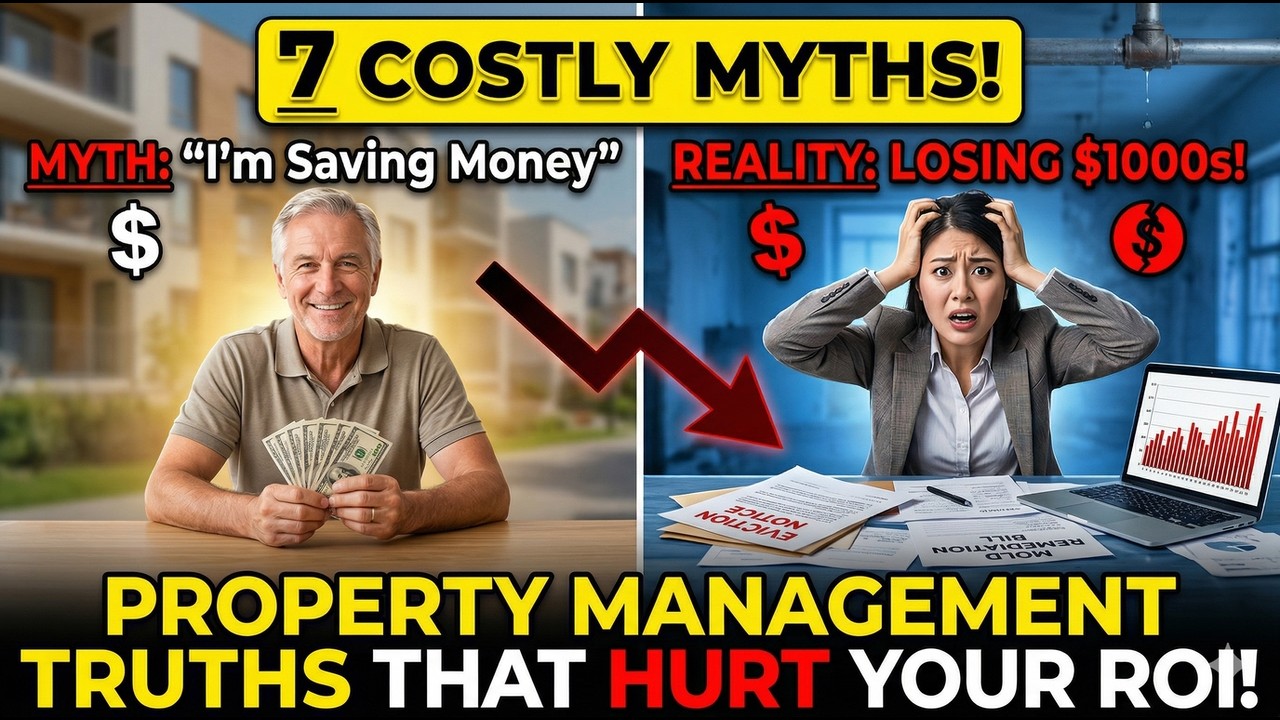
In this solo presentation, Mendell Gosnell of Centurion Real Estate Management systematically debunks seven pervasive myths that landlords and real‑estate investors often accept as truth. He explains why each myth—ranging from the belief that property‑management fees kill cash flow to the notion that rentals are truly passive income—appears plausible, then reveals the hidden costs, legal risks, and opportunity‑cost consequences that arise when the myths are believed. For each myth he provides concrete data (e.g., time spent per unit, turnover cost ranges, screening failure rates) and outlines the investment implications, emphasizing how professional property management can improve cash flow, protect ROI, and accelerate portfolio growth. The video concludes with a call to action for viewers to reassess their assumptions, adopt systematic management practices, and engage in the comments.
Chapters
Top property management myths that are costing landlords money. So are you a landlord or investor who thinks property management is easy or that tenants will just take care of things? Or maybe you believe hiring a property manager kills your cash flow. Uh, what if I told you these assumptions could silently be costing you thousands of dollars a year and most importantly, limiting how fast your portfolio grows. Today we're debunking the most expensive myths landlords believe about property management. So hi, welcome back to the channel. My name's Mendell Gosnell with Centurion Real Estate Management, and I'm here to help landlords and investors and future property owners understand how to manage rentals the smart way so you can scale faster, avoid legal surprises, and protect your return on investment. So in this video, we're breaking down some of the common costly property management myths and revealing the real truths that seasoned investors already know. So if you own rentals, you plan to buy rentals, or want your portfolio to actually perform the way you expect, then this video is for you. So let's jump in. The first myth, property management fees kill cash flow. We hear that all the time. And of course it does cost. We don't give away our services for free, right? But there's the opportunity cost, which is usually the biggest cost in the whole deal. But then the performance improvement that a lot of property professional property management can bring is well worth the expense. So this is the easily the first myth among self-managed managing landlords. Why people believe it? They see the fee, usually 8 to 10%, and they think, hey, I can do this myself and Save the money. But the reality is, yes, self-managing saves you that $200 to $300 per month, but here's what it costs you. 10 to 15 hours a month, right? Managing tenant issues, increased vacancy from slow turnarounds. And that's one that usually is like those stock trades that you don't tell your buddies about. Like, oh my gosh, it took me so long and you're justifying it like, well, I was on vacation and then I got sick and then the vendor and this and that. And, you know, months later, you finally get the turn back on the market. So that missed rent increases really the cost or the loss on your property. So also missed rent increases because you're not tracking the market. That's a common one we see when we're taking over for landlords that have been self-managing or having been managed by other management companies that are not doing their job. Costly mistakes from legal noncompliance or just emotional burnout, and most importantly, lost opportunity to buy your next rental. As I mentioned, the opportunity cost is huge. And so here's the math. If a property manager frees up enough time for you to acquire an additional rental within 3 years, that second property could appreciate, say, $100,000 in 10 years. Meanwhile, your total management fees might be let's say $30,000 over that period of time. So which would you prefer, saving $30,000 or gaining $100,000, right? I'll put money into a machine all day long. I'll put $30,000 to get $100,000 on. That's why you became an investor, right? So this slows investors' growth more than anything else. Myth number 2: rentals are passive income. Well, why people believe it? Instagram, HGTV, podcasts, and passive income influencers, right? The reality is it's a lot of hard work. And without systems or a property management, a property manager, rentals are about as passive as running a small business. You've got emergency maintenance, you've got accounting to deal with, you've got marketing, rent collection, tenant disputes, legal compliance, turnovers, inspections. And I'm sure you're, you're involved in continuing education, right? You're staying up with the market. You're staying up with the industry. You're staying about staying up with what the rental market's doing. You're staying up with all the continuing changes in landlord-tenant law, right? It's a full-time job. The average self-managing landlord spends 8 to 12 hours a month per property and double that with difficult tenants. The investment implication If your rentals feel passive, someone else is doing the work. That's the reality. And if that someone else isn't a professional, you're likely bleeding money from operational inefficiency. Myth number 3, good tenants don't need screening. Hmm. Why people believe it? A tenant seems nice, polite, or referred by a friend. But the reality is professional screening exists because 1 in 6 applicants falsify information. 1 in 4 have undisclosed landlord debt or eviction activity. Criminal checks follow strict legal guidelines. Income verifications can't rely on just a pay stub. A nice tenant can still lead to unpaid rent, property damage, legal issues, thousands in turnover costs, investment implications. So Bad screening destroys ROI, return on investment. Professional screening protects ROI. Myth number 4, tenants will, will report maintenance issues immediately. And here's why people believe it. They assume tenants care for the property the same way they care for their own home. And granted, there's some amazing tenants out there. We have some amazing tenants with us and they do take care of the place. But the reality is, is not all of them are gonna, they're not gonna report the repairs that are needed in a timely manner. So tenants often delay reporting leaks, moisture issues, pest control issues, HVAC noise, plumbing clogs. Why? Because they either hope it goes away or they worry they'll be blamed or charged. A $40 leak caught early is manageable. A $4,000 mold remediation is a little bit of a different story. So investment implications— delayed maintenance destroys cash flow and asset value. Regular inspections and proactive systems prevent expensive surprises. Myth number 5: Rent always goes up. So why do people believe that? They see news articles or general market trends. The reality though, rent growth depends on the market demand, seasonality, local economies, the competition, how many rentals in that area for the product that you're offering, the unit condition, tenant retention strategy, legislation. So SB 608 here in Oregon caps rent increases. Some years rents go up. They generally over time do go up, but some years they can stay flat and some years they even go down. Investment implication, your underwriting must include vacancy buffers, turnover costs, seasonal adjustments, regulatory limits. A property manager helps optimize rent increases strategically and not emotionally. Myth number 6, turnovers aren't expensive. Why believe, people believe it? Well, they really underestimate the real cost and Sometimes they're just cutting a lot of corners. They're just getting it kind of broom swept and cleaned up and ready to go. And that will sometimes hinder how quick it can get re-rented and it'll actually hinder really good tenants from moving in. So the reality is that turnover costs, um, can cost $1,500 in cleaning, paint, carpet repairs, you know, uh, $1,000 to $3,000 in vacancy loss, advertising and showing time. And all while it's vacant. Who's paying the utility bills? Right. Those still have to be paid. You got to change the locks and there's potential rent drops if the market cools, right? If you don't get the turn done before the winter season or the holiday season, you might be in a softer market. So a simple turnover easily costs $3,000 to $6,000. Investment implication. The number one way to improve return on investment is Not raising rent. It's keeping good tenants longer, right? Keeping— avoiding vacancy, avoiding those turnovers. Professional management dramatically reduces turnover frequency. Myth number 7: Self-managing protects my investment better. Why do people believe it? Well, they assume no one cares about my property more than me. And while I agree with the sentiment, the reality— self-managing often leads to emotional decision-making. Slow response times, avoidance of conflict. You don't want to deal with it, right? Do-it-yourself fixes that don't meet code, right? So just illegal. They make legal mistakes, poor documentation, and those things can go on for years unnoticed. You like, you don't have any problems, and then until there is a problem. Informal agreements that violate the law, increase risk and liability. Professional property managers operate differently. They enforce leases, they consistently document everything, follow legal processes, they communicate clearly and professionally, they manage the property as a business asset. So here's the investment implications. This myth leads to legal risk, higher turnover, property deterioration, and lower long-term returns. In conclusion, these myths persist because they feel logical on the surface, but in reality, believing them can quietly cost landlords tens of thousands in turnover, lost appreciation, legal exposure, opportunity cost, and stalled portfolio growth. Smart investors understand that real estate is a business, and businesses need systems, expertise, and scalability. So avoid these myths and you'll protect your rental income, your asset, and your long-term wealth. So hopefully this video has been insightful and eye-opening. Where do you fit in there? We'd love to hear your comments down below and like, subscribe, and thanks for watching.