Alana, age 11, working through William James's "On Habit"
Michael Strong walks 11-year-old Alana through William James's essay on habit. They unpack James's claim that living creatures are bundles of habits, explore how education shapes behavior from brushing teeth to common sense, and discuss what we can actually know about another person's mind.
Chapters
started. And I have a section from a book by a man named William James. Can you see it?
Yes, I can.
Okay. So this is a book he wrote called Habit. And I think, well, first, what are your thoughts on habit? Do you like, do you, what do you think about habits?
I think habits are a good, um, maybe not skill, but something like that for people to have. But it just depends on what habits you have because they can be either good or bad. A good habit might be waking up early in the morning and working out, or maybe, um, getting all of your schoolwork done or having a good attitude. Bad habits could be eating candy every day, or maybe wanting to play video games every day. But I think overall, if you use habits in the right way, they can benefit you a lot.
Totally makes sense to me. Today I just want to read the first paragraph, but the first paragraph is a little bit long. I'm going to just turn to the second page. See, it ends what its limits are. So it's basically all the first page and 2 lines on the second page. But do you want to go ahead and read and I'll turn the page when you get to the bottom?
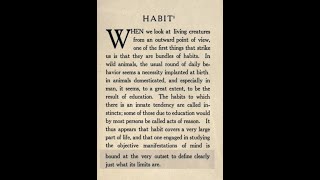
Sounds good. When we look at living creatures from an outward point of view, one of the first things that strike us is that they are bundles of habits. In wild animals, the usual round of daily behavior seems a necessity implanted at birth. In animals domesticated, and especially in man, it seems to a great extent to be the result of education. The habits to which there is an innate tendency are called instincts. Some of those due to education would by most persons be called acts of reason. It thus appears that the habit covers a very large part of life. And that one engaged in studying the objective manifestations of mind is bound at the very outset to define clearly just what its limits are.
Okay. So I always like to check in. What, on a scale of 1 to 10, how well do you think you understood that? 10 would be you understand every word, every sentence, every thought, why the author thought what he thought. 0 would be not sure what language it's in. Maybe it's Polish, Mandarin. Eswatini, I don't know. So roughly what percent do you think you— or with scale of 0 to 10, do you think you understand this?
I mean, I think it's around 6 or 7. I understand a good part of the first page, but once it gets into, I guess, philosophical— I don't know if that's the right word— part of habit, then I get a little confused. But I understand when it was talking about um, habits being implanted at birth and, um, instincts and things like that.
Got it. So a little more than half. 6 is a little more than half. 7 is a bit more than that. Um, and just at a high level, how would you summarize the paragraph given your current understanding?
Um, the paragraph talks about habits. Um, it talks about the difference between instincts and habits. How humans tend to have habits and instincts. We can also recognize habits and instincts, which— yeah, we can recognize habits and instincts. And I mean, it also— not part of the summary, but it does mention education. I don't really understand that part or how it's related to the part before it, which is about the habits and instincts.
Totally cool. You know, I got into doing this when in college, I went to a college where we read very difficult materials. And I found that the first time I could only sometimes even only like, you know, 30% understanding. But then I'd reread it and get a little bit more. And sometimes I'd have to read 3 times really to get it. So, let's go through it slowly now. It's good you have sort of a sense of how well you understand it and a kind of high-level summary of things you get. I'll go ahead and read the first sentence and see if you have any questions or if it makes sense. When we look at living creatures from an outward point of view, one of the first things that strike us is that they are bundles of habits. Does that make sense?
I think so. I thought that what they meant by bundles of habits is like the things we do on a daily basis without thought, maybe. I guess those are habits, but I'm not sure. Things like, I don't know, waking up and wanting to eat and wanting to maybe run or play.
All of that makes sense. And for some reason, I was thinking of non-human animals, living creatures like birds. Does it make sense to say a bird's behavior is a bundle of habit or not?
I think so.
Okay. Let's get the next sentence because he gets into it. In wild animals, the usual round of daily behavior seems a necessity implanted at birth. In animals domesticated, and especially in man, it seems to a great extent to be the result of education. So what does that sentence mean?
Well, at the beginning it's talking about wild animals, um, and I'm assuming— I assume that when it says a necessity implanted at birth, I assume he's talking about instincts, um, instincts to learn to fly if you're talking about birds and things like that. And then that becomes a habit. And then an animal is domesticated. This is where I did get a little confused when it said to be the result of education. Education is in— I mean, I guess that depends for every species, so I'm not sure.
Okay, I want to point out the very next sentence validates your first hypothesis. The habits to which there is an innate tendency are called instincts. So you use the word instincts. And so it looks like you and William James are aligned that the things a bird does might be described as instincts. It's a little bit curious to me that he calls them habits. Does this is a side conversation, but do you think it makes sense to call instincts habits or not?
I think they have a different definition, but I guess in some areas you could. Maybe an instinct would be, I mean, in the case of a bird, to fly or to learn to fly. And then after the bird learns to fly, when it jumps off of a branch and lifts its wings, it becomes a habit.
Interesting. And but rather than explore those, I want to go back to your example of human. You said waking up. Is waking up an instinct or habit for human beings?
Um, well, I'd say instinct because it's not a habit that needs to be developed per se. Um, people may not be good at waking up. Like, there's, there's some people that lay in bed for a little while longer maybe. Um, but you don't need— I mean, From what I know, you don't need to have another human teach you how to wake up in the morning.
So what I got implicitly from what you said is that instincts are things that you do without being kind of trained or cultivated or changed or something like that, whereas habits are things that are a result of a changed behavior. Am I accurately summarizing what you're thinking?
That's what I've always thought.
Okay. Well, in which case, let's go over this sentence again and see if we can figure out the second section. In wild animals, the usual round of daily behavior seems a necessity implanted at birth. Okay, so we're both, I'm with you and James, we're all three calling that instinct. And then the second clause, in animals domesticated, and especially in man, it seems to a great extent to be the result of education. Do you have a sense for what that might mean now, or it's still opaque?
Oh, I think that now it's talking about, um, what we were just talking about, where, um, habits at birth, or for domestic animals I guess, would lead to the education of those habits since they're domesticated.
Um, well, what I'm thinking is, you know, a dog you know, some dogs actually know how to, you know, roll over and do tricks and all sorts of things. You know, and so certainly going back to your hypothesis that instincts are what we do without any training, or here dogs, certainly there are things that we train them to do that are beyond instinct. And I guess, does it make sense to call in the case of dog those things habits?
I think so. If, I mean, if they're taught and it's a habit when somebody says roll over, I think so.
And then does it— I use the word training. Do you think it's fair to call that education? That is, the education of a dog might include, you know, roll over or don't beg or whatever we train a dog to do?
Yeah.
You feel like you've got that next sentence, that second sentence down pretty clearly now?
I think so.
Okay, cool. The— on to the third. The habits to which there is a tendency are called instincts. Okay, that one's solid. Some of those due to education would by most persons be called acts of reason. What does that mean?
Um, well, in the beginning Some of those due to education, so maybe things that are taught by being educated or trained would be called acts of reason. So maybe common sense, that's what I thought of. I guess a person may not be born with common sense and needs to be taught to think critically and maybe the right things. So I think that would, but it does develop to be a habit. So I think they're correct.
So I'm thinking of examples. I was— a pattern you might realize is often when there's a general claim, I always try to think of specific examples and see if the examples make sense in light of what we're saying. Does that make sense as a strategy?
Yes.
So I guess I was thinking of cleaning your room. Is cleaning your room a habit? And if so, is it common sense, or is that not a good example of a habit?
Well, I think cleaning your room is common sense, but it may not be a habit for everybody.
Um, so you're thinking by acts of reason, you're thinking that means common sense?
Oh, is reasonable, I guess, is what I'm getting from that, and then that translates to common sense. I think so.
So somebody who doesn't clean their room, are they lacking reason? Are they lacking common sense? Are they lacking habits? Or all, all of the above?
They may not lack any of those. They just don't. Or, but in the case of cleaning their room, they may not see the importance and/or benefits, maybe.
How about brushing your teeth? Is that common sense or not common sense or an act of reason? Or some people have the habit of brushing their teeth, some don't. Where does that come from? Where does that habit come from?
Well, in my opinion, brushing your teeth is all of the above. Every— I mean, people, everybody, or at least people should know that taking care of your teeth is important because you need teeth, that you use your teeth every day. I think that people who don't think that brushing their teeth is good may just be ignorant and they don't know, they haven't been taught the correct things. Or maybe they have been taught the correct things and they just choose to ignore it and don't want to consider the importance of it.
But so what do you make of cultures Different cultures have different practices, and in fact, many cultures do not brush your teeth. The toothbrush was invented— actually, I don't know when and where it was invented, but I know most cultures throughout history did not have toothbrushes. So how can it be common sense if entire cultures didn't do it?
Could be. I mean, I'm not saying that it's that everybody should know, but I guess I was thinking more about The people I know that are alive when I'm alive. I think, I mean, I learned when I was young that it's important to clean our teeth. I'm not saying that everybody should. I've never really thought about people in history who didn't really do that because honestly, I just thought it was something that everybody did. But I think it may be common sense maybe to us, but maybe not to them way back when. So I think it does depend in that area. But when everybody does it nowadays, you have to consider it, I think.
So I think this is a huge puzzle we'll leave for now. The puzzle being kind of what's common sense and what culture and what's the relationship between your culture and common sense. Does it make sense for me to call that a huge puzzle that we can just leave for now?
I think so. Yeah. Okay.
And let's go ahead and get— because I want to get to the end of this. One more sentence. It thus appears that habit covers a very large part of life, and that one engaged in studying the objective manifestations of mind is bound at the very outset to define clearly just what its limits are. I'll go back. I imagine this is a tough sentence. Is it fair to say this is a tough sentence?
Yes.
Okay. Let's do clause by clause. It thus appears that habit covers a very large part of life. You okay with that piece?
Yes.
Yeah, and, and just kind of what I'm thinking is, if there's instinct— well, is there anything beyond instinct and habit, or is everything we do either instinct or habit? What is there in addition to instinct and habit?
Well, actually, um, most of the things I can think of me doing on a daily basis is either instinct or habit. Um, getting hungry, that might be an instinct. But the habit of maybe opening the fridge, that's something taught. Reaching out and then pulling back, right? I guess some actions may not be fully defined as a habit, but I think at its base, it's something— if it's not an instinct, then it's something that was taught or observed, and it has its place at that area.
Okay, and we could explore that more, but I do want to get to the end of the sentence. And that one engaged in studying— I assume we're okay up to that part.
Yes.
The objective manifestations of mind— I assume that's tricky.
Yes. Um, when I hear manifestations, I honestly kind of think of, uh, think of people meditating and manifesting the future and things like that. I'm not sure if that's the right way to think about it, but it's not connected.
Yeah, and I think although people do use the word manifest that way, that is a different connotation. I would say manifestations is just what you see, what is evident. An objective manifestation is What do we see about the mind? What can we observe about the mind? So it's not manifestations in the sense you're thinking. It's simply what can we objectively observe about the human mind, which I want to pause and note, in a certain sense, we can't see it. You can't see my mind. I can't see your mind. I see your face. But presumably, you know, there's something going on inside. So do you think we can observe each other's minds or only our faces? What does, what does it mean to observe, uh, each other's minds or a human mind in general?
Oh, it changes. I think it changes when you say human mind in general because each human has its own individual thoughts. Um, but I think to studying the objective— objective, I think that, that in this case means maybe like part of a whole, the, the general and objective thoughts of the human mind. Um, but then instead of thoughts, they use manifestation. So I'm not really sure, um, on that part. But I think I understand that, um, actually, I think a little bit.
I actually said something there that's interesting. You're thinking of thoughts, or what I infer from what you said is that you're I was sort of saying, you know, we see each other's faces, but we don't see each other's minds. When you say thoughts, we are using words. And so presumably, in some sense, you're observing my mind through my words. And in some sense, I'm observing your mind through your words. Do you like that way of thinking about it or not?
I do.
Okay. So how to observe a mind, I think, is again, an interesting puzzle, but we'll You're okay with thinking of objective manifestations of mind as what we can observe about a human mind one way or another?
Yes.
Yeah. And I need to go back just to get— thus appears that habit covers a very large part of life. Okay with that. And that one engaged in studying the objective manifestations of mind is bound at the very outset to define clearly just what its limits are. And the immediate problem I have is what does its refer to? The limits of what? What are we talking about in terms of limits?
I'm assuming they're talking about habits. I mean, that's what I initially thought, but I guess it could be referring to what we were just talking about. Thoughts. So maybe the objective.
Yeah, this is an interesting grammatical point with 'it's' the pronoun we're looking at. What is the antecedent of that pronoun? So, and we have two— you propose two candidates. One is habits and the other is thoughts or objective manifestations of mind. So, one engaged in studying the objective manifestations of mind The reason I start with one engaged in is it looks to me like this first clause and the second clause are independent because you have an and. So, you could, I think you could write this sentence and have a period. It thus appears that habit covers a very large part of life, period. And then you could have a new sentence and the reason the new sentence is important is it makes me suspect that the antecedent to this pronoun is attached to this second clause rather than the first clause. Does that make sense?
Yes.
Okay. So, to figure out what the correct antecedent is to the pronoun "its," we're going to just focus on the second clause. And that one engaged in studying the objective manifestations of mind is bound at the very outset to define clearly just what its limits are. So we have to define clearly what the limits of what are.
Now I'm assuming, based on what you said, that it is referring to the objective manifestation of mind.
That's my inclination as well. And kind of what's tricky there, again, we're not going to figure this out. What's tricky there is we still have a bit of a mystery. How do we see each other's minds? And as a hypothesis, we're both going, you can sort of see my, or observe, not see, observe my mind through my words, and I can observe your mind through your words. And we're looking at the limits, just very clearly define what the limits are of the objective manifestations of mind. Does it— and this is my hypothesis, how I'm thinking about it right now— does it make sense that there are limits to the extent to which we can observe each other's minds? That is, I cannot— I certainly cannot observe all of your mind, and you certainly cannot observe all of my mind. But through words, we perceive, and maybe through facial expressions, we perceive— we can kind of sort of observe each other's minds and other human minds. How does that land for you?
I think that makes sense.
Okay. Would you say this is too hard, or you're okay with it being hard, or how, how are you doing on the difficulty?
No, I, I thought this was really interesting, and I don't think it was too hard either. I think after a little while, I understood at least most of it.
Okay, cool. Yeah, I like to, I like to read, you know, difficult, interesting material, and of course, I like to get young people to read interesting, difficult material. So with that, um, I will let you go and I will be rooting for you next weekend. Okay.
Thank you.
All right. Have a great tournament. Bye-bye.
Thank you. Bye.







