Alana on becoming a mentor
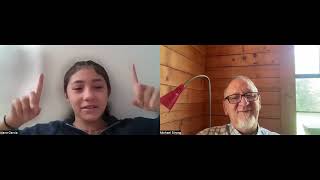
Alana, 11, considers mentoring a 10-year-old interested in math, programming, and sports. They explore how asking questions can spark understanding, how losing gracefully teaches life lessons, and why teaching deepens her own learning.
Chapters
So actually what I wanted to check in with you today on, Alana, is, um, I have— I met somebody who has a 10-year-old daughter, and she— this 10-year-old daughter is in a regular school and is bored and doesn't like it. And, um, I'm, I'm wanting to help this woman and her daughter kind of figure out how to, how the daughter can pursue her own interest. And one possibility is joining TSE, and she might, but it occurred to me that it might be good for this 10-year-old girl to have a very capable 12-year-old girl as her mentor. And so I thought I'd wonder, and I know you're not quite 12, but practically so, and I'm wondering how would you feel about mentoring somebody else?
I'd love to. I think that sounds like an awesome experience.
Somehow I thought you would like to like it. So, and we would, we would have to figure out exactly what this means. But when you think of mentoring somebody, let's explore that. What do you think of when you think of mentoring a girl 2 years younger than you? What kinds of things would you focus on? How do you think you would help her?
Well, first I'd have to understand a little bit more about her. What are her interests? And then what problems she's having? Because when I think of mentor, mostly now because of the mentorship program at TSC, I think of, like, Karen and you and how you guys have helped me. So I think— and then there's this other aspect of mentor that I think is not only helping with school but with life, and then not only problems but I guess just voicing thoughts. So I think I could be all of that. To her, um, and more.
I totally agree. And just to give you a little bit more information, so you're right, first thing is to know what the student is interested in. Um, and this is secondhand, so her— I've not met her. Her mom told me, so this is my version of what her mom told me. So when you talk to her directly, you'll get better information. But her mom said she's very physical. She likes to do a lot of physical things. And I thought Through jujitsu, you probably qualify as fairly physical. And she also likes math, and she also is interested in programming. And she's also, I think, creative. And so it seemed like physical check, math check, computers programming check, creative check. Do those sound like sort of realms where you could probably provide some mentoring?
I think so.
Cool. And then, you know, I guess one way I think of mentoring is somebody who knows the areas a little bit better, a little bit farther along, can help the younger person figure things out. And so I guess you're right. There are a couple of different components. There's, there are the domains, so to speak, the physical, the math, the programming, the creative. And then there's also kind of life in general. So maybe let's start with the domains. If you're a little bit more advanced in a domain, how do you see yourself helping a younger person think about those domains? Or what, what's, what's the goal in a mentoring session? Suppose, you know, you were going to mentor her this afternoon and, you know, there were those 4 domains and you are a bit more advanced in each of them. How would you think about helping her in those?
Well, I mean, if there's anything— I mean, the first thing that I think of is helping her with direct problems, but then I think about mentoring and I think it might be a little more deeper than that. Um, maybe, I mean, just besides the actual struggles, um, sharing thoughts that she might have, interests and questions, but I'm not sure. It kind of confuses me.
Oh, well, look, when this is— this is your very first time thinking about this, so I don't expect you to have it all figured out. Um, but one, one thing, what would your goal as a mentor be if you were going to— if you were to be a really great mentor, how would— how— what kind of impact? Let's put it this way, what kind of impact would you have on her? What would it mean to be a good mentor to her in terms of impact?
Um, I think something that could influence that is having somebody that not only look up to but learn from. I mean, maybe if I'm better, or maybe if I've had more experience in some of those domains, then she could, or I don't know, maybe I could rub something off to her.
I like to look up to and rub something off on. You know, actually, you've got the TSC mentoring experience, whether it's explicit mentoring or implicit mentoring. You know the difference between explicit and implicit?
No.
Okay. Have you heard those words before?
Yes, before, but I wasn't quite sure what they meant.
Okay. So explicit is if I, you know, say explicitly, help you set a goal. Implicit is more, I'm not explicitly helping you set a goal, but I'm asking you questions and getting you to think about direction and maybe modeling a direction. So explicit is saying out loud, very direct. Implicit is more kind of about the context. Does that make sense?
I think so. So like implicit could be kind of like Socratic dialogue where you're not lecturing them or telling them, leading them, maybe.
Exactly. So what I was going to suggest as an alternative model of mentoring is I suspect at your jiu-jitsu gym, um, they're either the teacher and/or some of the older students are kind of mentoring you. Is that accurate?
Yes.
And so how do they do it explicitly and how do they do it implicitly?
Well, I think the biggest example of them mentoring us explicitly is showing us moves and coaching us during rounds or sparring, but then implicitly Um, showing us how they act in tournaments, maybe when they win, when they lose, um, their attitude, because they're athletes. They're athletes that are going into their prime, and even if they're not telling us anything, watching them is, I'd say, very implicit.
Got it. And I assume from the way you talk about them that they're modeling how not to be a bad loser? That is, are any of them kind of bad losers?
No, I don't think so.
Yeah, I think that's actually an important part of competitions is to learn how to lose with grace and dignity. And so would you say they're all very good at losing with grace and dignity?
I think so.
And winning as well, because I could also imagine somebody winning and being a jerk about winning. But is it also the case that they do not, uh, they're not jerks about winning, that they are appropriate when they win?
I wouldn't say they're jerks about winning. Um, but of course there may be time for celebration. I'm not sure, but they're not jerks.
Yeah. And I think that's actually an interesting distinction. So what's the difference between, and I think people do have a right to celebrate winning. But is there a way of celebrating winning that is kind of jerk-like and a different way of celebrating winning that's not jerk-like?
There may be. I think when people do, especially kids in divisions or tournaments that don't really matter, when they do backflips and flex at the camera and stuff, it's not, it's not very, it's not cool, especially to the other kid. And then especially if it's not a big tournament. Everybody's gonna forget in the next 2 weeks who won or lost. Um, you know, I'm 11, they're 10.
So it sounds like there's a way of celebrating your victory that is appropriate and another way of celebrating your victory that's inappropriate.
I think so. I think people go a little overboard sometimes, and they may have a place to rightly do so if it's like the world championships or something. I mean, if you do a backflip after you've won the finals in a 9-10 beginners match at a jiu-jitsu world league, then maybe it's not quite appropriate. But maybe if you won Worlds and you've been working super hard, then maybe. Um, I think it depends on what people think. Everybody— I mean, some people might think that doing a backflip at Worlds is not appropriate, and some people think that going like this at JGWL is not either. So I'm not very sure.
One other factor that I can imagine might be relevant is I can imagine it's more appropriate to celebrate a victory if it was— if you really did a good job and the other person did a good job. But maybe if you only won like on a technicality or, you know, something that was in some way kind of unfair, then it's less appropriate to celebrate the victory. Does that sound right?
I think so, but when you say unfair, I mostly think of if there was bias in the match or not, which there usually isn't, but sometimes there is.
You're thinking from a judge?
Yes, but referee, then, then, and if, if you don't know, or if it was very subtle, then I mean maybe, but if you, or if there was recognizable and obvious bias, then maybe not.
Got it.
Bias or wrong calls, or even if it's ref's decision, cuz that means that the match was kind of close at least.
Mm-hmm.
But I mean, I'm not sure people do it anyways.
Got it. Going back to mentoring, um, then I wonder if we could say that in some ways, and I'm going to back to the appropriate, what's the appropriate way is to behave after a victory or a loss. Do you think in some ways part of the role of a mentor is to help the mentee learn how to be a better person?
Absolutely, yes.
What ways other than in, say, jujitsu matches, what are other ways in which an older person might help a younger person learn to be a better person?
Like you're doing with me, teaching me lessons and things like that, or maybe bringing up examples and reflecting, maybe stuff like that.
And it's great, of course, that you get the Socratic thing, has that impact. How is it that just asking questions could possibly make somebody into a better person?
Because as you ask questions and they realize— or, and they realize— well, I guess I've always felt that when you and I are discussing something and then I click, or the subject that we're talking about clicks in my brain, then I'm able to link maybe that to another example in life that may make me a better person. And that doesn't happen every time because subjects vary, but I think that helps and it has an effect.
That's interesting. And I'm glad you perceive the subject, something clicking in your brain, um, which is of course invisible to the outside world. There's not like a flash, flashing light that says something just clicked in Alana's brain, but I've certainly had that experience. Uh, and that's one of the reasons I actually love Socratic learning is I, for me, the power of something clicking in my brain is more powerful if it came from me through a question, but still it's something going on in my head rather than something telling people. That is, if somebody tells me something directly, it feels a little bit less likely to click. Does that make sense? Yeah. Would you say it's maybe once a month, once a year? How often do you think something clicks in your brain like this?
Well, I don't really think you can measure it by time because, um, like you said, the subjects may vary. It may take you longer to get from one point to the other, um, depending, depending on the person too. So I don't think it can be measured, but I mean, I love the feeling of getting something, so I try to make it happen as often as possible.
That makes sense. I also expect sometimes they're little tiny clicks, kind of not a big deal, but still a click, and other times that are bigger clicks, and those are, you know, cooler but less often. Does that sound accurate? So, what else? Anything else that you need to know in order to start mentoring this 10-year-old?
Well, other than interests, problems that she's facing, difficulties, or things she needs to overcome, whether it's like in those categories or outside— time, schedule, learning, I'm not sure— things like that.
Well, of course, and of course she will have to tell you that, um, but my expectation is that not only are you quite mature for your age, but mentoring somebody else will help you become even more mature for your age. Does that sound right?
Yes.
Why would— how is it that mentoring a younger person would help you become more mature?
Um, I think there's a couple ways. I think one is that you can get stuff to click, or to metaphorically click, in a different way than, uh, or you can get stuff to click in a metaphorical way, not just when you're learning from somebody, but I think when you're teaching from somebody. Um, I think I've heard the phrase, I'm probably just butchering it, but I'm not sure. Um, you learn, yet you get taught, and then you teach, and then it helps you learn more, or it helps you learn it more, whatever you're teaching and learning. And I think, uh, I've been taught all these years, and then maybe when I start to teach, um, I'll be able to explore it more and really think about it for myself instead of the other person doing that for me, or in a metaphorical sense, I guess.
For sure, for sure. Well, again, until, you know, you and she meet, I don't know if it'll work out or not, but I think it's a great idea to have you start mentoring with her and/or with others because I think you're very ready for it. Have you taught any jiu-jitsu classes or not yet?
I've taught a few one-on-one sessions with some of my younger friends, but not like I've done a whole class, you know. I've helped out, but not me personally.
Yeah, well, good. You're kind of just at that stage where I think you're becoming older and mature and knowledgeable enough to become more of a leader, uh, in mentoring, teaching, or all forms of leading. So, um, well, I'm again not surprised that you're interested in doing it. I'm nonetheless delighted. And I think it's going to be a new phase in the adventure of Elana. So I'll do an email introduction later this week. Until next time, have a wonderful day. Bye-bye.
Thank you too. Bye.







