Loving your child's mind: Alana on science
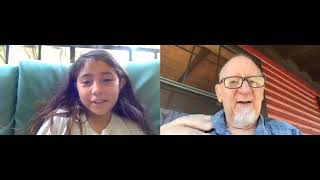
Alana explains what science means to her: doing experiments, forming hypotheses, and figuring out why things happen. She describes her homemade lava lamp and Coke-and-Mentos eruption, then connects everyday observations like the water cycle and Earth's rotation to scientific thinking.
Chapters
Yes, I can hear you now. I can hear you now. So who knows what happened? How are you? Can you hear me?
Yes, I can.
Okay. So, you know, we talked about— we've talked about books for a while, and then we talked about math. I thought I'd check in on science. So first, how is science going for you? What are you learning in science?
Um, what, what things would you say in science? Because most of, like, in my school, we don't, we don't really do science that much. Yes, one, I did some experiments yesterday. I made a lava lamp out of oil, water, um, and food coloring, and I did the Coke and Mentos explosion.
Oh, the what explosion?
The Coke and Mentos explosion?
Coke and Mentos?
Yeah, so if you— you can't hear me?
No, no, I can, but I don't know what that explosion is, so explain what it is.
So recently a guy found out that if you have a bottle of Diet Coke and you put Mentos in it, if you put like 13 Mentos in it, it makes an explosion.
Got it. Okay, got it. Um, okay, well, so what— I want to back up a little bit. What is science? What, what would you say? What is science?
Um, I would probably say science is where like you interact with maybe microscopic things or something like that.
Does it have to be microscopic things?
No, I don't think it— no, I don't think it has to be. Like, maybe you're interacting, or maybe you're using like food coloring, or maybe you're trying to make something live when it's done, when it— when it already died, or maybe you're just trying to find something out. Okay, um, I think it's not to be basically anything you want.
Science can be anything you want?
I mean, it can't be writing. I mean, writing is writing, but you could write like hypotheses down, like for what you think is going to happen if you're doing an experiment or something like that.
Okay. So I was going to go, sometimes a way to understand something is to see what's not that thing. So you say, so what are some examples of not science? You said sometimes writing is not some science. Not science. What else is not science?
Reading's not science. I think math is a little bit of science because you have to calculate stuff. Um, I don't really know what else is not science.
Okay, one of the definitions of science I think you mentioned was figuring things out, is that right?
Yeah, like, for example, if, like, you did an explosion and you just wanted to find out what happened, you had a nuclear bomb or something like that, and you wanted to find out what— who— like, if you're in a war and you had a nuclear bomb exploded near you, maybe you could find out, hey, what's the enemy doing? Can we make this too? Blah, blah, blah. And then you can find out what's in it. Maybe that's a little bit of science.
Oh, I think your words exactly made— your words might have been what's going on, figuring out what's going on. Is that a better definition?
Yeah, like what's going on, you have to solve that problem, that problem.
So suppose you think that somebody is, um, maybe going to have a surprise birthday party for you and you ask your mom, what's going on, are they going to have a surprise birthday party for me? Would that be science?
You know what, no. I don't— I wouldn't think so. Maybe another explanation of science could be maybe when you're like trying to make things happen, like not like trying to make a surprise birthday party happen, like maybe if you're trying to do an experiment, maybe you're trying to make this do that or that do this.
Okay, um, do you know what causation is?
Maybe the cause of something.
Okay, um, it's definitely, yeah, related. So, um, do we— how do we know what causes various things? How do we know what causes the sun to go down in the evening, for instance? You know, it's light during the day, dark at night. What causes that?
Because the Earth keeps spinning.
Okay. And do you think that that is a science-like thing or is that not a science-like thing?
Uh, um, it could be like maybe you have to figure out why is this, why is Earth turning? Does it have, does it have like a special kind of gravity that pulls it around? Or anything like that.
Okay, and how do you know that the— it doesn't get dark at night just because your mind wants it to get dark at night?
Because maybe because you know that there are other people and they probably don't want the sun to go down, but it's going down anyways.
Okay, that, that seems like a pretty good reason. Um, how do we know why, um, Why the rainfall sometimes?
Because when water evaporates, it clumps into clouds, and then when the clouds get too heavy, they burst and the rain falls down until there's no more.
You think that's a science-like way of seeing things or not?
I think so, yeah.
Why?
Like maybe you could try and make your own rain? Doing the same thing.
It sounds like for you, experiments are kind of a core part of science, is that right?
Yeah. Like trying to see what happens or something like that.
Okay, so science is a matter of trying to see what happens. Can we figure out what happens with just about everything, or are there only some things we can figure out what happens?
It might be possible that we could figure out anything that's happening. Maybe if we were still— if we still didn't know how to create, um, let's see, how to create cars and we created cars now. I, I think that, that, that was a possibility, or maybe people didn't think that we could, like, we could make cars back, like, when they weren't existing, like, even when the first prototype wasn't made.
Um, so are you saying that, um, we could figure out— so if we don't know how to do something we could figure out how to do it and then make something based on what we figured out?
Yeah.
Okay, um, do you know how we figured out how to make cars?
Maybe, you know, I don't know. I've never really studied that.
Okay, um, so do you think it would be fun to be able to instantaneously You've seen in Star Trek where people can instantaneously be moved all over?
Yeah, at warp speed.
Yep.
At warp speed.
Yep. Do you think that that would be cool?
Yeah.
So how would we figure out—
How would that be made?
So how would we figure out how to do that?
Maybe you could figure out a way to get like a ton of energy and then put it into one little space where the pressure builds up. And then if it— and if you travel enough into space where it just keeps building up and up and up until like super, super, really, really, really, really, really— like when the pressure really, really, really, really, really built up, maybe you could try let it go and maybe you could go at least as little as fast.
So do you think there's any relationship between the kind of Coke experiments you were talking about on the one hand And figuring out how to go at warp speed on the other?
Kind of, because you have to like build up pressure and then boom.
Okay, um, and do you think that, um, the kinds of experiments you're doing could help you understand how the world works?
Possibly, if you keep trying and maybe if we keep evolving, maybe we get another set of hands, we could try to do more things.
Okay. Well, my computer is running out of battery and we're not going to figure out science completely today, but, you know, we're going to keep thinking and talking about reading and books and stories and heroes and good guys and bad guys. We'll keep thinking and talking about math. And we'll keep thinking and talking about science and a whole bunch of other things. So keep your eyes out into the world to figure out what is science and how does it work, okay?
Okay.
All right, have a wonderful day, Lana. Bye-bye.







