Loving your child's mind: Figuring out Vygotsky together
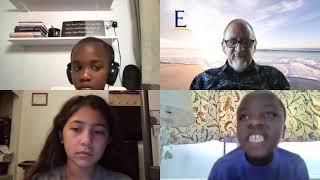
Michael Strong walks three primary-school students through a dense paragraph about how minds can't communicate directly, only through words and meaning. He breaks the text into pieces, asks each child what they think it means, and has them test their ideas against each other. The kids rate their own understanding on a 1-to-10 scale and reflect on what confused them.
Chapters
Sankara, can you hear us?
Yeah.
Okay, so Marwa is joining us. Um, just so that everybody knows each other, uh, how about everybody just does like what your name is, where you are, what grade you're in, and something you love? So Alana, do you want to introduce yourself first?
Sure. Um, hi, my name is Alana. I'm in third grade. And something I love is reading.
Terrific, go Sankara.
Hello, my name is Sankara and I'm in Year 4 and I like maths.
Terrific, thank you, go Marwa.
My name is Marwa, I'm 7 years old, Grade 3, and I like soccer.
Fabulous, fabulous. So Sankara, before you got on, I let Marwa know we're going to do something difficult. So last week, uh, it was just Sankara and we tried to understand this paragraph. It's a very difficult paragraph and I don't know that we figured it out last week, but maybe with 3 of you working together we can make progress. Do you want to read it out loud for us, Alana?
Sure. So direct communication between minds is impossible, not only physically but physio— Physiologically.
Psychological.
Communication can be achieved only in a roundabout way. Thought must pass first through meanings and then through words.
Would anyone say this is easy to understand? Okay, actually something that I like to do with really, really difficult things is look at a scale of 1 to 10. So 10 would be You understand this perfectly. You understand every word, every sentence. You know what the author was thinking. 10 is absolutely perfect understanding. 1 is you have no idea what language it's in. Maybe it's in Polish or Mandarin. You're really not sure. I bet you all know this is in English, so probably none of you are at a 1, and I bet none of you are quite at a 10. So maybe let's start with Sankara this time. Between 1 and 10, How well would you say you understand this?
2.
2? So you know it's English but not a whole lot beyond that, maybe. Okay, cool. How about you, Alana?
Um, maybe a 2 or 3.
A 2 or a 3. She's brave. Go, go, Marwa. How well do you think you understand it?
5 or 4.
5 or 4. Wow. Um, Well, since you understand the most, do you want to kind of give us what you think it's saying, Marwa?
Uh-oh.
Okay. And Sankara, do you remember this from last week?
Yeah.
Okay, so one way that I like to do things, I often, if I don't understand something, I break it apart into little pieces because this has 3 sentences, and every one of them is complicated. And the first one has 2 clauses. So, I described the comma as breaking that first sentence into 2 clauses. So, let's just start with the first clause: "Direct communication between minds is impossible." What is the author saying there? Go, Alana.
Um, I'm not entirely sure about this, but it sounds like basically communication, like mind reading or something like that, between minds without actually having to say, is impossible.
Okay, so you're thinking there's some people that believe we can read minds directly. Um, you're saying this author is saying we can't, that we have to have words. That's your interpretation? Possibly, yeah. Okay, does anybody agree with Alana, disagree with Alana, or have a different interpretation? Go, Sankara.
I agree with Ilana.
Okay, the way I think of this is— do you guys know what a hypothesis is? What's a hypothesis? Go, Ilana.
Um, hypothesis, for example, if you're doing an experiment, it's your estimate of what's going to happen or how much it's going to be.
There you go. So I would say you have an interpretive hypothesis for that first clause. That is, you are— you have a kind of speculation, a sort of guess about what that sentence might mean. And I think of us kind of going through this to see if your hypothesis is correct. Does that make sense? Okay. Um, how are we doing, Marwa? Are Alana, Sankara, and I making sense? Are we kind of not making sense?
You're making sense.
Terrific. Okay, so let's look at the next clause. So the first clause, direct communication between minds is impossible. 'not only physically but psychologically.' What do we think he means by that clause? I don't know. Okay. Um, do we know what psychologically means? Sorry, you're nodding. Do you know what it means?
Um, something to do with your mind.
Okay, fair enough. Psychology is kind of the study of the mind. Psychologically is something to do with the mind. And then physically, how would physically be different from psychologically? Go, Sankara.
Physically, something that you can touch or something.
Okay, so direct communication between minds is impossible, not only physically but psychologically. So just based on what you said, Sankara, I'll give you my interpretive hypothesis. Direct communications with the mind, it's not— my mind is not touching Alana's mind, or it's not touching Sankara's mind, it's not touching Marwa's mind. Does that make sense? So we don't have kind of direct physical connection between minds. Maybe if we like had a cord, you know how computers, you hook up computers with cords? Maybe if we had like a cord that plugged into my brain and then it plugged into your brains, then we'd have direct communication of minds. Physically? Does that seem crazy or does that make sense?
Um, it, it's, it makes a little bit of sense, but it also sounds kind of crazy.
Yeah, I thought— go ahead, Marwa, what were you going to say?
The same that Alana said.
Okay, there are people who are doing technology where the brain connects like to, um, Like with people who've lost a hand, they have technology to connect your brain with your missing hand, and so your brain can actually control missing hand. They're actually doing things like cables to the brain so that, like, people who've lost a hand can move their artificial hand. So it is a little bit crazy, but it's also something that's kind of happening. But let's go to the next sentence and see if we can make sense of that. Communication is to be achieved only in a roundabout way. What might that mean? Go, Sankara.
Um, it means like somebody has to say something and it has to return, like, um, um, like, I can't really explain that.
So, go ahead, Alana.
I was going to say the same as Sankara, but like he said, I do think that that sentence means that if you're doing it physically, one person has to do it and then the other person returns the sentence.
Okay, what do you mean one person returns the sentence? I think I know what you mean.
They say a reply to the person that spoke to them.
Okay.
It's like a roundabout.
What both Alana and Sankara are saying, what makes me want to go to the third sentence, because it sounds like you're already kind of thinking about the third sentence if I'm right. So the third sentence, thought must pass first through meanings and then through words. What do you guys interpret that to mean? Joelana?
Maybe you either mean to do something before you actually say it, or maybe you have to think about your words before you say it.
Okay, so what's the— so that's a great hypothesis. What's the difference between a meaning and a word? Are meanings and words the same, or are words and meanings different?
They're different.
How so?
Well, in my opinion, meanings are kind of like what you mean to do. So for example, like you could be meaning to read something, I don't know, something like that. And then words, you're actually saying something.
Okay.
You could say I was meaning to do this or I was meaning to say this.
Okay. In some ways, the way you're using the word meaning right now sounds a little bit like the word intention or intending, that I was intending to do this and intending to do that. Is that how you understand the word meaning?
Yeah.
Okay. Well, I want to go back and think about— so both Sankara and Alana had said with that second-to-last sentence that people have to talk. One person— the picture I got in my head was One person talks and then the other person talks, and that's what you thought communication can be achieved only in a roundabout way meant. Did I understand each of you correctly? Sankara is nodding yes. Is that what you meant, Alana?
Alana is frozen.
I thought so. I thought so.
Me too.
Are you back, Alana? Oh, she's freezing.
Sorry, can you say that again?
Yeah. So with that second sentence, communication can only be achieved in a roundabout way, my understanding is that you were both saying that—
Ah, yes, I am.
OK, that's right. So in which case, how thought must pass first through meanings and then through words. How do the second to last sentence and the last sentence connect? Do you have something? Does any— it looked like Alana was raising her hand. Mar was maybe raising his hand.
I just got kicked out, so I don't know what's going on.
Okay, um, you know, you froze for a minute. Where I was asking about the second and third sentences, um, you— the picture I had in my head was that you and Sankara was saying the second sentence was that people had to use words to communicate with each other, and then I think Alana, you were saying something about there's a little bit of a difference between the meaning and the words. Did I get that correct? Yeah. And so maybe let's try the whole thing and see if we have any idea what it's saying. I'll read it this time. Direct communication between minds is impossible, not only physically but psychologically. Communication can be achieved only in a roundabout way. Thought must pass first through meanings and then through words. Do we have any idea what that means?
The last sentence or the whole thing?
Either one.
I think so.
I don't know. Go for it, Alana. Give us what you got.
Um, okay, so I think this passage talks about maybe the the communication between people. The first sentence is about how you, or how you can't communicate between minds. And the second sentence might be about, 'cause like it says, communication can be achieved only in a roundabout way. So it's talking about how one person speaks and then the other and then the other over and over again. And then I think the last sentence means like you maybe, You have to say it and then maybe you do it.
What do you think, Sankara and Marwa? Is Alana partway there? Do you think she got— if she's mostly right or partly right, or you think she's wrong?
Mostly right.
Okay, why do you think that, Marwa? Well, it's okay. I actually— so I'm running out of time because another call-up. So quickly, let's go around and say one thing that you liked or were frustrated about. So Marwa, what did you like about this conversation, or what were you frustrated by?
I like the whole thing.
Fabulous, love it. How about you, Sankara?
I didn't like that we still— that I still don't really understand what this means, but I like the way it was like problem solving.
Excellent. How about you, Alana?
What was kind of frustrating today was that I didn't get it fully and this was really hard. And then one thing I liked today One, I was finally on because I missed it the last few weeks, and two, I just thought it was really fun.
Excellent. Well, thank you all three for working hard. I know this is really hard work, but I like to work our brains hard. I like to make your brains think hard. Is that okay?
Yes.
All right, um, thanks to all of you, and I will see you again next week, hopefully. Have a great week, you guys. Bye-bye.
Excuse me, excuse me.
Yes.







