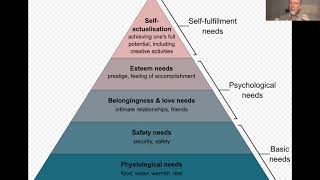
In this talk, Michael Strong, founder of expanseonline.co, explains how his virtual talent‑development accelerator for middle‑school, high‑school, and young‑adult learners uses Maslow’s hierarchy of needs as a framework to nurture children’s growth. He notes that physiological needs are assumed met, and the program focuses on safety (especially emotional safety), belonging, love, esteem, and self‑actualization. To meet safety and belonging needs, the school builds a positive community through intentions, appreciations, improv and theater games, and student‑led decision‑making. A Socratic dialogue component encourages intellectual intimacy, allowing students to explore deep topics via challenging texts, fostering esteem through mastery of writing, mathematics, science, arts, and entrepreneurship. The program emphasizes deliberate practice (the 10,000‑hour rule) to develop world‑class talent, ultimately guiding students toward self‑actualization. Strong invites families to learn more at expanseonline.co.
Chapters
Hello, I'm Michael Strong, founder of expanseonline.co, a talent development accelerator serving children in middle school and high school, young adults. We believe that Maslow's hierarchy is a crucial way to understand how to get the best out of children. So I'm going to start by giving us an overview of how we think about Maslow's hierarchy and how it can really help children become amazing. So as a virtual school, we cannot address physiological needs. We at this point can only work with people who have mostly had those met. We cannot work with physical security, but in terms of safety needs, we can and do work with emotional safety a lot. People don't realize that Lord of the Flies was written by a man who worked with middle and high school students, they on their own can be extremely mean, sometimes subtly, sometimes obviously. The brutality, subtle and less subtle, is immense at that age in many schools. And in addition, at that very point when they most need to feel a sense of belonging and safety, safety first and then belonging, it's often hardest to get. I actually believe a significant amount of adolescent dysfunction and a significant amount of adult dysfunction can ultimately be found in the insecurity and bullying that's very often characteristic of this age. So one of the things we do very deliberately is we work to create a positive, healthy community. We have various ways to do this. It includes intentions and appreciations, improv and theater games, discussions about all aspects of life, empowering the students to make decisions about how the community works in various ways. We make it normal to think and talk about who we are, who we want to be, and how to be healthy, good versions of ourselves. This sort of first safety then blends into belonging and love needs. Again, appreciations— often elementary schools do appreciations, middle and high school rarely do appreciations. We create a culture in which it's ordinary, normal to appreciate each other. We also create a culture in which we really get to know each other. In addition to our community program, which addresses the belonging and love needs in various ways, we also have group Socratic dialogue, which is not kind of harsh bullying Socratic dialogue, but it's very much more a matter of who are you and what do you believe. We read difficult texts and thus develop academic skills and develop writing skills. But actually, a lot of our Socratic program is getting to know somebody, getting to know what they believe and why. Truth, love, friendship, betrayal, justice. We want students to think and talk about these things on the foundation of sophisticated texts. And gradually, they are part of a deep intellectually intimate community. Many people don't think of intellectual intimacy as a thing, certainly not at elementary or middle and high school, but we have students really engage together. Esteem needs, then they feel a sense of empowerment as they are articulate and thoughtful and they're appreciated for who they are. And they're reading very difficult material, they're developing amazing writing skills, developing the ability to think, talk, and argue. Some of them develop their esteem needs also in mathematics. We can support students who are arbitrarily capable of mathematical achievement, scientific achievement, Also artistic creative achievement, entrepreneurial achievement. So then we really build out, talk about 10,000 hours to become world class. Whatever the child is amazing at, we build and develop and support that version of the child's skills so that they can be capable in a way that is perceived by the adult world. And finally, as they become, as they develop this sense of ability, often doing, achieving adult-level performance while still in elementary, middle, and high school. High school. And looking at the end route, then we begin to get to the point where even adolescents are in a place of self-actualization. It's an ongoing, continuous thing, but they begin to explore who they are, who they could be, what could their potential be in this lifetime. and we get them to think about the possibilities of self-actualization in this lifetime. All of which is to say our program, which is focused on talent development within a very safe, warm community, helps bring out the best, and I would say the healthiest aspect of each individual young person with whom we work. To find out more, go to expanseonline.co and If this sounds like something that's appealing to you and your family, please get in touch. Thank you.