Loving your child's mind: Writing books as an eight year old
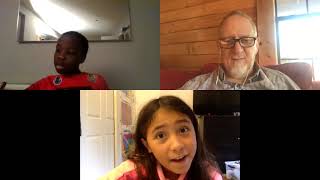
Ilana talks with eight-year-olds Alana and Sankara about the books they're writing. Alana is working on a myth-inspired story with demigods fighting Medusa; Sankara is writing an autobiography about moving from Kenya to London and living through COVID-19. They disagree on how to plan: Alana writes paragraph by paragraph, Sankara outlines whole chapters first.
Chapters
Yeah.
What did you get for Christmas?
Uh, we got a lot of things, but one of our favorite toys, um, it's this hovering UFO that you guide with your hands.
Wow, it actually floats above the ground?
Yeah.
How does it work?
So there's these spinner— yeah, there's like these spinner things that propel it up into the air. And then I guess there's motion sensors on each side, and if you like put your hand near it, it goes the other way.
So cool. Sankara, you want to tell Ilana what you got for Christmas?
Do I have to say all of it?
You can be brief, you can be brief.
Um, so I got a new, um, a piano, and I also got a Um, I've forgotten what it's called. And I've also got a Beyblade, and I've also got, um, um, um, I've forgotten all of that.
That's okay. Um, Alana, do you know how to play the piano or keyboard at all?
Um, I have a keyboard in my room, but I only know how to play the beginning of Fur Elise, and then I just makeup songs.
Got it. Okay, well, Sankara is also writing a book. Do you want to tell Alana about your book, Sankara?
My book is about my life, and yeah, and your life, um, starting—
how old were you when you moved from Kenya to London?
5.
You remember that move?
Yeah.
Aha, so does the book include that move?
Yeah.
Aha, and Alana, do you want to tell Sankara a little bit about the book you wrote?
Sure, basically it's just Greek mythology kids going around and trying to save the world because, um, so they're demigods, which means they're half god and half human, and they're trying to save the world from Medusa. Because now, because she turned super, super evil for some reason.
So she's sort of doing a myth-style book, and last time we talked about myths. Would you say that, does your book about your life have anything to do with myths, Sankara, or if it's real, there's nothing mythological about it?
It has nothing. There's nothing mythological about it.
Okay, well, since you are both authors, let's think about how we write books. So, Sankara, when you write a book, do you think forward? Do you think to the very end of the book and write it chapter by chapter, or do you just figure out what you're going to say paragraph by paragraph?
I think forward.
You think forward all the way to the end?
Yeah.
So how does your book end? Can you tell us, or is it secret?
I haven't really finished it.
If it's your autobiography, is it going to end when you're how old?
8 and 3/4.
How old?
8 and 3/4.
8 and 3/4, okay, up to the present day. Alana, have you ever thought about writing an autobiography?
I haven't, actually.
Aha. So what inspired you to write an autobiography, Sankara?
I don't know.
Okay.
I started writing it by mistake.
How can you start writing it by mistake?
I'm just thinking about something and then I started writing.
Aha. Could that happen to you, Alana? You were just thinking about something and then by mistake you write an autobiography?
Maybe, but that's never happened to me. It's mostly like I'm looking for my pants, but I'm holding them, or maybe I just don't know where the keys are, but it's in my pocket or something. That usually happens to me sometimes.
But never writing an autobiography by mistake?
No.
So, Elana, when you wrote your book, did you start with the end in mind, or did you just go paragraph by paragraph and let it go where it went?
Um, I think I just went paragraph by paragraph because I really only had an idea for the beginning, and then as the story went on, I started to get ideas.
Got it, got it. Um, and so do you think it's— do you both think it's fun to write books, or is it hard to write books, or is it both hard and fun? What is it like to write a book?
I think it's kind of fun because you get to write and you get to extend it as far as you want and also put anything you want in it. And if you learn and if you know how to type, I don't think it's that hard.
How about you, Sankara? Is it fun or is it hard or both or something else?
I think it's fun because you have to think about an idea that you have and But it's still hard because you have to think about what's happening. You can't just like be, this man went to his house and then made a coffee and then went to sleep or something like that.
So I'm very interested in the thinking about it. So would you say you think about what you're going to write before you write? Do you like think, do you think a whole paragraph? Do you think a whole chapter? How much do you think about it before you write about it?
I only think, um, a whole chapter first.
You think about the whole chapter? So does that mean you basically know everything you're going to write in the chapter before you start writing it?
Yeah.
Wow. How about you, Ilana? Do you ever think about a whole chapter before you start writing it?
Um, mostly I just think up like a story and then yeah, I just make up the chapter.
As you go along.
Yeah.
So does it seem strange to you, Ilana, that, um, to think about the whole chapter before writing it, or do you think that's an interesting approach?
I don't think it's very strange because what basically what happens to me is that whenever like I'm in bed going to sleep or like the next day, um, when I'm about to write it and I'm just like thinking of ideas, like I would just think, and then I'd write.
I see. So you actually do— it sounds like you don't figure out the whole chapter, but you do kind of think about the story before you start writing it?
Kind of, yeah. And if the story ends that I just thought about, then I'd think of more before I type.
Got it. And Sankara, when you think about it, are you thinking about it like the night before and the day before, or it's just like you sit down to write, you think for 15 minutes or half an hour, and then you write it? What's your writing process like? Are you thinking about your story a lot?
Yeah.
And what's the— because it's your life, you already know your life, right? So does that mean you already know what you're going to write, or you have to figure out what parts to keep and what parts not to keep?
I have to figure it out because for some reason I can't remember anything before I was 2.
I think that's common. Do you know what's the youngest you can remember, Alana?
Um, sometimes I, um, have memories of when I was maybe 1 or 2 or 3 when we were going to Legoland. I really don't know how young that was. I can remember when I was like 4, 3 maybe, I don't know, maybe 5.
And Sankara, I assume that you don't like write what you had for every breakfast and every lunch and every dinner, right? So what, what counts as important? How do you decide what's important enough to write about?
It's been— if I can still remember them, it's important. If I can't, it's not important.
I see. That makes it pretty simple. If you can remember it, it's important. If you can't remember it, it's not important. Does that seem true in your own life, Alana, that if you can remember something, it was important, and if you can't remember it, it's not important?
I've never really thought of that, so I don't know.
Do you think that you sometimes remember things that are not important?
Kind of, like when we're just going to special events or this, or I just thought of like when we were going to like a dinner party at my, at the person who lives right next door to me, um, I was really young but then, and maybe that wasn't important.
That makes sense, that makes sense. How about, um, what you had? Can you both remember what you had for breakfast today?
I don't think I— I just, I kind of just woke up, so I don't think I've ever had breakfast today.
Okay, how about yesterday? Can you remember what you had for breakfast yesterday?
Um, scrambled eggs with steak.
Can you remember, Sankara?
I didn't have— I forgot to.
So maybe breakfast. I would say most days breakfast, while it's important to make you strong, it's not an important thing to remember. Is that fair enough?
Yeah.
What's the most— how about the most important thing in the last year?
Covid.
What is it? Say it again.
Covid.
Covid.
Yeah, Covid and the lockdown.
That is huge.
Yeah, Covid.
You agree, Alana?
Yeah, I do.
And would you both say it's because you changed— it changed your lives quite a lot?
Yeah, my dad said that maybe they will— they won't even stop wearing masks. I don't like wearing it.
I get it, I get it.
My face gets hot or it's hairy. It just feels uncomfortable.
Um, and how about you? Why do you think COVID was, uh, such a big deal, Sankara?
It's killed more than 1 million people this year.
So that's a very big thing. That's a very big thing. Well, I'm convinced. And actually, in your autobiography, Sankara, do you mention— are you going to mention COVID, or you haven't decided yet?
Um, I'm going to mention COVID because then if somebody reads it like in the future, then they can learn about history and COVID and everything.
Got it, got it. Okay. Well, I am enjoying this. You know, we've got an author's club. You know, I've written 2 books, you guys have each written a book, and so we can think of this as our little author's club where we know how to write books. I am inclined to call it a day on our conversation, and yeah, maybe I will check, touch base with your mom later, Sankara. And Alana, what are you going to do today?
Um, I really don't know.
All right. You know what you're going to do for the rest of the evening, Sankara?
Um, dinner.
Okay. All right, well, um, thanks for joining us in the Authors Club, and we'll find something interesting to talk about next week. How's that sound? Okay, bye-bye.







