Ryan and Michael talk about personalizing Ryan's daughter's education
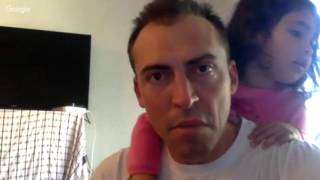
Ryan's three-year-old daughter Alana learns through her own curiosity, exploring crafts, games, and reading. Ryan and Michael discuss peaceful parenting, building a parent community around unschooling, and simple tools like photo-sharing that let kids document and share observations with peers.
Chapters
Number dos.
Numero dos. ¿Cómo estás?
He's good. He's big, healthy, talks a lot. He's happy.
All right.
He's a good little baby.
All right. And big sister still enjoys being big sister?
Oh yeah, she loves it. Alana is a great big sister and she's very helpful. We have a lot of fun.
Alana, do you like being a big sister?
Her mouth's full, but she said yes.
Got it, got it, got it.
So maybe let's just do a catch-up. So what's been going on with Alana and her fantastic development in the last, I don't know how many weeks?
Yeah, no, it's been a couple weeks. I was gone for a week. You know, that's the first time that I've been away from the kids that long, when I was in Turkey. And when I came back, I couldn't believe how big she looked. Right? And same thing with Logan. But Alana's doing great. Her school is on spring break, so she hasn't been to her Spanish class in a couple of weeks, unfortunately. But what you gonna do? She's playing board games. A friend of ours, actually, Nick Slepko, was very kind to Alana and got her a whole bunch of board games and stickers and— and art when we saw him in Vegas a few weeks ago. And Alana's been digging into crafts and making puppets. We have a bunch of games and really like Alana, she's just a little bit away from reading, I think.
Wonderful, wonderful.
Drawing words or drawing letters. She's memorized a few words like pig, though she misspells it here and there. I feel like it's just a few months away.
Does she spell her own name?
Oh yeah, for a long time. Okay, right. For a long time. If anything, I feel like with having Logan around, just being busier and having an infant, we haven't been able to give Alana as much attention as we would like on specifics of reading and what have you. So something we need to do a better job of, but she continues to make progress without us.
Well, it sounds like, you know, she initiates a lot of learning herself already. Would you say that's accurate?
Oh, definitely. She's constantly learning. Like, it's— we tried to make it what she does, and it clearly is. She's just constantly doing some arts or using the iPad or trying to read a book or asking questions. "Why?" is her new question. She asks it for everything. I think that's great.
So I want to give you some context. I've met another woman who homeschooled her sons, and they're now mostly grown teenagers. And, you know, they basically educate themselves, you know, are fabulous, well-behaved, healthy, and so forth. And I'm thinking of maybe, you know, doing a video series with her and with you and maybe wrapping the two up together. I think that there are replicable ways that we can help parents develop their children so that they really become natural learners and healthy, happy people. And I think it's a matter of creating a community where we talk about this. Some of the things she likes to talk about are, um, well, parenting. Are you familiar with the term peaceful parenting?
Oh, definitely, definitely. Yeah, that's what we try to do, right?
Very much so. And, and so, and then we extend it She's also libertarian, so peaceful parenting, peaceful community, peaceful education, you know, ultimately creating a whole peaceful world. And I think you and I and her and, you know, several more— I've got a few more in my network— I think that we all see that there's an alignment when you're deeply respectful of other human beings from in utero onwards, when you look for consent as opposed to coercion, you know, involuntary consent as opposed to coercion, all the way through. You know, I think that there's something that we can share with the world. I would add one other piece that's more relevant for teens, but I would expect, you know, you totally see this, which is the importance of optimism and empowerment. You know, a lot of teens are indoctrinated in this sometimes ecological alarmism and fearmongering, sometimes political hatred that, oh, everything would be good if the evil other side didn't mess everything up.
Only Bernie Sanders for president.
Right, right.
And so I think outside of— and then there are kind of autistic libertarians who are not terribly interested in these kind of issues. And then there are also people who are more progressive-leaning but who really understand the peaceful parenting. And I think I know some of them who, although their instincts are very much progressive, understand that peaceful parenting should extend to peaceful schooling, and that that's impossible in a government system, that that should extend to peaceful community. And they kind of get an inkling that, you know, government's not very friendly towards peaceful community either. And so I see really a trans-partisan community. And so some of this is— I'm thinking of also online resources. I'm thinking, have you ever developed a forum? Have you ever done an online forum?
I've participated in a mixed martial arts forum since like 2003. Right.
I'm not sure forum is the best medium, but I don't want to hold it on Facebook because then Facebook owns it and it's captured and so forth. So I'm looking at a forum. I would see this as something where at some point there's a free aspect, but at some point people also pay for premium benefits.
But I think there's a lot of them having all the materials collectively developed.
Very sweet-a-lotta. You love your daddy? You love your daddy?
Yeah. She's a little shy, but being a part of this family, she wants to be in on that camera.
That's wonderful.
Rico, I always tell people that the most significant thing that I'll ever do in my life is raise my kids peacefully. Yeah. I believe that. That is the one thing that we can do to leave behind or to make the world a better place is to have children who principally respect the rights of others in contrast to everyone else on this planet.
Yeah.
So that's— I mean, and we're not, I guess, perfect peaceful parents. I read articles here and there saying don't do this, do that. And maybe we fall a little short of the mark. But we don't hit our kids. We don't threaten them with being hit. We try very hard not to mess with their psyche or their emotions or threaten them or—
Right, right.
We just don't do it. And it seems to be working fine. Alana is happy, well-adjusted. She's a pleasure to be around. She's able to step into new situations and be brave. She makes friends well. And she's all girl.
No, she's wonderful. And for me, really, the way to play with this is not as an ideology. Sometimes peaceful parenting might come across like an ideology. But really, it's about wouldn't you want your teen to be happy, healthy, well, spontaneous learner, or autodidact and so forth. I think most— I think most people realize that, yeah, we're going to find out. But I think many of them rely on the establishment, and the establishment is not going to bring us this direction. But I want to say a community of people who, you know, some of us might have grown Laurel— Laurel— Laurel— her kids are mostly grown. You're just starting out. Somebody with, uh, your Makes sense? Makes sense?
Oh, absolutely. Absolutely.
Okay. Okay.
I would love to do that and be part of it. And I think that it dovetails with everything else we're trying to do with Alana's education and plugging her into other like-minded people. Which kind of brings me to what I texted you about when I was at the zoo. So I've taken Alana to the zoo a million times. And it occurred to me the other day as we were there and we were kind of spending time together because I just got back from Turkey and, you know, We're having a date. And so as we're walking, I always try and find new things to stimulate her and make her think. So I look at the flower. There was this beautiful flower. And I thought, gee, wouldn't it be cool if we took a picture of every flower that we saw today and then made a blog post, Alana, so you could share the information and we could research about some of the flowers? And she's like, oh yeah, that sounds great. And it occurred to me it'd be so much easier, especially since she can't write at this point or type, if she could just do like a Snapchat or take her phone, make a 10-second video, send it to her little friend Estella who's 3 and a half. I've sent it to 2 or 3 other people privately with say, oh, look at this flower. And then her friend could look at it and say, oh, that's really pretty, what kind is it? And they could have a little conversation about something and learn, right?
Very cool, very cool.
It's kind of what I do with Alana, but so I guess Snapchat isn't the perfect tool for this even though it's simple and you can make these little videos. 'Cause they disappear, and I thought it was possible to make like a permanent record, like a storybook, but I guess not. So I'll find some other app or thing. We could just do Google Drive.
Can you do it on Facebook?
Facebook, do it? I don't know if you can like make like a 30-second blog post, so to speak, and basically upload it the way you can on YouTube or something. I'm not sure if it's YouTube, or maybe it's Google Plus, actually.
Google, yeah, Google might work for it. Might be best.
Yeah, but it's something that Alana can do off of an iPod or a little, or like an old phone. She doesn't need a data plan. She just needs wireless here and there at the home. But she could have like a little video blog.
I think that's so cool. That's so cool. And I could see that, so for instance, in this forum, I can imagine a community where say parents of 3-year-olds who want to do this, talk together. You know, also say, So cool. You probably don't want to show their kid eating the sugar cereal every morning. Right.
No, no, but like a book club. Like every night, or in the morning, it's like, which books did you read last night? We read Dr. Seuss. It was about green eggs and ham. It was funny. What do you think, Estella?
And I would say one of the clear problems of our schools, because in essence we want to say that we're not about a didactic about that is our idea is the kids learning how to listen. Like, okay, what are we doing? That's really, really important. So ideally, you know, this community of parents and then at a more granular level, community of, you know, 3-year-olds, 3-year-olds, book clubbing, and then you can have this sort of healthy community. They could help parents who are wondering about un-schooling have access to that. Even if they go to school like Rob does, it results in a broader community of parents.
Yeah, no, I definitely want to get that going for her, and it'll be powerful for her to learn the value of— or to learn a method and the value of learning before she can even read or write, so that it's second nature to her, and reading and writing becomes just one what one means.
Big time, big time.
Yeah, and Alana would be great at it. Like, I'm sure she'd want to meet friends who speak in Spanish because her Spanish is pretty good, and she'd want to— I mean, Alana, what are you into? What's your favorite thing to learn about?
Building words.
Building words. Oh, somebody knows the path to my heart.
Alana, do you know how to spell okay? How do you spell dog? Go ahead, spell dog. Spell dog.
Oh, um, oh gee, D-O-G. Whoa, whoa, watch the coffee. She's, she's getting it, just a little, little shy.
I, I love, I love the fact that we're back. So congratulations, Alana. I'm so excited to see you love words. I love words. I love words.
I love words too, thank you.
Um, well, we've got a lot to do, but I've got another call at 11:30.
Okay, sounds good. Sorry I was a bit late, Michael Strong.
Back on track. Back on track.
No, very good. And again, sorry I was late. It won't happen again.
No problem.
No problem.
High five. High five.
Take care. Bye.







